

Every industry has its own language, and logistics is no exception. For shippers and buyers of logistics services, understanding the terminology is not an academic exercise. It affects which contracts you sign, how you brief providers, what service levels you can reasonably demand and how you interpret the data your logistics partners give you.
This glossary brings together the terms shippers encounter most often, organised by theme. It covers logistics provider types, core supply chain concepts, warehouse and fulfilment terminology, transport and freight terms, Incoterms and the inventory and planning language your 3PLs and carriers use every day. Use it as a reference when evaluating providers, reviewing contracts or making sense of the metrics in your weekly operations reports.
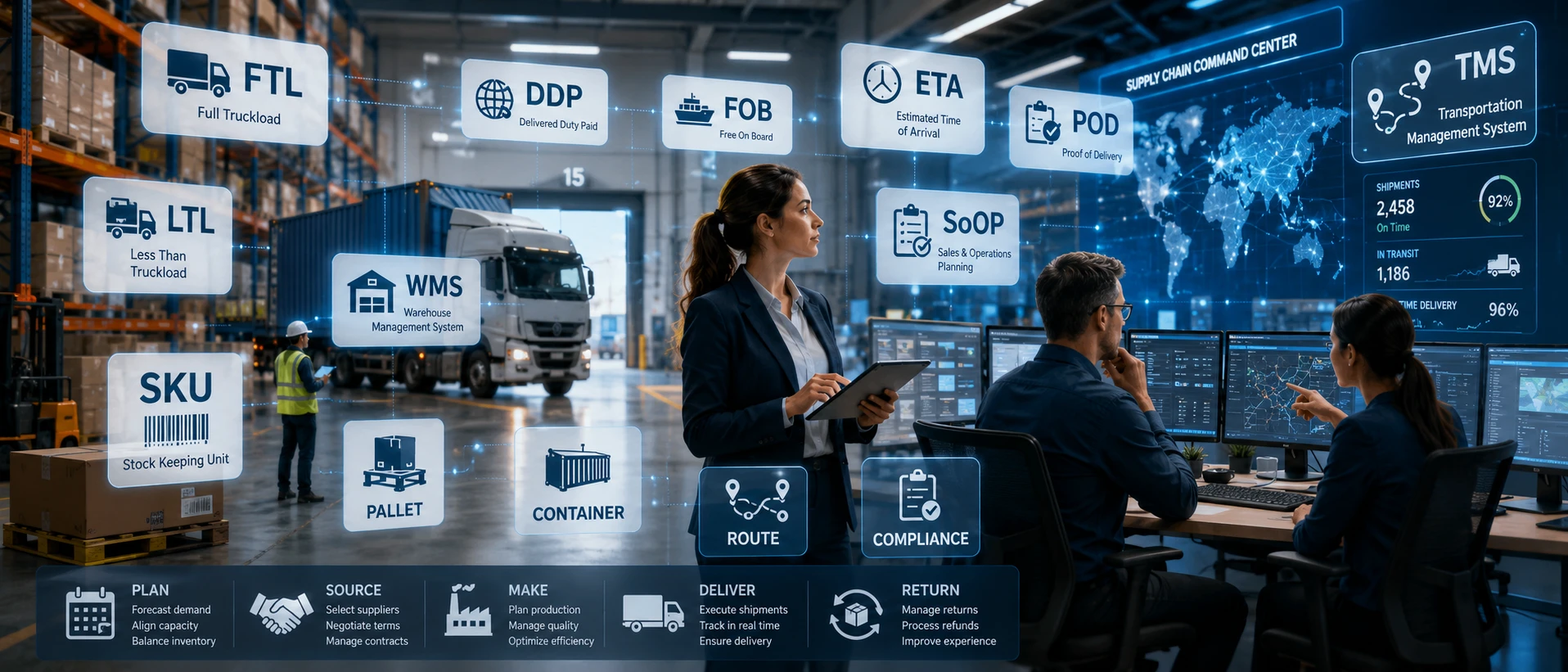
Logistics provider types: 1PL to 5PL
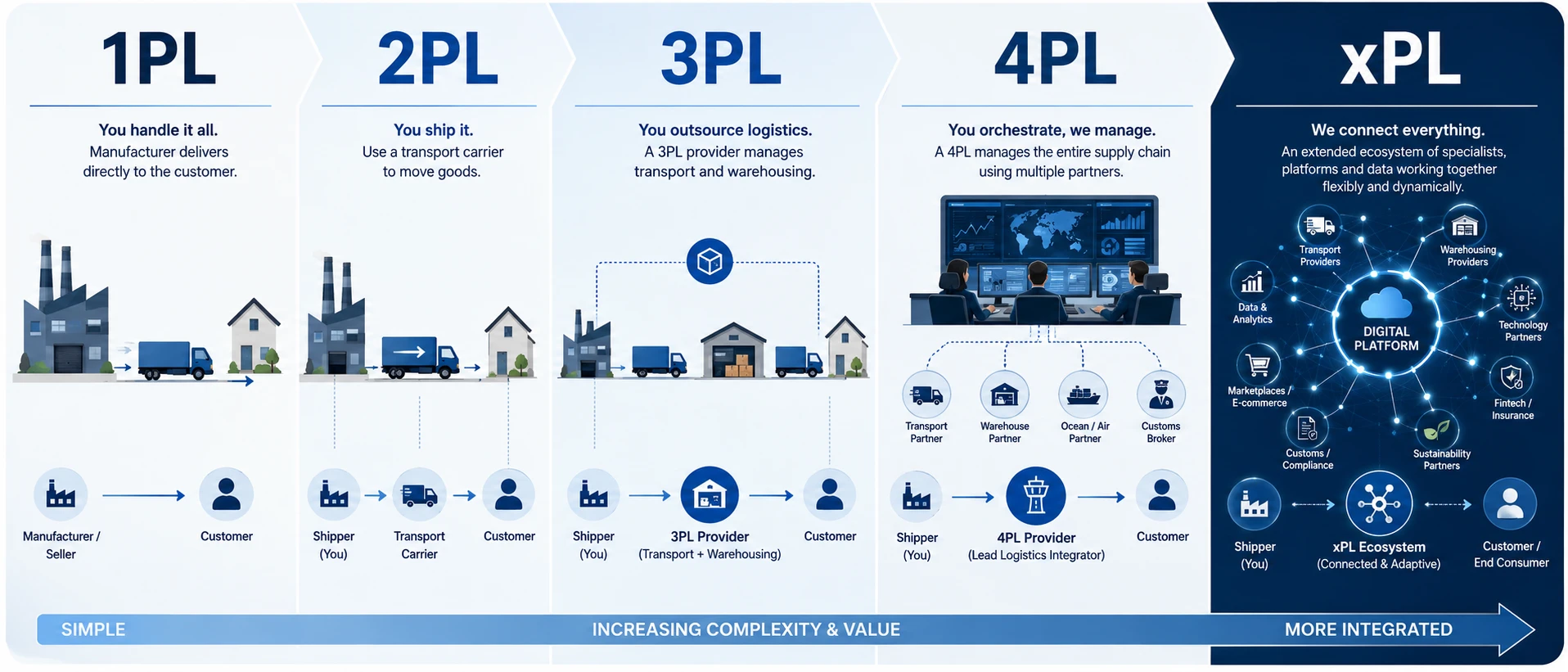
One of the most persistent sources of confusion in logistics is the xPL naming convention. Understanding what each type means clarifies who is responsible for what and helps shippers choose the right model for their operation.
1PL - First-Party Logistics
A 1PL is a company that owns its own logistics assets and handles all logistics operations in-house. It uses its own vehicles, warehouse facilities and distribution infrastructure without outsourcing to external providers. Large manufacturers and retailers operating their own delivery networks are examples of 1PL operations. The model gives full control but requires significant capital investment and management resource.
2PL - Second-Party Logistics
A 2PL provides a specific, targeted logistics service to clients: haulage, warehousing, yard management or freight forwarding, for example. The relationship is typically contract-based and tailored to the client's particular requirements. A shipper using a 2PL still manages most of its own supply chain decisions internally and simply buys specific operational services as needed. Manufacturers, retailers and automotive businesses commonly use 2PLs for individual functions while retaining overall logistics control in-house.
3PL - Third-Party Logistics
A 3PL offers integrated logistics services across multiple categories: haulage and distribution, warehousing, inventory management and often value-added services such as co-packing and customs clearance documentation. 3PLs typically operate their own asset base and maintain a partner network for services outside their direct capability.
3PL contracts often include provisions for outsourcing some supply chain management functions, allowing clients to reduce internal headcount while accessing the provider's scale and expertise. The trade-off is a risk of reduced in-house operational knowledge and, over time, a weaker negotiating position as dependence on the provider grows.
4PL - Fourth-Party Logistics
A 4PL acts as the sole interface between a client and all of its logistics service providers. The term originates from Accenture's 1996 definition: a supply chain integrator that assembles and manages the resources, capabilities and technology of its own organisation with those of complementary service providers to deliver a comprehensive supply chain solution.
A 4PL is typically asset-light or entirely asset-free. It manages the relationships and performance of the providers rather than operating directly. Clients retain only strategic planning and high-level control. The appeal is that operational complexity moves to the 4PL. The risks are overdependence on a single integrator and the loss of direct visibility into day-to-day operations.
5PL - Fifth-Party Logistics
The most precise definition of a 5PL is a pure technology platform: an asset-free software layer that enables a client's own supply chain team to plan, manage and optimise all logistics operations using advanced data management and analytical tools. Unlike a 4PL, which takes operational control away from the client, a 5PL returns full operational control to the client while providing the technological capability to exercise it effectively.
Key characteristics of a 5PL include: integration across the full end-to-end supply chain network, LSP-agnostic operation able to work with any provider, advanced analytics and optimisation tools and management of all provider relationships through a single platform. The main advantage is that the client retains in-house operational knowledge while removing the management overhead of running multiple bilateral provider relationships.
We cover how the different provider models affect day-to-day operational management in our piece on logistics operations productivity.
Client responsibility by provider type:
1PL: All operations, decisions and risk management in-house. No external LSP.
2PL: All decision-making and risk management retained. LSP delivers specific contracted functions.
3PL: Overall planning and operational control retained. LSP handles short-term planning and daily operations.
4PL: Strategic planning and high-level control only. LSP manages planning, operations and subcontractor selection.
5PL: Full operational control returned in-house via technology. Platform delivers specific service functions on demand.
Core supply chain management concepts
These terms appear frequently in provider presentations, industry reports and contract discussions. They are broad enough to mean different things in different contexts, so understanding what each actually covers helps shippers ask more precise questions of their providers.
Supply Chain Visibility
The ability to track and monitor the movement of goods or materials along the supply chain in a way that supports informed decision-making. Visibility covers inventory levels, transport timelines and fulfilment status. The key variable is not just whether data is available but whether it is timely, accurate and integrated across the interdependent functions that need to act on it: procurement, inbound supply, warehousing and outbound fulfilment.
Visibility tools range from management dashboards that report retrospective performance to real-time tracking systems using GPS, RFID and IoT sensors. The value of any visibility tool depends on how effectively the data it produces is converted into decisions that improve operations.
Real-Time Visibility
A more specific term referring to the ability to identify potential delays and disruptions as they occur rather than after the fact. Real-time visibility enables proactive responses: rerouting shipments, adjusting production schedules or notifying customers before a service failure becomes visible to them. Connecting real-time transport data to inventory and production decisions requires integrated systems and the capability to act on the signals quickly.
Supply Chain Agility
The ability of a supply chain to respond quickly and effectively to changes in internal and external conditions. An agile supply chain can expand, contract or reshape its operations in response to shifting customer requirements, market disruptions or supply constraints. True agility depends on three attributes working together:
Responsiveness: the ability to quickly adjust and reallocate resources to meet changing demands, supported by real-time access to supply chain data and fast decision-making processes.
Resilience: the ability to withstand disruptions from natural events, geopolitical changes or supplier failures, backed by risk management strategies and contingency planning.
Collaboration: effective communication and joint decision-making across internal teams and external supply chain partners, aligned around shared goals and mutual benefit.
Supply Chain Resilience
The ability to absorb the impact of a disruption and return to normal operational performance. Resilience is built through supplier diversification, safety stock policies, contingency routing arrangements and the operational flexibility to switch between logistics modes or providers at short notice. We cover the relationship between resilience and exception handling in our piece on supply chain exception management.
Logistics Collaboration
A strategic approach in which multiple supply chain parties coordinate operations to produce shared efficiency gains. In transport, this takes the form of horizontal collaboration: multiple shippers sharing vehicle capacity on overlapping routes to reduce cost and emissions per unit moved. Effective collaboration requires trust, shared data standards and a neutral platform that can hold shared operational data without exposing commercially sensitive information between participants.
End-to-End Visibility
Visibility that spans the entire supply chain from origin to final delivery rather than being limited to a single operational leg. End-to-end visibility enables decisions that optimise the whole system rather than individual parts, for example adjusting inbound scheduling in response to outbound demand signals rather than managing each function independently.
“The logistics industry is a unique industry because by default, de facto, it has to collaborate. FLOX is built to enable exactly that.”
Paul Brooks, MD or GFC, Author

Warehouse and fulfilment terms
These are the terms shippers encounter when working with warehouse operators, 3PLs and fulfilment providers.
Distribution Centre (DC)
A facility designed to receive goods in bulk, sort and process them and despatch outbound orders efficiently. Distribution centres are the backbone of B2B distribution and retail replenishment. Primary performance metrics are throughput speed and inbound-outbound efficiency rather than individual order accuracy.
Fulfilment Centre
A warehouse configured specifically for individual order processing: receiving stock, picking individual items, packing and despatching. Optimised for e-commerce and direct-to-consumer delivery. Key performance metrics are pick accuracy, order cycle time and returns processing speed.
Bonded Warehouse
A warehouse where imported goods are held under customs control, with import duty deferred until the goods are released for domestic sale or re-exported. Useful for shippers who want to manage duty payment timing or hold stock for potential re-export without committing to UK duty upfront.
Cold Storage Warehouse
A temperature-controlled facility for perishable or temperature-sensitive goods including food, pharmaceuticals and flowers. Must comply with regulatory requirements for food safety and pharmaceutical handling. For shippers in these categories, access to compliant cold storage is a non-negotiable operational requirement.
Dedicated vs Shared Facilities
A dedicated facility is reserved for a single client, offering maximum control over configuration and process design at higher cost. A shared facility serves multiple clients simultaneously, distributing infrastructure costs and offering greater flexibility in space volume and contract terms. Most 3PL warehousing operates on a shared basis.
SKU (Stock Keeping Unit)
A unique identification code assigned to a specific product variant, typically linked to a barcode or electronic tag for inventory tracking. A product sold in multiple sizes or colours carries a separate SKU for each variant. High SKU count is a primary driver of warehousing complexity and pick labour cost.
RH&D (Receipt, Handling and Despatch)
The three core physical activities in warehouse operations: receiving goods inbound, processing and storing them, then preparing and despatching them outbound. Warehouse operators often quote RH&D as a cost per unit separate from storage, for example a per-pallet RH&D charge plus a weekly storage rate.
Pallet Weeks
A unit used to quantify warehousing demand, calculated as the number of pallet spaces required multiplied by the number of weeks required. Used in quoting and capacity planning between shippers and warehouse providers.
Finished Goods Inventory
Completed products that have left the production line and are ready for sale or despatch. Distinct from raw materials and work-in-progress inventory. Managing finished goods levels against demand forecasts is central to supply chain planning.
Just in Time (JIT)
An inventory management approach in which goods are ordered or produced to satisfy immediate demand rather than being held in stock in advance. JIT reduces holding costs and the risk of obsolescence but depends on a reliable supply chain with short, consistent lead times. Supply chain disruptions expose operations that rely too heavily on JIT without safety stock buffers.
Lean
A management approach focused on eliminating waste from operational processes. In warehousing, lean principles are applied to reduce unnecessary movement, minimise waiting times and avoid excess inventory. Lean does not mean low stock: it means holding only what is needed and removing non-value-adding activities.
Kanban
A signal-based replenishment system originating in Japanese manufacturing that triggers delivery of a defined quantity when stock reaches a minimum level. In warehouse operations, a Kanban signal indicates that a bin, shelf or production line input needs replenishing. The principle underpins just-in-time inventory management.
Lead Time
The elapsed time between a trigger event and the completion of the resulting action. In procurement, this is the period between placing an order and its arrival in stock. In logistics, it can refer to transit time from collection to delivery. Understanding lead times at each stage of the supply chain is essential for setting realistic stock levels and delivery commitments.
Dead on Arrival (DOA)
Stock that is non-functional or unusable when delivered. A DOA rate is a standard performance metric in electronics, pharmaceutical and other quality-sensitive supply chains.
For a detailed look at warehouse and fulfilment models and how shippers should choose between them, see our piece on warehousing and fulfilment operations.
Transport, freight and Incoterms
These terms govern how goods move between locations, who pays for what and where risk transfers between buyer and seller in international trade.
Modes of Transportation
The means by which goods are moved from one location to another. The principal modes used in logistics are: road (HGVs, vans and couriers), rail freight, sea freight and air freight. Most supply chains use a combination of modes, with the choice between them driven by cost, speed, cargo type and distance.
Air Freight
Transportation of goods by aircraft. Used for high-value, time-sensitive or perishable shipments where the premium over sea or road alternatives is justified by speed. Air freight is significantly more carbon-intensive per tonne-kilometre than sea freight and therefore subject to increasing scrutiny in sustainability reporting.
Freight Forwarder
An intermediary that organises the movement of goods on behalf of shippers. Freight forwarders coordinate shipment legs, book carrier space, manage documentation and arrange customs clearance. They do not typically own transport assets themselves but hold carrier contracts across multiple modes and geographies, providing shippers with access to a broader logistics network than they could build independently.
Freight Charges
The fees associated with transporting goods from one location to another. Components typically include a base rate, fuel surcharges, handling fees and accessorial charges for services such as tail-lift delivery, timed delivery windows or hazardous goods handling. Understanding the breakdown of a freight charge helps shippers identify where cost reduction or renegotiation is possible.
Demurrage
A charge levied when goods, vehicles or containers are held beyond the agreed free time. In sea freight, demurrage applies when a container is not returned to the shipping line within the allowed period after discharge. In road freight, detention charges apply when a vehicle is held at a loading or unloading point longer than booked. Demurrage is a significant source of unplanned cost in operations that lack reliable booking and exception management processes.
TEU and FEU
TEU (Twenty-Foot Equivalent Unit) is the standard measure of ocean freight container capacity. One TEU equals one standard 20-foot shipping container. An FEU (Forty-Foot Equivalent Unit) is one standard 40-foot container, equivalent to two TEUs. TEUs are used to measure port throughput, vessel capacity and shipping line volumes.
Customs Clearance
The process of obtaining authorisation from customs authorities for goods to enter or leave a country. Requires submission of a customs declaration detailing the nature, quantity and value of goods. Duties and taxes are assessed and must be settled before goods are released. Delays in customs clearance are a common source of supply chain disruption for importers and exporters.
Customs Broker
A professional or firm that manages customs clearance on behalf of importers and exporters. Customs brokers prepare and submit documentation, arrange payment of duties and liaise with customs authorities to facilitate timely release of goods. Using an experienced customs broker reduces the risk of delays and penalties from documentation errors.
Customs Duties
Tariffs or taxes charged on goods crossing international borders. The duty rate depends on the commodity code, the value of the goods and their country of origin. Understanding duty rates and available reliefs, including preferential rates under trade agreements, is part of the landed cost calculation for any internationally sourced product.
Incoterms
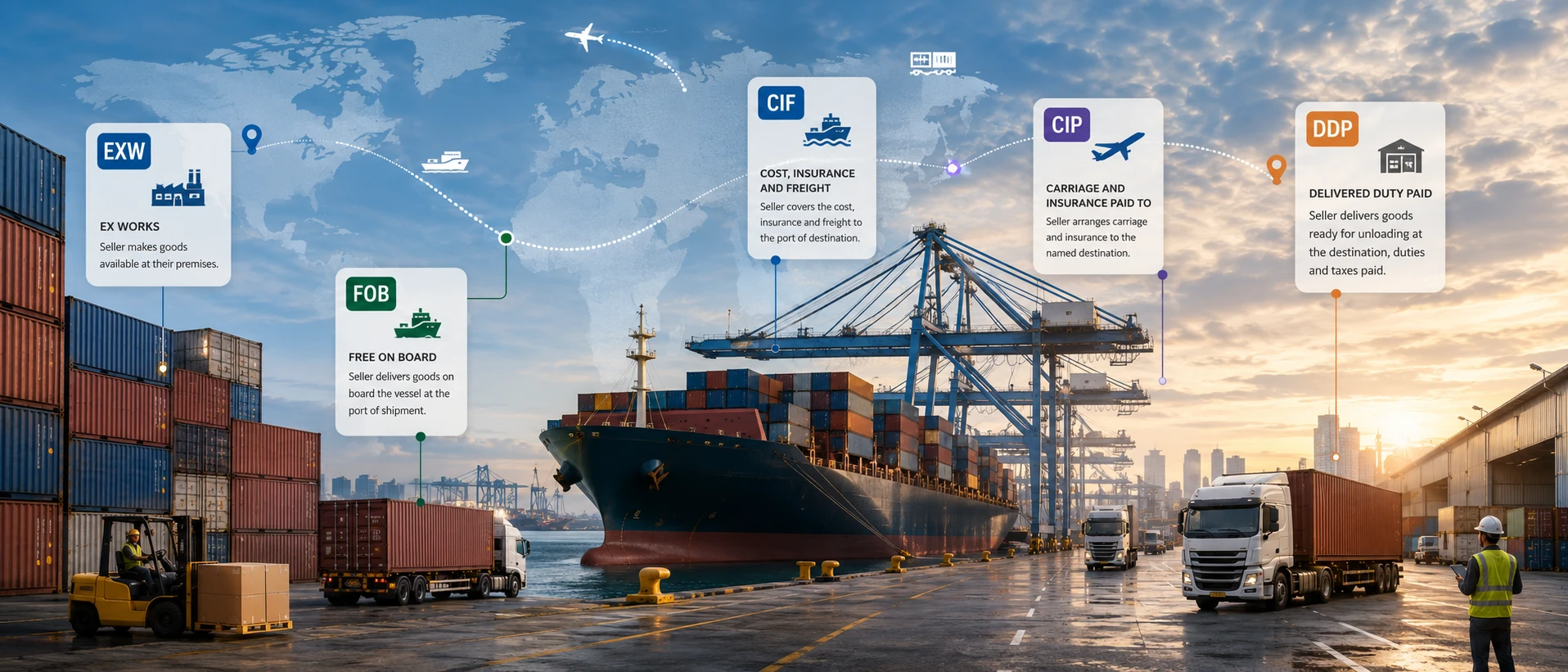
Internationally standardised trade terms published by the International Chamber of Commerce that define the respective responsibilities of buyers and sellers in the delivery of goods. Incoterms specify who pays for freight and insurance, where risk transfers between the parties and who handles customs clearance at origin and destination. The most commonly encountered terms in UK logistics are:
EXW (Ex Works): The seller's only obligation is to make goods available at their premises. The buyer bears all costs and risks from that point.
FOB (Free on Board): The seller delivers the goods on board the vessel named by the buyer. Risk transfers when goods are loaded on board.
CFR (Cost and Freight): The seller pays freight to the destination port. Risk transfers when goods pass the ship's rail at the port of origin. Insurance is the buyer's responsibility.
CIF (Cost, Insurance and Freight): As CFR, with the seller also providing insurance cover for the goods during transit.
CPT (Carriage Paid To): The seller pays freight to the named destination. Risk transfers to the buyer when goods are handed to the first carrier.
CIP (Carriage and Insurance Paid To): As CPT, with insurance arranged and paid by the seller.
DAP (Delivered at Place): The seller delivers to the named destination, bearing all risk until the goods are ready for unloading. Import clearance is the buyer's responsibility.
DDP (Delivered Duty Paid): The seller is responsible for everything including import duties and taxes. The maximum obligation for the seller and the simplest terms for the buyer.
Logistics Service Provider (LSP)
A generic term for any company that provides logistics services to another business. The term covers all xPL types and is useful when referring to the logistics supply base collectively without specifying the type of provider.


Helen Hardy
CEO of CILT
Chain Reaction Podcasts
Logistics Has a Talent Problem - This CEO Knows Why
Logistics moves everything, yet struggles to attract talent. Helen explains why the sector needs to reposition itself as a modern, purpose-driven profession — not just a job.
Inventory, planning and procurement terms
These terms appear in supplier contracts, operational reviews and the planning systems used to manage stock, orders and procurement.
Economic Order Quantity (EOQ)
A model that calculates the order quantity at which total inventory cost, the sum of ordering cost and holding cost, is minimised. EOQ takes into account demand rate, cost per order and holding cost per unit. It identifies the order size at which the combined costs are lowest, avoiding the twin inefficiencies of ordering too frequently in small quantities or holding too much stock from infrequent large orders.
Material Requirements Planning (MRP)
A planning process that determines what materials are needed, in what quantities and when, to satisfy a production or delivery schedule. MRP works backwards from the required end-date, calculating the timing and volume of each input based on current stock levels and supplier lead times.
Distribution Requirements Planning (DRP)
A system for determining inventory demand across a distribution network. DRP consolidates demand signals from distribution points and feeds them as input to production and procurement planning, linking distribution requirements to the upstream supply decisions that satisfy them.
Enterprise Resource Planning (ERP)
Software that integrates core business functions, including procurement, inventory, production, finance and logistics, into a single platform with a shared data layer. ERP removes the need to reconcile information between separate systems and provides a single source of operational truth across the organisation. Large shippers typically use an ERP as the backbone of their supply chain data management.
Activity-Based Costing (ABC)
A costing methodology that traces resource consumption to the specific activities that generate it, rather than allocating costs using broad averages. In logistics, ABC provides a more accurate view of the true cost of each operational activity, helping to identify where spending is disproportionate to the value delivered.
ABC Management (Pareto Classification)
The application of the 80/20 principle to inventory or supplier management. Items are ranked into A, B and C categories by value, volume or frequency. A-category items typically account for the majority of total value and receive the closest management attention and tightest stock controls. C-category items are lower value and may be managed through simpler, more automated processes.
Average Cost (AVCO)
A stock valuation method that values all units of a product at the weighted average cost of all units held. Used for financial reporting and inventory management where cost fluctuations between purchase batches need to be smoothed for reporting purposes.
Service Level Agreement (SLA)
A formal document defining the expected service standards between a provider and a client. In logistics, an SLA typically specifies collection and delivery on-time performance targets, order and pick accuracy rates, damage rates, reporting frequency and escalation procedures. It should also define the remedies available when targets are missed. Shippers should specify data access and reporting requirements in the SLA before signing rather than discovering gaps once the relationship is operating.
Supplier Relationship Management (SRM)
The structured management of the relationship between a buyer and its suppliers. SRM covers supplier selection, performance monitoring, development and risk management. Effective SRM is a two-way process intended to improve performance on both sides of the relationship, not simply to monitor supplier compliance.
Vendor Rating
A systematic approach to scoring supplier performance against agreed criteria. Vendor ratings typically cover on-time delivery, quality, responsiveness and compliance. The output informs sourcing decisions, contract renewals and the allocation of volume between competing providers.
Reverse Logistics
The planning and management of goods flowing back through the supply chain, typically from end customer to seller or manufacturer. In e-commerce, returns handling is a major reverse logistics function. It also covers the return of packaging materials, reusable assets and end-of-life products for repair, recycling or disposal.
Procurement
The complete process of acquiring goods or services, from identifying a requirement through to its disposal at the end of its useful life. Procurement includes pre-contract activities such as market analysis, specification development and supplier selection, not only the act of placing orders. Often used interchangeably with purchasing, though procurement is the broader term.
Electronic Data Interchange (EDI)
The exchange of structured business documents between computer systems using a standardised format. EDI is used in logistics to transmit purchase orders, despatch notices, delivery confirmations and invoices between shippers, carriers and warehouses without manual data entry. EDI connections are a standard data integration requirement when establishing new logistics provider relationships.
DMAIC
The five-stage process structure of Six Sigma quality improvement: Define, Measure, Analyse, Improve, Control. Used to structure problem-solving and process improvement projects in logistics. Common applications include reducing pick error rates, improving on-time delivery performance and eliminating waste in warehouse handling processes.
Kaizen
A Japanese term meaning continuous improvement. In logistics, Kaizen describes an operational culture in which small, incremental improvements are made consistently over time rather than through periodic large-scale change programmes. A genuine Kaizen approach requires frontline staff to be involved in identifying and implementing improvements, not just management teams.
Poka-Yoke
A Japanese term for mistake-proofing. A Poka-Yoke device or process step makes it difficult or impossible to perform an operation incorrectly. In logistics, examples include barcode scan verification at every pick step, automated weight checks on packed orders and interlocking systems that prevent a despatch step from completing until the preceding confirmation has been recorded.
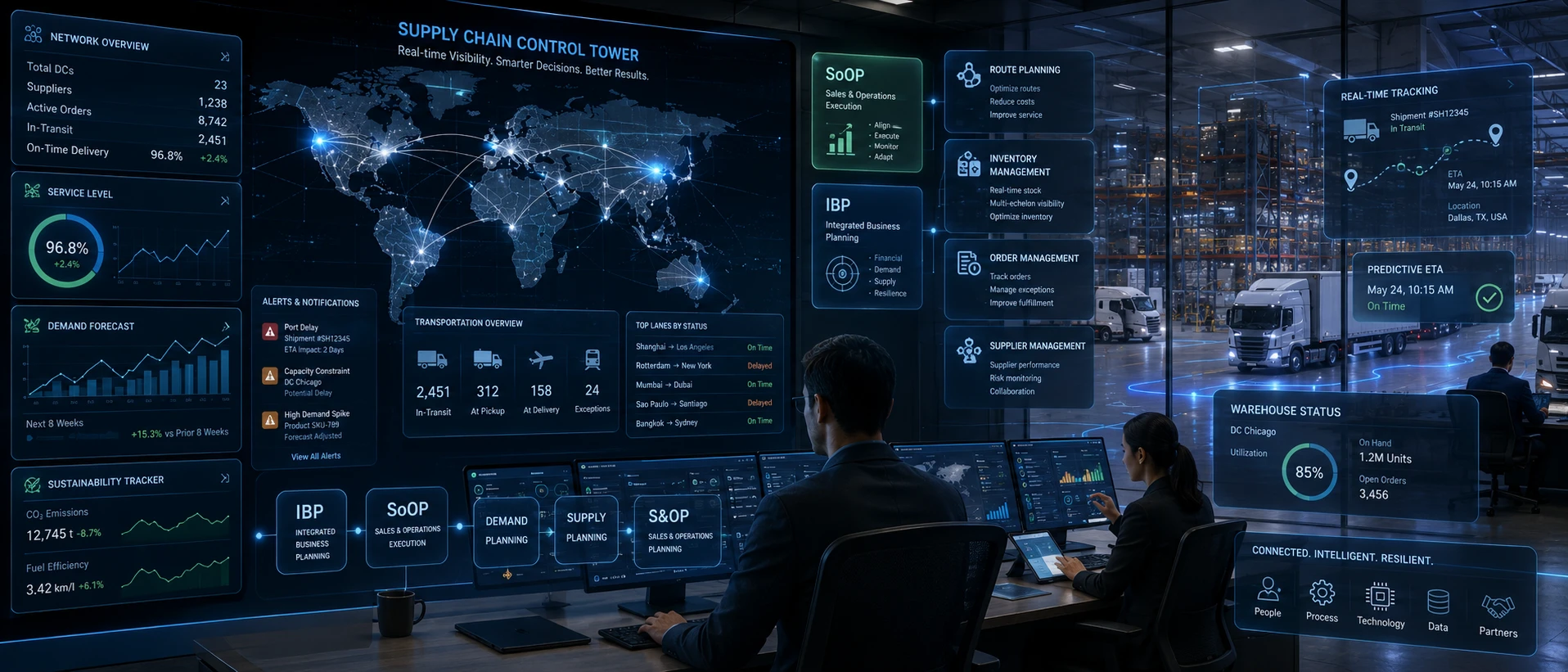
Common logistics abbreviations quick reference
The following abbreviations appear regularly in logistics contracts, reports and provider communications.
3PL: Third-Party Logistics. A provider of integrated logistics services across transport, warehousing and related functions.
ACH: Automatic Clearing House. An electronic payment method for routine financial transactions.
ARR: Average Rate of Return. The average annual return as a percentage of initial investment cost.
AVCO: Average Cost. A stock valuation method based on the weighted average cost of all units held.
COD: Cash on Delivery. Payment made at point of delivery before goods are released.
CRP: Capacity Requirements Planning. The process of measuring and adjusting operational capacity within a planning cycle.
DOA: Dead on Arrival. Goods that are non-functional when delivered.
DRP: Distribution Requirements Planning. A system for managing inventory demand across a distribution network.
EDI: Electronic Data Interchange. Structured document exchange between computer systems.
EOQ: Economic Order Quantity. The order size that minimises total inventory cost.
ERP: Enterprise Resource Planning. Integrated business management software.
FEU: Forty-Foot Equivalent Unit. One standard 40-foot ocean freight container.
JIT: Just in Time. An inventory approach in which stock is ordered to meet immediate demand.
LSP: Logistics Service Provider. Any company providing logistics services to another business.
MIS: Management Information Systems. Systems used to collect, process and report management data.
MRO: Maintenance, Repair and Operating. Goods used in maintenance or operations without forming part of the finished product.
MRP: Material Requirements Planning. A planning process for calculating material needs against a schedule.
OPC: Operations Planning and Control. The management of resources to deliver products or services to customers.
POD: Proof of Delivery. Documentation confirming goods were received at the delivery point. A core input for invoice reconciliation and performance reporting.
RFID: Radio Frequency Identification. Technology using radio waves to identify and track tagged goods.
RH&D: Receipt, Handling and Despatch. The three core physical warehouse activities, typically quoted as a combined cost per unit.
SKU: Stock Keeping Unit. A unique code assigned to a specific product variant for inventory tracking.
SLA: Service Level Agreement. A contract specifying expected service standards between a provider and a client.
SMART: Specific, Measurable, Achievable, Realistic, Time-framed. A framework for setting operational or project objectives.
SRM: Supplier Relationship Management. The structured management of buyer-supplier relationships.
TEU: Twenty-Foot Equivalent Unit. The standard measure of ocean freight container capacity.
TMS: Transport Management System. Software managing transport planning, carrier selection, booking, tracking and invoice reconciliation.
TOA: Time of Arrival. The estimated time a shipment is expected to reach its destination.
VAN: Value Added Network. A private network for exchanging electronic documents between businesses and their trading partners.
WMS: Warehouse Management System. Software managing warehouse operations including stock location, picking, packing and despatch.
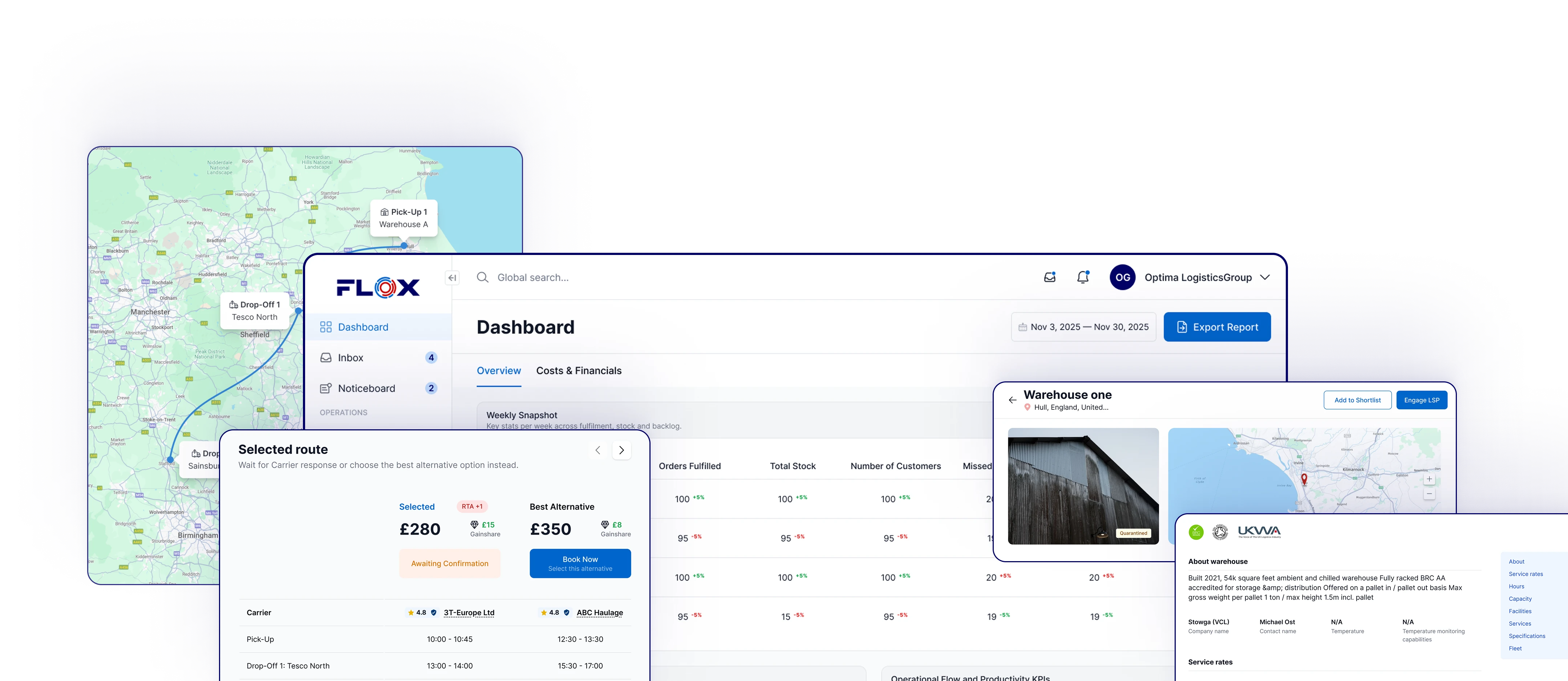
Understanding how the different provider types, systems and operational processes connect is key to getting more value from your logistics partners. FLOX operates as a marketplace and orchestration platform, connecting shippers with warehouse providers, 3PLs and hauliers and coordinating execution across every shipment through a single operational interface. For the context of how these terms apply in the UK logistics market today, see our piece on the UK logistics market state of play. For how AI is changing the capabilities available within logistics systems, see our piece on AI in logistics and warehousing.

Explore storage and fulfilment solutions that give your business flexibility and the support it needs to grow.
Subscribe to our newsletter.
Stay up to date with practical insights and useful logistics content
FAQs
A 3PL provides integrated logistics services across multiple categories using its own assets and partner network. A 4PL acts as the sole interface between a client and all of its logistics providers, managing their relationships and performance rather than operating directly. A 4PL is typically asset-light or assetless. The practical trade-off is control: a 3PL gives the shipper more direct operational visibility, while a 4PL removes day-to-day complexity but increases dependence on a single integrator and reduces in-house operational knowledge over time.