

AI has moved from logistics conference headline to operational reality. The shippers who feel this most directly are those whose logistics and warehousing providers have deployed it effectively and those whose providers have not. The difference shows up in forecast accuracy, inventory levels, fulfilment speed and the number of manual interventions required to keep orders moving.
For shippers evaluating logistics and warehousing partners, the practical question is not whether a provider uses AI. Most now incorporate some form of it. The more useful question is which AI capabilities produce measurable outcomes for the shipper and whether a provider's AI investment is translating into operational performance that the shipper can see and rely on.
Why AI now matters to shippers, not just operators
The data problem in logistics is well documented. Supply chain workers spend close to two working days per week on manual data tracking: locating information, reconciling records across systems and communicating status updates that a connected, AI-enabled operation would generate automatically. 92% of supply chain executives report that they sometimes make decisions based on instinct because their reports do not provide predictive guidance.
Manual processes and outdated planning tools produce data that describes what has happened, not what is about to happen. Decisions made without forward-looking data are slower, more error-prone and more dependent on individual knowledge that is difficult to share across a team or replicate under pressure. The practical consequence for shippers is not limited to the cost burden on their providers. It flows through into service quality.
A warehousing operation that relies on manual data processes will be slower to identify a potential stockout, slower to replan when a collection is late and more likely to produce inaccurate pick data. An operation that uses AI to surface those signals automatically can respond before they become a service failure. This is the lens through which shippers should evaluate AI in their logistics partners: not as a technology adoption question but as an operational performance question. What decisions does AI improve, at what speed and with what reliability?
Demand forecasting and inventory management
Inventory management is the area of logistics where AI delivers the most direct benefit to shippers, because the cost of getting it wrong falls on both sides of the relationship.
AI-powered inventory systems analyse historical sales data, market conditions, seasonal patterns and external signals to forecast demand with greater accuracy than traditional planning methods. The practical output is a reduction in both excess stock and stockouts: the two failure modes that drive up carrying costs and damage customer service levels respectively. For a shipper with a complex, multi-SKU product range, the ability to set and adjust reorder points based on current signals rather than historical averages directly reduces working capital tied up in slow-moving inventory.
AI can identify patterns in inventory data that conventional analysis overlooks, including demand signals from social media activity, weather conditions and market events that do not show up in historical sales records but have a real effect on order volumes. The supply constraint side matters equally. AI systems can integrate internal data, stock levels and replenishment lead times, with external data, supplier conditions, port conditions and market factors, to adjust forecasts and trigger procurement decisions before shortages become visible at the ordering stage.
The 93% of decision-makers who believe in keeping humans in the loop when AI makes significant decisions reflects a pragmatic reality: AI forecasts improve the quality of decisions, but the commercial judgements and risk trade-offs remain with the people running the operation. The goal is not to automate out the decision-maker but to give them better information faster. We cover how exception management across multi-party logistics fits into this picture in our piece on supply chain exception management.
“Technology is the future and it's the future, particularly for supply chain, because we spend a lot of time focusing in on little bits of things that actually technology could do for us.”
Leanne Parkin, Operations Director at Ramsden International

AI in warehousing: what capable providers now offer
The warehouse has become the primary site of AI deployment in logistics, partly because it is data-dense and partly because the efficiency gains from automation are most concentrated and measurable within a single facility.
Demand for warehouse space has grown by 73% since 2019, driven by the growth of e-commerce and multi-channel retail. Managing this increased volume efficiently, with labour costs rising and accuracy expectations tightening, has made AI adoption an operational priority for warehouse operators rather than an aspiration.
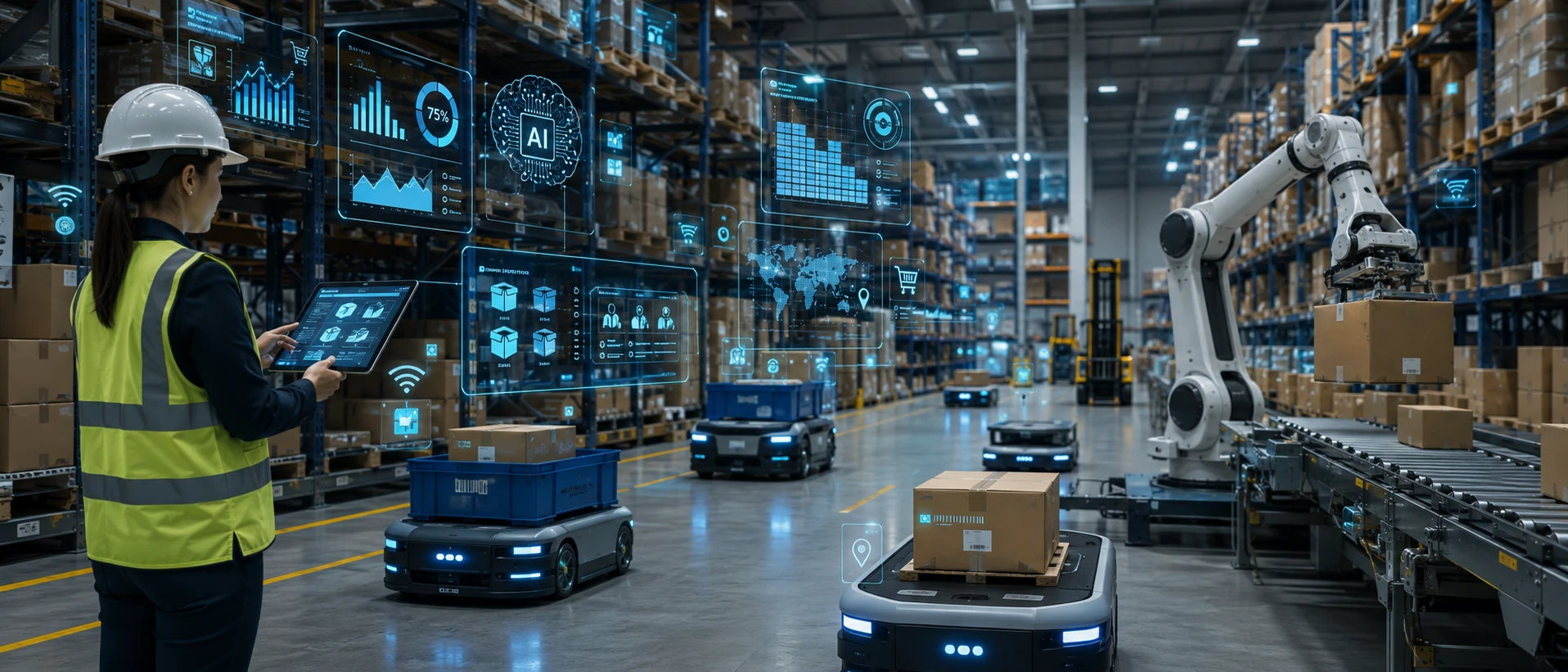
In practice, AI-enabled warehousing covers several capabilities that shippers can now reasonably expect from capable providers. Autonomous mobile robots equipped with AI navigation systems operate picking routes with real-time obstacle avoidance, adjusting to changes in warehouse layout and traffic without human intervention. This improves pick throughput and reduces errors compared with manual picking, particularly for operations with high SKU counts and variable order profiles.
Predictive analytics built into warehouse management systems allow capacity and labour to be positioned based on forecast order volumes rather than reacting to actual order arrivals. A warehouse that knows several hours in advance that a demand spike is coming can allocate pickers, adjust dock scheduling and plan outbound sequencing before the pressure arrives. One that finds out when the orders land is always operating behind the curve. For shippers, this translates directly into order processing speed and the reliability of delivery windows.
AI also enables demand-driven slotting: the automatic repositioning of stock within the facility to reduce travel distance for the most frequently picked SKUs. In a high-volume fulfilment environment, the labour cost reduction from optimised slotting compounds across every pick cycle. Shippers do not manage this directly, but its effect appears in provider cost structures and in the speed and accuracy data their providers report.
Route and transport optimisation through AI
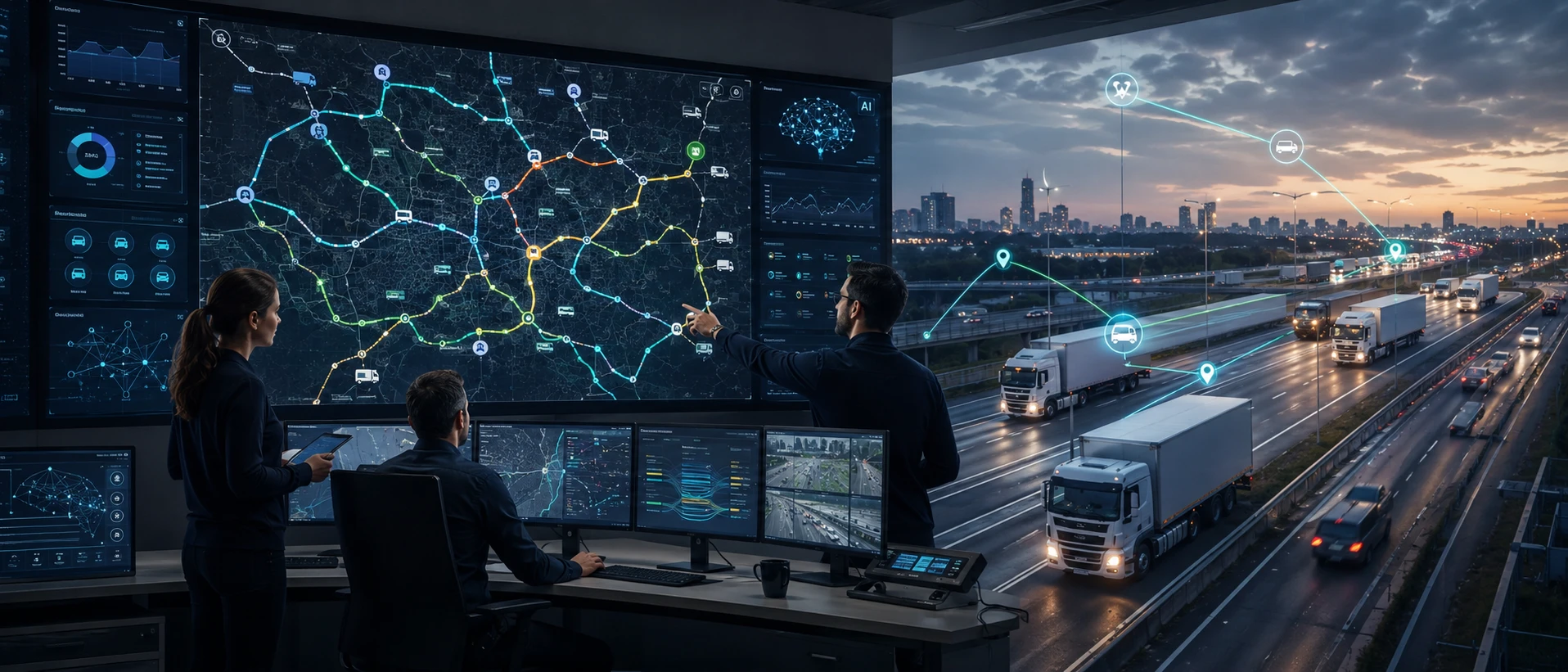
Beyond the warehouse, AI delivers measurable gains in transport planning and execution. AI-driven route optimisation analyses traffic patterns, weather conditions, delivery time windows and vehicle load data to calculate efficient routes and adjust them in real time as conditions change during the day.
Estimates suggest that AI integration across logistics operations could generate between $1.3 trillion and $2 trillion in economic value annually over the next two decades. Early-adopting providers are already seeing profit margin improvements of around 5% or more compared with non-AI operations. The mechanism is straightforward: better load utilisation means fewer vehicles moving the same freight, better routing means fewer kilometres per delivery and faster replanning means fewer missed delivery windows passed back to shippers as service failures.
For shippers, the benefit is visible in carrier rates and on-time delivery performance. A carrier using AI route optimisation can consistently plan at lower cost per delivery than one operating with static route structures and manual replanning. The efficiency gap between AI-enabled and non-AI-enabled carriers widens over time, and shippers who remain with lower-capability providers carry that cost difference in their rates.
AI also enables dynamic load matching: identifying opportunities to consolidate shipments across multiple shippers on overlapping routes in near-real time. This is the operational mechanism behind logistics collaboration at scale, and it depends on the computational speed that AI provides. We cover the cost and emissions case for logistics collaboration in our piece on logistics collaboration and sustainability.


Wajahat Akram
CTO of FLOX.is
Chain Reaction Podcasts
AI Is a Lens, Not a Brain
Most logistics platforms are built for databases, not operators. Wajahat explains why FLOX started from user workflows outward — and where AI genuinely adds value versus hype.
The data foundation AI requires to work
AI is only as effective as the data that feeds it. This is the constraint that limits the benefit of AI deployment across many logistics operations and a consideration that shippers should factor into how they evaluate providers.
The data quality problem in logistics is persistent. Many providers operate across legacy systems, siloed databases and manual recording processes that produce fragmented, inconsistent data sets. AI running on this foundation produces unreliable outputs. The investment in AI tooling is largely wasted if the data it processes does not accurately reflect operational reality.
For shippers, the data quality question has two dimensions. The first is whether a provider's systems capture operational data accurately and in real time at the event level rather than through periodic batch updates. A warehouse that logs stock movements at end of shift cannot give an AI system the signal quality needed to plan dynamically during the day. The second is whether the provider's data can be shared with the shipper's own systems in a consistent, usable format.
Real-time, bi-directional data exchange between the shipper's systems and the provider's systems is the foundation on which AI-enabled logistics operations deliver their value to shippers. Without it, the AI operates in the provider's system alone and the shipper experiences the outputs without the visibility to understand what is driving them or integrate them into their own planning processes.

Ask anything to learn how FLOX works and helps buyers and sellers of logistics run more efficient and profitable operations.
How FLOX applies AI across marketplace and orchestration
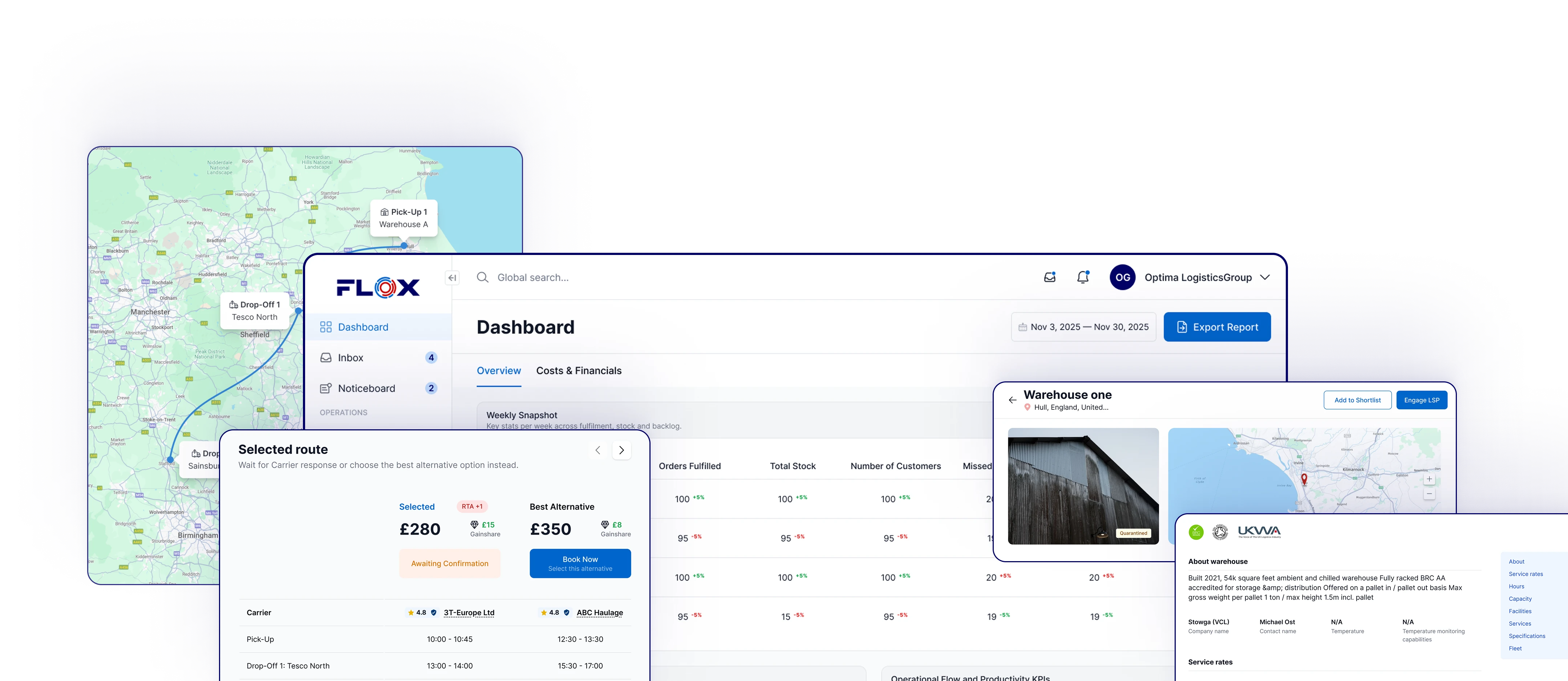
FLOX operates as a marketplace and orchestration platform. AI runs across both layers.
In the marketplace layer, AI identifies consolidation opportunities and matches shipper demand to available capacity across the provider network in near-real time. The matching considers route overlap, timing windows, load compatibility and historical provider performance, producing connections that would not be practical to identify manually across a network of this size.
In the orchestration layer, AI monitors the status of every active shipment against its planned state, surfaces exceptions as they occur and supports decision-making by presenting options and consequences to the relevant parties. Rather than distributing alerts that require manual interpretation, the system provides context and suggested actions that enable faster, better-informed responses across the shipper and their provider network.
The data captured through both layers feeds back into demand forecasting, network optimisation and provider performance evaluation, creating a learning loop that improves accuracy over time. Shippers operating through the platform benefit from AI that is trained on network-level data rather than their own historical volumes alone, which means the forecasts and optimisations reflect broader market patterns rather than a single shipper's sample of the demand signal.
We cover the market context that shapes logistics investment decisions in the UK in our piece on the UK logistics market state of play.
Subscribe to our newsletter.
Stay up to date with practical insights and useful logistics content
FAQs
In logistics and warehousing, AI analyses operational data to improve the speed and quality of decisions. In warehouses, it drives demand forecasting, inventory positioning, pick path optimisation and autonomous robot navigation. In transport, it optimises routes dynamically based on real-time conditions and enables load consolidation across multiple shippers. The common thread is automating the data processing and pattern recognition that would otherwise require manual effort, freeing logistics teams to act on the output rather than produce it.