


Productivity in logistics operations is measured at the wrong level in most organisations. The measurement happens in management reports, dashboards and KPI reviews. The loss happens on the floor, in the coordination gap between parties and in the manual processes that fill the space where integration does not exist. Closing the gap between these two levels is what operational productivity in logistics actually requires. The tools available to operators have become significantly more capable. Whether those tools are being applied to the right problem is a different question.
The difference between management tools and operational tools
The distinction between management productivity systems and operational productivity systems matters more in logistics than in most industries, because the operational layer is where cost is either controlled or lost.
Management productivity systems, which include business intelligence platforms, KPI dashboards, supply chain visibility tools and reporting layers, measure what has happened. They produce reports that managers review, targets that management teams set and analyses that inform quarterly planning. These systems have genuine value. A logistics operation without performance measurement is flying blind. But the value of management reporting is limited by the quality of the operational data that feeds it and by the speed at which the information can be acted upon. A dashboard that tells a manager what went wrong last week does not stop it going wrong again this week.
Operational productivity systems work differently. They govern what happens now: how a load is planned, how a collection is booked, how a warehouse slot is allocated, how a delivery exception is raised and who acts on it. ERP systems, transport management systems (TMS), warehouse management systems (WMS) and demand forecasting tools all belong to this category. Their value is in execution, not reporting. The productivity gain from a TMS is not visible in a management review; it is visible in load planning time, vehicle utilisation and carrier rate management. These are different kinds of value and they require different organisational commitments to realise.
Why data quality undermines reporting before it reaches management
The most common failure mode for management productivity tools in logistics is not the tool itself. It is the data that feeds it.
A business intelligence platform is only as useful as the data it processes. In a logistics operation where bookings are made by phone, proof of delivery is captured on paper and invoice reconciliation is done manually in spreadsheets, the data that reaches any reporting system has already passed through multiple manual entry points, each introducing delay and inaccuracy. The dashboard reports what was entered, not what happened. When the two diverge, as they do routinely in complex operations, management decisions are made on information that does not reflect operational reality.
This is not a criticism of management tools specifically. It is a description of a sequencing problem. Data quality is an operational discipline, not a reporting one. The data that management tools need to function accurately must be captured at the operational level, at the moment of each event, by the party closest to it. A proof of delivery captured digitally at the point of handover is more accurate and more timely than one entered into a system three days later by a back-office administrator. An exception logged automatically when a vehicle misses a geofenced window is more reliable than one reported by a driver who has already moved on to the next collection.
Operational systems that capture data at the source address this problem. The standard operating procedures that govern how data is captured and verified at each stage of the operation are covered in our piece on logistics standard operating procedures.
“It’s about data. You measure how long does it take to pre-pack a gift, how long does it take to dispatch a gift. And you try and optimise that.”
Johannes Kloess, Head of Operations at Thortful

Where TMS, WMS and ERP add genuine value
The productivity case for dedicated operational tools in logistics is real, but it is often oversold relative to the actual implementation experience.
A transport management system, at its core, automates the decisions and administration involved in moving freight from origin to destination. Load planning, carrier selection, rate management, collection booking, track and trace, proof of delivery capture and invoice reconciliation are all processes that a well-implemented TMS handles more efficiently than a combination of spreadsheets, phone calls and email chains. For an operator running significant volumes across multiple carriers and lanes, the productivity case is clear: a TMS reduces planning time, reduces rate variance and produces a data record that can be acted upon rather than reconstructed.
A warehouse management system delivers similar benefits within the four walls of a warehouse. Slotting optimisation, pick path efficiency, labour planning, inbound dock management and inventory accuracy all improve when operations are governed by a WMS rather than by paper-based or spreadsheet-based processes. The return on this investment is well established in high-volume operations where labour cost is material and inventory accuracy directly affects service levels.
ERP systems tie these operational processes to financial management: procurement, accounts payable, accounts receivable and cost accounting. The integration of operational data with financial data within a single system removes the reconciliation burden that exists when these domains are managed in separate tools.
The honest limitation of all three is that they are designed primarily for single-entity operations. A TMS manages the transport function of one company. A WMS manages the warehouse function of one company. An ERP manages the financial function of one company. The moment the operation spans multiple parties, each with their own systems, the integration that these tools provide stops at the organisational boundary.

The productivity ceiling of single-entity tools
The most consequential productivity problem in logistics is not within any single organisation. It is between organisations.
A buyer who has a fully implemented TMS still cannot see, in real time, what is happening inside their carrier's operation. A 3PL with a fully implemented WMS still coordinates inbound deliveries by email with their haulage partners. A carrier with route optimisation and real-time tracking still resolves collection failures by phone call with the warehouse they collect from. Each of these tools produces accurate data within the organisation that uses it. The data stops at the boundary of that organisation and restarts as a phone call, an email or a manually entered field on the other side.
This is where the productivity ceiling of single-entity tools becomes visible. The efficiency gains from a TMS or WMS are real but bounded. Beyond that boundary, coordination relies on bilateral communication between parties who are each working from their own incomplete picture of the shared operation. Exceptions, which in multi-party logistics are frequent and consequential, are resolved by the most labour-intensive method available: human-to-human communication, often on delayed timescales, without shared visibility of the options or the downstream consequences of each decision.
Speed expectations compound this further. When customers expect next-day or same-day fulfilment, a collection failure that takes three phone calls and 45 minutes to resolve is not an operational irritation; it is a broken delivery promise. We cover the relationship between coordination gaps and delivery pressure in our piece on modern supply chain speed pressure.


Malcolm Pope
Founder of Loguro
Chain Reaction Podcasts
Transform Logistics or Be Left Behind
Up to 30% of UK lorries run empty. Malcolm argues the logistics industry's biggest problem isn't technology — it's a stubborn refusal to collaborate.
What multi-party logistics operations actually need
Closing the productivity gap in multi-party logistics requires a different framing than the one that drives investment in TMS, WMS and ERP.
The question is not how to make each party's internal system better, though that matters. The question is how to make the coordination between parties faster, more accurate and less dependent on bilateral communication. That requires a shared execution layer: a system where every party in a shipment can see the same operational state, where exceptions are visible to all affected parties at the moment they occur and where the decisions and communications that currently happen by phone and email are structured, recorded and acted upon through a common interface.
This is a materially different requirement from a management reporting layer. A reporting layer answers what happened. A shared execution layer answers what is happening and ensures the right party acts within the window where action is still useful. The productivity gain from this layer is not measured in dashboard improvements; it is measured in reduced exception handling time, lower detention charges, fewer re-delivery costs and faster invoice settlement. The broader structural context for why this matters in UK logistics is covered in our piece on the UK logistics market state of play.
For buyers and shippers, the case is visibility across the provider network rather than only within the party they contracted with directly. For 3PLs and carriers, the case is structured demand that arrives with the information needed to execute, not bookings that require three follow-up calls to confirm. For warehouse providers, it is inbound certainty: knowing what is arriving, when and in what condition, rather than managing collections that could arrive any time within a four-hour window.

Ask anything to learn how FLOX works and helps buyers and sellers of logistics run more efficient and profitable operations.
The productivity model that matches operational reality
Productivity in logistics is not primarily a reporting challenge or a software implementation challenge in the traditional sense. It is a coordination challenge. The tools that deliver the most operational productivity are those that reduce friction between parties, not just within them.
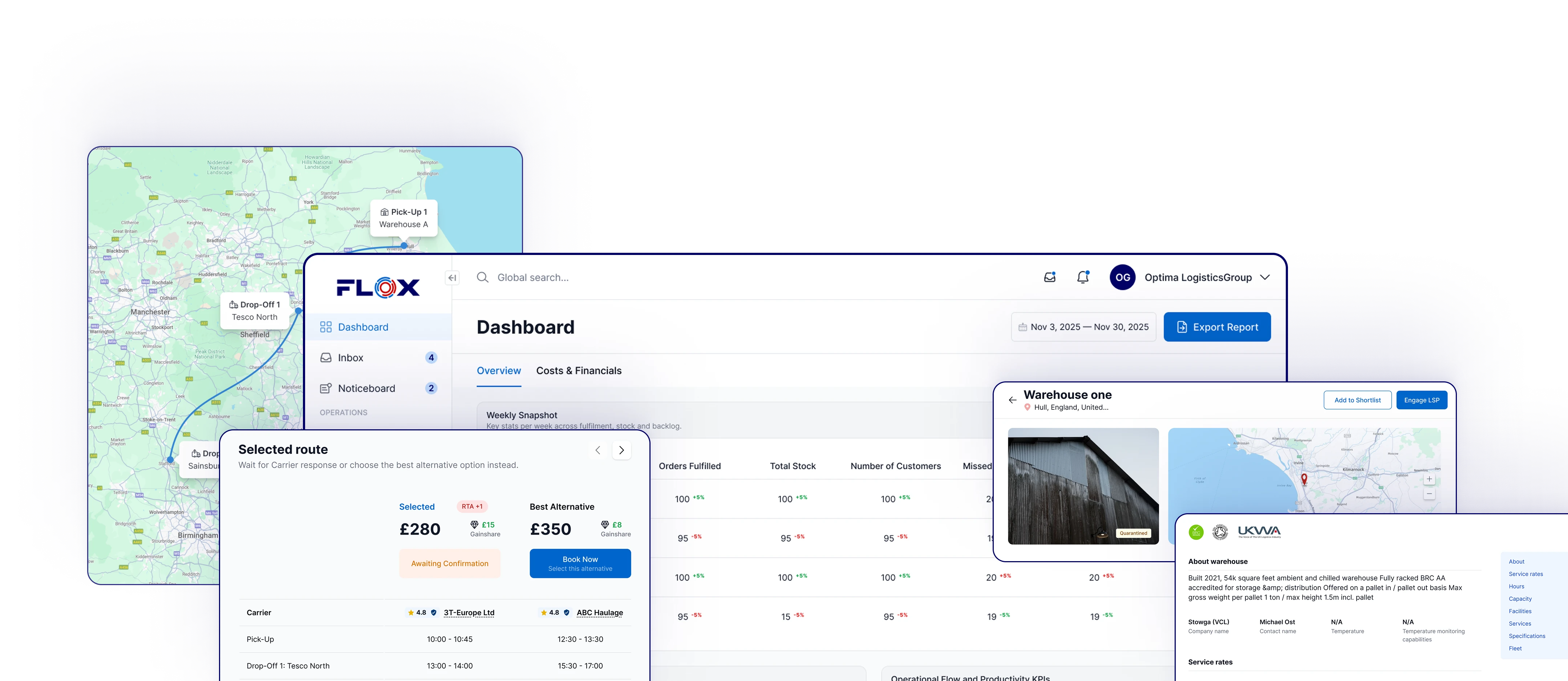
FLOX addresses this as a marketplace and orchestration platform. The marketplace layer connects buyers and shippers with warehouse providers, 3PLs and hauliers, making capacity visible and transactable without the administrative overhead of traditional procurement and quoting processes. The orchestration layer coordinates execution, exceptions and financial flows across every party in every shipment, replacing the bilateral communication that currently handles these functions with structured data shared across a common operational picture.
The combination matters. Marketplace access without orchestration depth produces a faster version of the existing process: quicker to book, but still manual to manage once the shipment is in motion. Orchestration without marketplace access limits the network to parties already known and contracted, which does not solve the capacity discovery problem. Together they address the productivity problem at the level where it actually exists: between parties, at the point of execution, in the moments where coordination either holds or fails.
The standard for measuring productivity in logistics operations should shift from how efficiently each party manages their internal processes to how effectively the parties in a shipment coordinate with each other. That is where the material gains are and where current tools leave the most ground unclaimed.
Subscribe to our newsletter.
Stay up to date with practical insights and useful logistics content
FAQs
Management productivity tools, such as business intelligence platforms, KPI dashboards and visibility systems, measure what has happened. They inform decisions retrospectively. Operational productivity tools, such as TMS, WMS and ERP platforms, govern what is happening now: load planning, warehouse slot allocation, collection booking and delivery exception handling. In logistics, the distinction matters because cost is generated and controlled in the operational layer, not the reporting layer. Management tools are only as useful as the operational data that feeds them, which means operational data quality must come first.