


UK logistics runs somewhere between organised complexity and managed chaos. The sector keeps shelves stocked, factories fed and e-commerce promises kept, but the machinery behind each delivery is fragmented, under-digitised and increasingly stretched. Understanding where the market actually stands, rather than where the press releases say it should be, is the first useful thing a logistics operator, buyer or investor can do.
The structural shape of UK logistics
Road freight is the backbone. The vast majority of domestic freight by value moves by road, handled by a patchwork of own-account operators, regional hauliers, national carriers and 3PLs of every description. Rail handles bulk commodities. Air handles time-critical, high-value goods. Coastal shipping handles heavy industrial freight on specific corridors. But for the daily movement of palletised goods, parcels, ambient and temperature-controlled food, road dominates.
That road-dominated structure has two characteristics that define how the market operates. First, it is structurally fragmented. A significant proportion of UK road freight capacity is operated by companies running fewer than five vehicles. The major 3PLs and carriers are large businesses, but they contract and subcontract into a long tail of smaller operators to handle geographic or volume spikes. The result is a supply chain that, from the buyer's perspective, looks like a single provider and, from the execution perspective, involves six parties who have never met.
Second, post-Brexit customs has changed the international gateway. Cross-channel freight that previously moved through a largely frictionless customs union now requires declarations, sanitary checks and phytosanitary inspections. The practical effect at ports like Dover and Folkestone is more paperwork, more dwell time and more broker involvement. Freight that was routine is now managed. That extra management cost does not disappear; it distributes across carrier margins and buyer quotes. Operators building bonded or customs-controlled warehouse capacity are partly responding to this shift, using bonded warehousing to defer duty liability and manage cross-channel inventory more flexibly.
“AI effectively is a lens, not a brain. The best compliment FLOX gets is silence, because it means the system is doing its job and customers can focus on theirs.”
Wajahat Akram, CTO of FLOX.is

Capacity pressure is permanent, not cyclical
The HGV driver shortage in the UK has been discussed long enough that most operators now treat it as a structural feature of the market rather than a temporary problem to be solved. That reading is broadly correct. The supply of qualified drivers has not kept pace with demand, training pipelines are long and an ageing driver workforce means retirements continue to outpace new entrants. Post-Brexit changes to the ease of hiring drivers from EU countries removed a buffer that had partially masked the underlying gap for years.
The practical effect is not that trucks sit idle. It is that capacity is tighter across the year, peak periods produce more significant rate spikes and carriers with strong driver retention charge a premium that the market mostly accepts. For buyers, rate volatility at peak is not an anomaly; it is a feature of the UK road freight market that procurement teams need to price into their planning.
Warehouse availability follows a similar pattern. The growth of e-commerce fulfilment and the shift toward holding more domestic inventory following COVID-19 supply chain shocks absorbed a large portion of new warehouse development. Grade A logistics space in the Midlands Golden Triangle, around major ports and near major urban centres now commands occupancy rates and rents that would have been difficult to project five years ago. Short-notice capacity, the kind an operator needs when a supplier delivers four weeks early or a customer cancels a slot, is expensive and not always available.
The consequence for multi-party supply chains is that the margin for error at each node has shrunk. When capacity was loose, late decisions and missed slots were recoverable. When capacity is tight, they cascade. A missed collection becomes a warehouse detention charge. A warehouse detention charge becomes a delayed delivery. A delayed delivery becomes a customer service failure. The operators who have come through recent volatility in good shape are those who built financial buffers and flexibility before they needed them. The mechanics of that resilience are worth understanding in detail; we cover them in our piece on UK logistics business resilience.
Technology adoption: what has actually changed
UK logistics has been promised a digital revolution for the better part of a decade. The reality is more incremental and more interesting than either the hype or the cynicism suggests.
Telematics and fleet tracking are now close to standard among mid-size and larger operators. Real-time vehicle location, driver hours monitoring via digital tachograph and temperature monitoring for refrigerated units are operational expectations, not competitive differentiators. The data exists; using it intelligently varies widely across the market.
Transport management systems are more common than five years ago, but adoption among smaller operators remains low. Where a 3PL running hundreds of vehicles has a TMS managing load planning, capacity allocation and carrier rate management, a regional haulier running fifteen vehicles may still rely on a spreadsheet and a whiteboard. The data that buyers need to make smart decisions about their supply chain stops at the boundary of whoever their carrier's system reaches.
Electronic proof of delivery is gaining ground, accelerated by regulatory direction. The Electronic Trade Documents Act 2023 gives legal effect to electronic documents in England and Wales, removing one of the practical barriers to paperless freight. eCMR adoption for international road freight is growing, though the pace varies by trade corridor and counterparty capability. The infrastructure for paperless freight is being built; it is not yet the default.
What has changed slowly is the ability to coordinate execution across multiple parties in real time. A buyer can track their shipment. A 3PL can see their carrier's location. A warehouse can see an inbound booking. But when something goes wrong at one node, the information travels by phone call, WhatsApp message and email, not by structured data flowing automatically to every party who needs to act. That gap is where operational cost lives.
Sustainability: from aspiration to operating cost
UK logistics operators face sustainability pressure from three directions simultaneously: regulation, customer reporting requirements and their own cost structures.
Regulatory pressure is intensifying. The Corporate Sustainability Reporting Directive reaches UK supply chains through European trading partners. Large UK retailers and manufacturers face their own Scope 3 reporting requirements, which means they need verified emissions data from their logistics providers, not estimates. That data requirement is now working its way down the supply chain from large 3PLs to the regional carriers and owner-operators they subcontract to. The ability to provide verified freight emissions data is moving from a commercial differentiator to a commercial requirement.
Electric vehicles are entering the fleet. Last-mile and urban delivery is the most advanced segment, where the combination of low-emission zones, shorter ranges and predictable routes makes electrification viable today. Long-haul HGV electrification is further out, held back by charging infrastructure, vehicle range and the economics of replacing assets before end of useful life. The market is moving, but not at the pace that some fleet transition plans assumed.
The most immediate sustainability lever for most operators is utilisation. Empty running, partial loads and inefficient routing waste fuel and produce avoidable emissions without any commercial return. The commercial and environmental interest in reducing empty running are aligned: better matching of available capacity to actual demand reduces cost and reduces emissions. This is where the coordination layer of the supply chain earns its keep. A well-coordinated multi-party network runs fuller, runs fewer empty legs and produces fewer exceptions.

The multi-party coordination gap
Every logistics operation of any complexity involves multiple parties. A buyer contracts with a 3PL. The 3PL subcontracts haulage to a carrier. The carrier uses a driver who may be employed or self-employed. The goods transit through a warehouse run by a fourth party. The delivery is received by a fifth. Each of these parties has their own system, their own data standard and their own definition of what "on time" means.
The practical result is that coordination between parties relies on bilateral communication: phone calls, emails and messaging apps that sit outside any shared operational system. When the shipment is on plan, this is invisible. When an exception occurs, such as a capacity cancellation, a warehouse delay or a customs hold, it becomes the dominant activity for everyone involved. Someone calls someone who calls someone. Instructions travel verbally. Actions are taken without shared visibility of what other parties have already decided.
This is not a failure of individual operators. It is the natural result of building a supply chain from components that were never designed to interoperate. The gap is structural, and it is where the real cost of logistics complexity accumulates. Detention charges, re-delivery costs, emergency procurement, manual reconciliation of invoices against what was actually delivered: these are the costs of coordination failure, and they are consistent features of multi-party logistics wherever the coordination layer is thin. Structured operating procedures reduce this cost; the discipline of how those procedures are built and maintained is covered in our piece on logistics standard operating procedures.
Addressing this requires more than a tracking tool at one end of the chain. It requires a shared execution layer where every party has visibility of the same operational reality, exceptions surface to everyone who needs to act on them and financial flows are part of the operational record rather than a separate process run weeks later.


Chris Clowes
COO of FLOX
Chain Reaction Podcasts
The Real State of Logistics, Looking Beyond the Headlines
Headlines say logistics is recovering. The data tells a different story — stable volumes, compressed margins, and an industry quietly deciding its next move.
What the market needs next
The UK logistics market is not short of tools. It is short of integration. Every segment of the chain has adopted point solutions: TMS here, WMS there, route optimisation over there. What the market has not solved is the layer that sits across all of them, connecting buyers, warehouse providers, 3PLs and hauliers into a single shared operational picture.
The commercial appetite for that layer is real. Buyers want visibility across their provider network, not just within the party they contracted with directly. Providers want to expose their capacity and receive structured demand, rather than manage RFQ processes by email. Hauliers want bookings that arrive with the information needed to plan, not bookings that require three phone calls to complete.
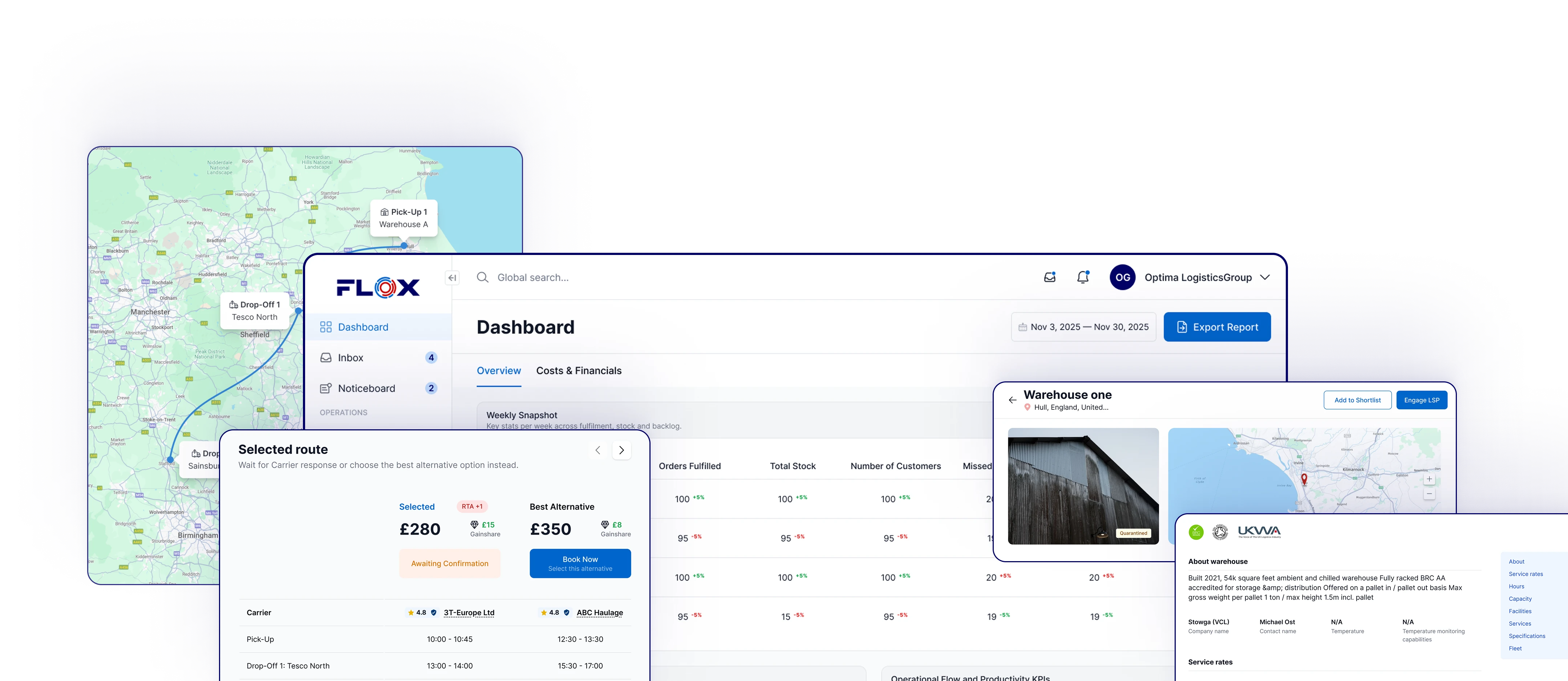
FLOX addresses this as a marketplace and orchestration platform. The marketplace layer connects buyers and shippers with warehouse providers, 3PLs and hauliers, making capacity visible and transactable. The orchestration layer coordinates execution, exceptions and financial flows across every party in every shipment. Neither layer works without the other. A marketplace without orchestration depth produces a matching service; useful for a spot booking, insufficient for managing an operation. Orchestration without marketplace access limits the network to parties already connected and does not solve the capacity discovery problem.
The UK logistics market has the structural complexity, the regulatory pressure and the operational pain to make the case for this combination self-evident. The question for each operator is not whether the market will move in this direction. It is whether their current coordination model will hold until it does.

Ask anything to learn how FLOX works and helps buyers and sellers of logistics run more efficient and profitable operations.
Subscribe to our newsletter.
Stay up to date with practical insights and useful logistics content
FAQs
UK logistics is dominated by road freight, which handles the vast majority of domestic cargo by value. The market spans large integrated 3PLs, national carriers, regional hauliers and a long tail of smaller owner-operators running fewer than five vehicles. This fragmentation means most supply chains involve multiple parties who contract and subcontract capacity between them. The sector is closely coupled to retail, manufacturing and e-commerce performance, and is sensitive to fuel prices, regulatory change and driver availability.