

The warehousing and fulfilment decisions a shipper makes early tend to stay in place far longer than the business conditions they were designed for. A centralised distribution model that worked when delivery expectations were five to seven days becomes a constraint when customers expect two. A third-party fulfilment arrangement set up for one volume level becomes expensive headroom or inadequate capacity as the business grows in directions that were not planned for.
Getting these decisions right, or right enough to adapt from, requires understanding the range of models available, the genuine trade-offs between them and the operational disciplines that make any model perform. This guide covers the core choices that matter for shippers and what to look for when evaluating warehousing and fulfilment providers.
Why warehousing decisions shape the whole logistics operation
For shippers, warehousing is not a back-office function. It determines how quickly orders reach customers, what the per-unit cost of storage and handling is, how easily the operation scales during peak periods and what data is available to manage inventory intelligently.
The delivery speed expectation has sharpened the stakes. Research shows that 91% of supply chain executives report that customer delivery expectations have increased in the last 12 months, and 94% are targeting a two-day or less delivery window. 83% of customers expect delivery within two days, and for large or bulky items 38% still expect two-day service. These expectations apply whether the shipper is operating owned infrastructure or outsourced capacity.
The implication is that warehousing configuration directly affects customer experience. A warehouse located 400 miles from the majority of a shipper's end customers, regardless of how efficiently it operates internally, produces longer transit times and higher last-mile costs. The location, structure and operating model of warehousing are commercial decisions as much as logistical ones, and the two should be evaluated together.
“There’s no magic wand to anything. Inventory is the magic wand.”
Keiran Hewkin, Co-Founder and CEO of Swyft Home

Centralised or regional: the network decision
The foundational choice for most shippers is whether to consolidate inventory in a small number of locations or distribute it regionally to position stock closer to end customers.
Centralised models hold inventory in a single national facility or a small number of large sites. The operational advantages are real: simpler inventory control, lower total stock holdings, easier management and meaningful economies of scale in handling and processing. For shippers with predictable demand patterns and customers distributed evenly across the country, or for B2B shippers where lead times are less sensitive, centralisation often delivers the best unit economics.
Regional models distribute inventory across multiple facilities to reduce last-mile distances and, in most cases, delivery times. For shippers competing on speed or serving customers concentrated in specific geographies, regional networks close the gap between centralised economics and the service level commitments the market requires. The trade-off is operational complexity: managing multiple facilities, coordinating different logistics service providers and keeping inventory balanced across sites all add overhead.
In practice, many shippers operate hybrid arrangements: a central hub for slow-moving or high-value lines and regional coverage for fast-moving stock. Around 52% of companies fulfil orders year-round from multiple distribution points. 48% of businesses cite coordination across multiple logistics service providers as a significant operational challenge and 39% highlight the cost of operating multiple warehouse sites.
The decision between centralised and regional is not permanent. As volumes grow or the customer base shifts geographically, the optimal network configuration changes with it. Warehousing agreements that allow scaling without long-term lease commitments give shippers the flexibility to adapt. We cover the coordination complexity that comes with multi-location operations in our piece on supply chain exception management.

In-house vs outsourced: the honest trade-off
Operating warehouse space directly gives a shipper control over the facility, the processes and the data. Integration with internal ERP and order management systems is simpler when the warehouse is run in-house, and the shipper sets the operating standards rather than negotiating them with a service provider.
The cost and commitment profile is the constraint. Owned or leased warehouse space requires capital investment or long-term contracts. Fixed capacity does not scale with demand: a shipper carrying spare space in a slow quarter and stretched capacity in a peak period is paying the cost of both. Staff recruitment, training and management add operational overhead. For a business where logistics is not a core competency, the attention required to run a warehouse well competes with attention that could go into product development, sales or customer relationships.
Outsourcing to a third-party logistics provider converts most of these fixed costs into variable ones. The shipper pays for space, handling and services based on actual usage. A 3PL serving multiple clients in the same facility achieves economies of scale in infrastructure, technology and staffing that a single-site shipper cannot match. Access to the provider's network also means a shipper can establish coverage in new geographies without building each provider relationship independently.
The trade-off is visibility and control. A shared facility is managed to the provider's standards, not the shipper's. Real-time stock data depends on the quality of the warehouse management system and the data-sharing arrangements in the contract. Service level failures require a contractual response rather than a direct management decision. Shippers who outsource benefit most when they specify data and reporting requirements clearly at the point of contract rather than discovering the gaps once the relationship is operating.


Joshua Hegarty
Founder and CEO of Cloud9 Fulfillment
Chain Reaction Podcasts
Poker Pro Turned Logistics CEO: What E-Commerce Gets Wrong About Fulfillment
Professional poker taught Joshua to read situations, manage risk, and stay calm under pressure — skills that transferred directly to running a fast-growing fulfilment operation.
Warehouse and fulfilment types: what each is designed for
Not all warehouse and fulfilment facilities serve the same function. Understanding what each type is optimised for helps shippers match their requirements to the right kind of provider.
Distribution centres are designed to receive goods in bulk, sort them and dispatch outbound orders efficiently. They are the backbone of high-volume B2B distribution and work well for shippers moving large quantities with relatively predictable order profiles. Throughput speed and inbound-outbound efficiency are the primary performance metrics.
Fulfilment centres are configured for individual order processing at speed: receiving stock, picking individual items, packing and dispatching. They are the infrastructure behind e-commerce and direct-to-consumer delivery. The operational metrics that matter are pick accuracy, order cycle time and returns processing efficiency. For shippers with high order volumes and mixed SKU profiles, the process discipline of a dedicated fulfilment centre typically outperforms a standard warehousing operation.
Cold storage facilities maintain controlled temperature environments and are a requirement for shippers handling food, pharmaceuticals, flowers or any goods with temperature-sensitive integrity requirements. The cost of cold storage space is higher and the operational disciplines more demanding, but for the categories that require it there is no substitution.
Bonded warehouses hold goods under customs control, allowing imported items to be stored without payment of duty until they are released for domestic sale or re-exported. For shippers importing from outside the UK who want to defer duty obligations or manage customs timing, bonded facilities provide the legal and administrative framework to do so.
Within each type, the decision between dedicated and shared space maps onto the broader in-house versus outsourced question. Dedicated space gives a shipper sole use and full control over configuration. Shared space, which is how most 3PL operations work, distributes infrastructure cost across multiple clients and offers more flexibility in space volumes and contract terms.

What to look for when choosing a warehousing partner
The choice of warehousing and fulfilment provider is as consequential as the network model decision, and the two should be evaluated together. Selecting a provider with the wrong geographic footprint or the wrong technical infrastructure creates constraints that are difficult and expensive to reverse.
Geographic coverage is the starting point. The right network configuration for the shipper determines where capacity needs to be. A provider with facilities only in one region cannot support a multi-site model. A provider with broad coverage but no presence near the shipper's key customer cluster is a poor fit regardless of facility quality.
Systems integration is the second consideration. A warehouse management system that cannot connect to the shipper's order management or ERP platform creates a manual reconciliation burden. Real-time stock visibility, order status feeds and automated exception notifications should be treated as baseline requirements rather than optional enhancements. Shippers should confirm the technical integration approach with any provider before agreeing terms, including which data fields are available, at what frequency and in what format.
Scalability terms are the third consideration. A fulfilment contract that requires 12 months notice to scale down, or a lease with no break clauses, reduces the shipper's ability to respond to demand changes. Flexible space agreements tied to actual throughput and short notice periods for capacity changes are preferable for most shippers unless the operation has genuinely stable, predictable volumes.
Lean inventory management disciplines also contribute to how well any warehousing arrangement performs. Holding less safety stock, having suppliers deliver smaller quantities more frequently of fast-moving lines and using real-time WMS data to manage reorder points all reduce the space requirement and the carrying cost of stock within whatever facility model the shipper has chosen. We cover the speed and fulfilment pressures that underpin these decisions in our piece on modern supply chain speed pressure.

Explore storage and fulfilment solutions that give your business flexibility and the support it needs to grow.
How FLOX connects shippers to warehousing and fulfilment capacity
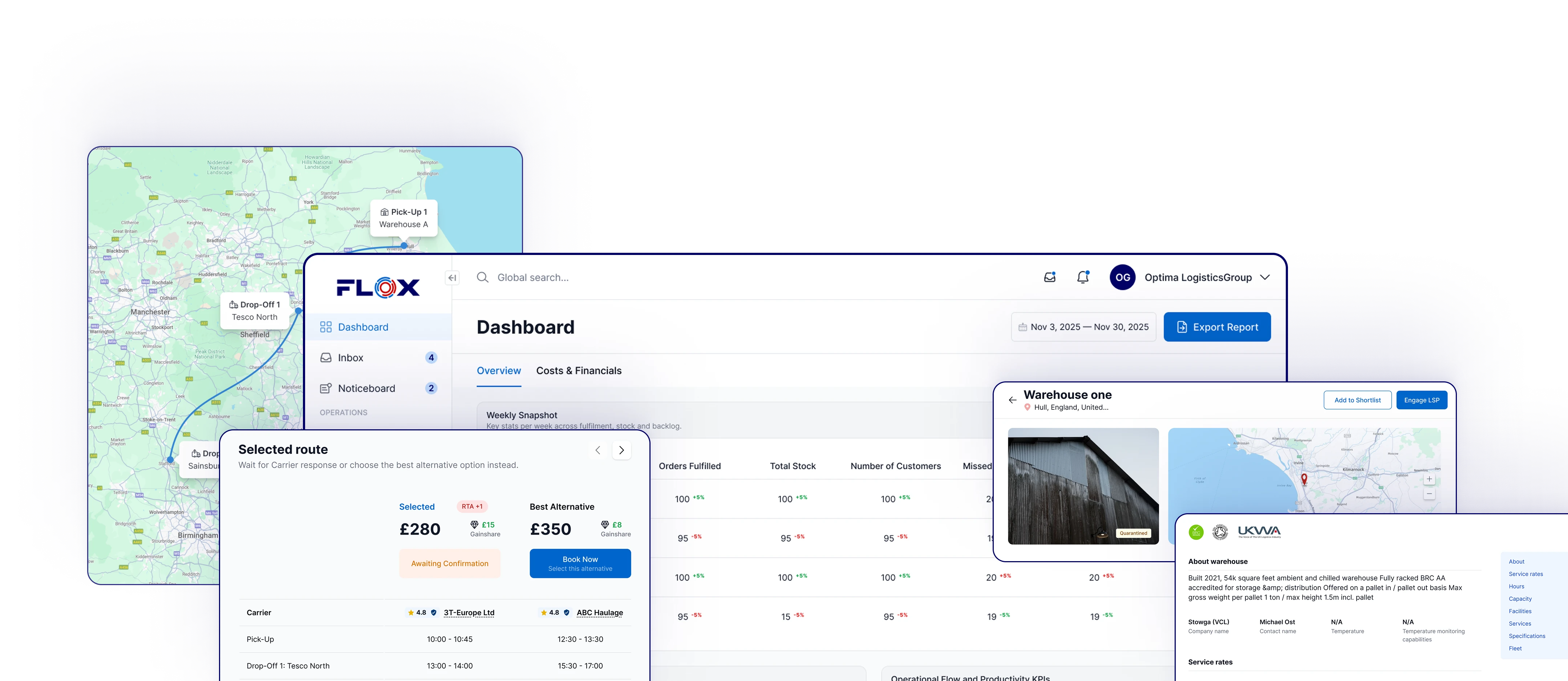
FLOX operates as a marketplace and orchestration platform. For shippers, the marketplace layer makes warehousing and fulfilment capacity visible across a network of vetted providers covering different geographies, facility types and service models, without requiring the shipper to develop and maintain individual relationships with each.
The orchestration layer coordinates booking, inbound and outbound operations and exception management across every provider relationship through a single operational interface. Rather than managing separate communication channels with each 3PL or warehouse operator, the shipper has visibility of all activity, exceptions and performance data in one place.
For shippers evaluating their warehousing model, the platform allows capacity to be accessed where it is needed, scaled in line with demand and managed without building a bespoke provider network from scratch. The data captured through the platform covers all provider relationships in the same format, removing the manual effort of consolidating performance and inventory data from different sources.
The broader context for warehousing and logistics decisions in UK supply chains is covered in our piece on the UK logistics market state of play.
Subscribe to our newsletter.
Stay up to date with practical insights and useful logistics content
FAQs
A distribution centre receives goods in bulk, sorts them and dispatches outbound orders, typically for B2B customers in larger quantities. A fulfilment centre is configured for individual order processing: picking, packing and dispatching single items or small quantities, usually for direct-to-consumer or e-commerce orders. The key performance metrics differ: distribution centres are measured on throughput and inbound efficiency, fulfilment centres on pick accuracy, order cycle time and the speed and quality of returns handling.