


Freight emissions sit at the heart of most corporate sustainability targets, and logistics is where those targets are either met or missed. For shippers, the operational lever that moves both carbon and cost in the same direction is collaboration: sharing transport capacity, pooling route data and coordinating across the supply chain rather than optimising each shipment in isolation.
The economics and the regulatory environment are both pushing in the same direction. Vehicle utilisation in UK and European freight sits below 60% on average. Regulations now require auditable scope 3 data rather than broad declarations. And procurement teams at major buyers increasingly require verified emissions figures as a condition of contract. The opportunity is clear. The friction that has historically stopped shippers from acting on it is operational, not strategic, and it is resolvable.
The regulatory pressure shippers cannot ignore
Regulations affecting freight sustainability have moved from directional to operational. The EU's Fit for 55 package sets a legally binding pathway to a 55% reduction in greenhouse gas emissions by 2030. The Corporate Sustainability Reporting Directive began applying from the 2024 financial year, placing new disclosure requirements on supply chain emissions for companies within its scope. In the UK, the ZEV mandate hardwires rising zero-emission vehicle sales targets through to 2035, and the DMCC Act 2024 gives regulators direct fining powers for misleading environmental claims of up to 10% of global turnover.
For shippers, the practical consequence is that transport emissions data must be accurate, auditable and comprehensive. It is not sufficient to ask each carrier to self-report. The data must come from a shared, verifiable source that covers the entire transport network, not only the legs where the shipper holds direct contracts. A product's carbon footprint spans dozens of logistics partners. One company cannot verify or communicate the full picture from within its own systems alone.
The commercial pressure reinforces the regulatory one. Procurement teams at large buyers now routinely require scope 3 transport data as part of supplier qualification. Investors are scrutinising Scope 3 disclosures with greater rigour. Companies that cannot provide reliable, supplier-level transport emissions data are increasingly excluded from tenders they would otherwise win on price and service grounds alone.
“We are seeing a change in mindset now … there seems to be more of a collaboration to succeed theme. You need that system thinking. You need to understand the whole, the big picture.”
Helen Hardy, CEO of CILT

The cost case for shared freight capacity
The economics of transport collaboration are well established but underused. Across UK and European logistics, average vehicle utilisation sits below 60% whether measured by weight or volume. Only 63% of journeys carry a useful load. The gap between what freight vehicles carry and what they could carry represents direct operating cost for carriers, passed through to shippers in the rates they pay, and direct carbon output with no commercial justification.
Research into collaborative vehicle routing demonstrates that load consolidation can deliver savings of around 20% on transport cost and around 25% on CO2 emissions per collaborative shipment. These are not projections from modelling exercises. They reflect the consequence of matching available capacity to available demand across more than one shipper's requirements simultaneously, on the same or overlapping routes.
For a shipper the practical version of this is straightforward. Two companies shipping from the same origin region to the same destination region, at compatible times, can share a vehicle rather than each booking at partial load. Both pay less per unit moved and both emit less carbon per unit moved. The same logic applies across inbound consolidation, shared warehousing intake and multi-drop route sharing. The barrier has historically been finding the partner, agreeing terms, coordinating timing and managing exceptions when something goes wrong. Each of those barriers is operational and administrative. None is fundamental.
At the network level, the aggregate opportunity is significant. UK road freight accounts for substantial annual CO2 output, and the portion attributable to suboptimal loading is recoverable without waiting for fleet electrification or infrastructure investment. It requires coordination, not capital.
Why logistics collaboration is harder than it looks
The benefits of transport collaboration are widely understood. The practice is less widespread than the opportunity suggests, because the barriers are real and have resisted simple solutions for decades.
Trust is the first barrier. Shippers are often reluctant to share route data, volume patterns or delivery windows with companies that may be customers of the same carrier or, in some sectors, competitors in adjacent markets. Without a neutral intermediary that holds shared data without exposing it to other participants, the commercial risk of sharing outweighs the efficiency benefit. This is particularly pronounced in transactional shipper-carrier relationships where there are no long-term contracts and the default assumption is competitive rather than cooperative behaviour.
Information asymmetry is the second barrier. Carriers and logistics service providers manage capacity and routing data within their own systems, which are not connected to the systems of other carriers or to the shipper's transport management tools. Coordinating a shared load across multiple carriers, each with their own visibility and booking processes, requires manual effort that erodes the cost saving the collaboration was supposed to produce. The overhead of coordination can exceed the saving from consolidation unless the process is automated.
Real-time route optimisation is the third barrier. Collaborative routing is mathematically complex. Finding the optimal combination of loads, routes and timing windows across multiple shippers and carriers simultaneously is a computational problem that manual planning cannot solve at the speed freight operations require. Traditional approaches to this problem required heavy upfront implementation and produced results too slowly to be operationally useful. The planning cycle for collaborative loads was longer than the booking window available.


Dan Pass
Supply Chain & Logistics Lead at Ann Summers
Chain Reaction Podcasts
Collaborative Supply Chains Drive Resilience
Resilience isn't built in isolation. Dan reveals how genuine collaboration between supply chain partners — not just contracts — creates the flexibility to absorb disruption.
What effective collaboration requires from shippers
Shippers who have moved from the aspiration of collaboration to the practice of it share a set of operational disciplines that make participation in collaborative networks viable.
Data readiness is the first requirement. Collaboration depends on sharing route data, volume forecasts and delivery windows in a format that other parties can act on. Shippers who maintain this data in structured, accessible formats can participate in collaborative routing opportunities as they arise. Those who manage transport planning through spreadsheets or offline processes cannot match the speed at which consolidation opportunities appear and close.
Flexibility in booking windows is the second requirement. Shared load planning requires that loading and delivery windows can be coordinated across the requirements of more than one shipper. A shipper with rigid, narrow windows reduces the available opportunities because the overlap with other shippers' windows is limited. Even modest flexibility significantly increases the pool of viable collaboration partners on any given lane without affecting service level commitments to end customers.
Willingness to operate through shared infrastructure is the third requirement. Consolidation centres, shared booking platforms and multi-carrier orchestration tools each require the shipper to operate through a common interface rather than managing each carrier relationship separately. The administrative gain from this approach is material: one booking process, one data format and one exception management channel replace the overhead of maintaining separate relationships with each carrier.
We cover the cost of managing exceptions across multiple carrier relationships in our piece on supply chain exception management.

The emissions reporting benefit of network-level data
Sustainability reporting is one of the clearest commercial benefits of logistics collaboration for shippers, because shared platforms generate the emissions data that standalone carrier relationships cannot.
When a shipper books transport through a fragmented set of direct carrier relationships, the emissions data for each leg arrives from a different source, in a different format, calculated with a different methodology. Consolidating this into a single, auditable figure for a regulatory disclosure or a customer tender requires significant manual effort and produces results of questionable reliability. Auditors and procurement teams are increasingly aware of this methodological fragmentation and are beginning to discount self-reported figures that cannot be traced to a consistent data source.
Network-level logistics platforms generate consistent, comparable emissions data across every shipment, carrier and lane, because the data is captured through a single operational interface using the same calculation methodology throughout. For a shipper preparing a CSRD submission or responding to a tender that requires scope 3 transport emissions data, this is a material operational advantage. The data exists, is verifiable and covers the full transport network rather than only the legs the shipper can directly observe.
The broader regulatory and market context for sustainability pressure in UK logistics is covered in our piece on the UK logistics market state of play.

Move products with greater speed and control by picking services that fit your route, timing and delivery needs.
How FLOX makes logistics collaboration operational for shippers
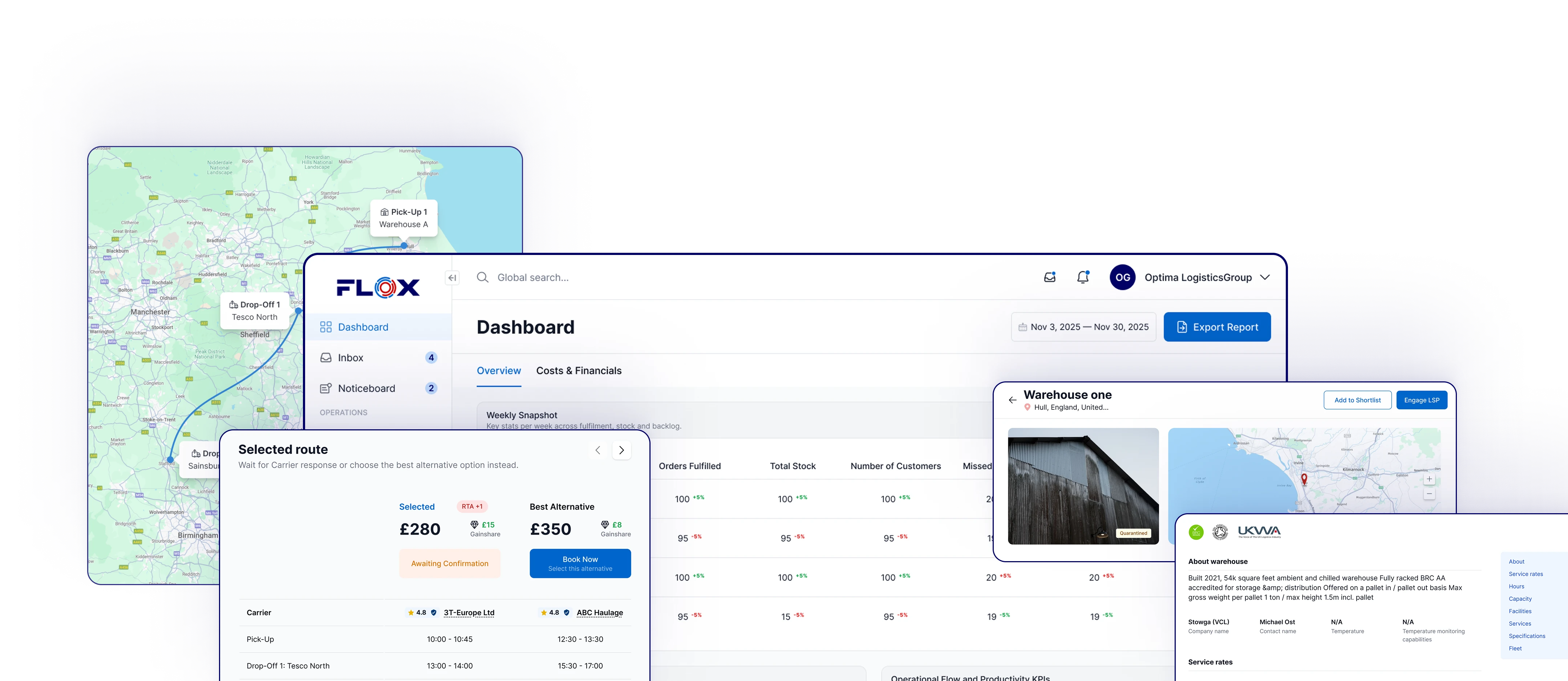
FLOX operates as a marketplace and orchestration platform. For shippers, the marketplace layer makes available capacity visible across a network of warehouse providers, 3PLs and hauliers without requiring the shipper to maintain a separate procurement relationship with each. The orchestration layer coordinates booking, routing and exception management across every shipment, replacing the administrative overhead of multi-carrier management with a single operational interface.
For logistics collaboration specifically, the platform identifies consolidation opportunities across the shipper network, matches loads with overlapping routes and timing windows and coordinates the booking with the relevant carriers. The neutral data environment addresses the trust barrier: route and volume data is held within the platform rather than shared directly between participants, so shippers can benefit from consolidation without exposing commercially sensitive information to other parties.
The emissions and cost data from every collaborative shipment is captured consistently in the same format, so the shipper can report accurately on what the collaboration delivered in quantified terms, not directional claims.
The barrier that has historically prevented shippers from collaborating at scale is not willingness. It is operational friction: the effort of finding partners, coordinating timing, managing exceptions and reconciling emissions data across a fragmented set of carrier relationships. Infrastructure that removes that friction turns collaboration from an aspiration into a routine part of how freight is planned and managed.
We cover the coordination pressures in modern logistics operations in our piece on logistics operations productivity.
Subscribe to our newsletter.
Stay up to date with practical insights and useful logistics content
FAQs
Logistics collaboration is the practice of sharing freight capacity, route data and transport infrastructure across multiple shippers to reduce cost and emissions per unit moved. For shippers, the primary benefits are lower transport rates through load consolidation, reduced carbon emissions per shipment and more consistent, verifiable sustainability data. Research shows collaborative shipments can reduce transport cost by around 20% and CO2 per shipment by around 25% compared with each shipper booking separately at partial load.