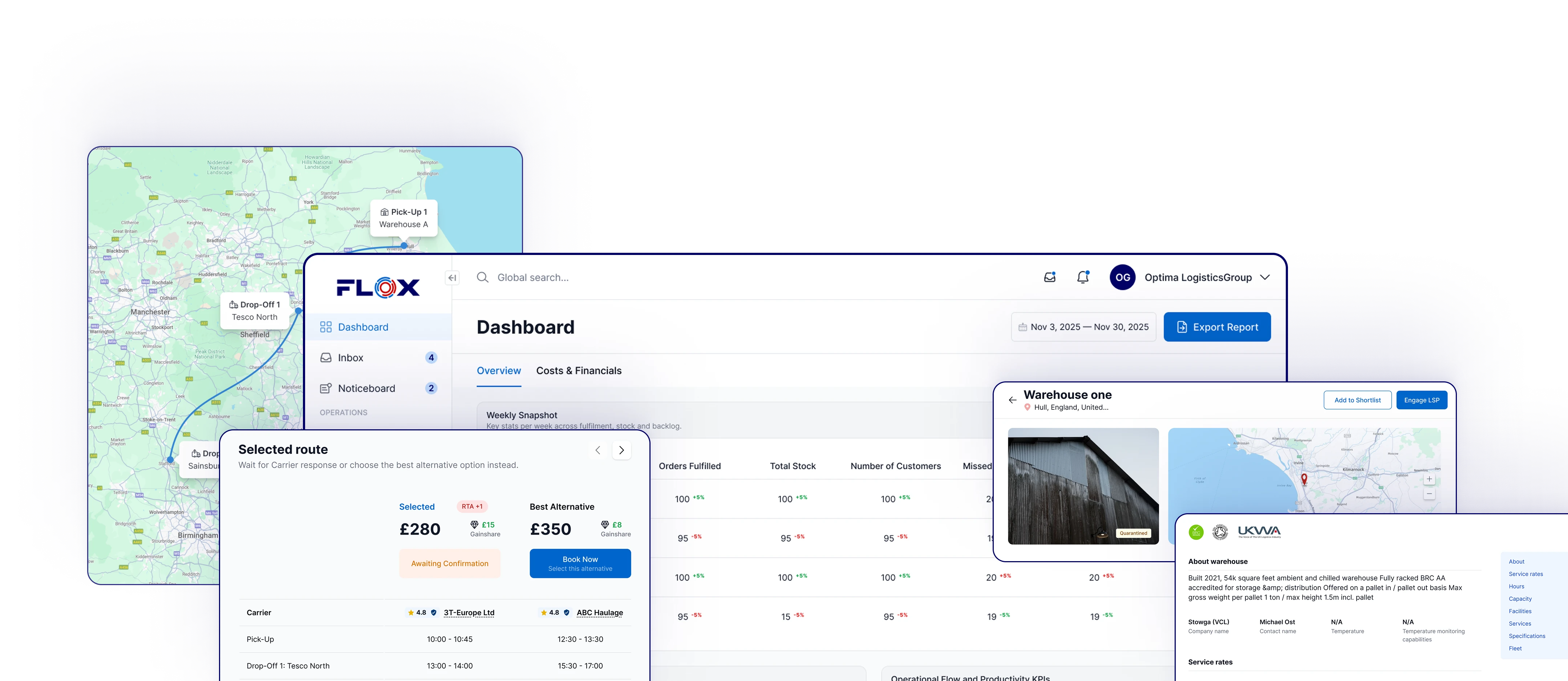



Most logistics problems do not start with a shortage of capacity. They start with a shortage of visibility. A shipper needs additional warehouse space in the Midlands for six weeks. Their regular 3PL is full. Three rounds of calls later, the space is found but the timeline has slipped, the rate is higher than expected and nobody has a clean record of what was agreed.
This is not unusual. It is how UK logistics operates day to day. Capacity exists on both sides: spare pallet positions, available trailer slots, hauliers with empty backhaul lanes. The infrastructure to connect it is fragmented, manual and slow. FLOX was built to change this.
FLOX is a multi-party logistics platform combining two integrated layers. The first is a marketplace connecting buyers, warehouse providers, 3PLs and hauliers so capacity gets found and booked quickly. The second is an orchestration layer managing everything after the match: tracking, exceptions, proof of delivery, financial settlement and reconciliation across all parties. The two layers are designed to work together. One finds the capacity. The other makes sure it actually moves.
“The logistics industry is a unique industry because by default, de facto, it has to collaborate. FLOX is built to enable exactly that.”
Paul Brooks, MD or GFC, Author

How the marketplace layer works
The marketplace lets buyers describe what they need and find verified providers who can meet those requirements. Regional warehouse cover, specialist cold-chain storage, a carrier with capacity on a specific lane: buyers can search by location, capability and availability rather than working through contacts in sequence, hoping someone picks up.
On the supply side, warehouse operators, 3PLs and hauliers list what they have available and when. This gives providers a qualified route to demand that does not require a full sales and marketing operation. A warehouse with 400 spare pallet positions and no current way to advertise them can make that availability visible to buyers in the right region, at the right time, without a sales team doing the outreach.
Demand sourcing does not have to go through a traditional RFQ process. Holly, the FLOX AI assistant, handles natural language queries directly. A logistics manager can describe their requirement in plain terms and receive a qualified shortlist in minutes rather than waiting days for manual responses. The system understands context: proximity, capacity type, handling requirements and timeline are all factored into the results without the buyer having to specify each one separately.
Pricing is transparent from the outset, which removes one of the most common friction points in logistics: the gap between the quoted rate and the rate that appears on the invoice. The marketplace handles both spot capacity and longer contract arrangements. Spot covers single shipments, short-term warehouse requirements and one-off haulage bookings. Contract arrangements let buyers and providers establish ongoing commercial relationships with consistent, documented terms that both parties can refer to when something goes wrong.

How the orchestration layer works
After a booking is confirmed, the orchestration layer takes over. This is where FLOX handles the operational complexity that most marketplace platforms leave to phone calls and email threads once the match is made.
Shipments are tracked across all parties on the same platform. Exceptions surface with structured workflows rather than a flurry of messages. A trailer running two hours late, a warehouse that cannot receive until the following morning, a discrepancy in pallet count on arrival: each exception has a clear owner, a clear record and a resolution path that does not depend on who happens to answer the phone.
Proof of delivery is captured digitally and attached to the relevant shipment record automatically. PoD disputes are one of the most consistent sources of invoice delay in UK logistics, and they almost always come down to one party having a piece of paper the other cannot find. Digital capture eliminates the problem at source.
Financial flows are core to the orchestration layer, not an afterthought. Invoices are generated against confirmed delivery data, payments are tracked and disputes have a full paper trail. For buyers managing multiple carrier and warehouse relationships simultaneously, this replaces a process that typically involves spreadsheets, email inboxes and significant manual reconciliation each month.
Role-based visibility means each party sees what is relevant to them and nothing more. A warehouse provider can track active inbound shipments without accessing commercial rate information that belongs to the buyer. A carrier can submit proof of delivery without seeing invoicing data that relates to other providers in the chain. This structure is what allows genuinely multi-party operations to run through a single platform without exposing confidential commercial information across the network.


Dan Pass
Supply Chain & Logistics Lead at Ann Summers
Chain Reaction Podcasts
Collaborative Supply Chains Drive Resilience
Resilience isn't built in isolation. Dan reveals how genuine collaboration between supply chain partners — not just contracts — creates the flexibility to absorb disruption.
What the data shows about wasted capacity
FLOX uses Load Matching Capacity Allocation (LMCA) algorithms to identify co-loading and route-sharing opportunities across the platform's active network. Rather than each booking being treated in isolation, the system looks for cases where vehicles travelling similar routes can consolidate loads, reducing empty miles without requiring any manual coordination from the parties involved.
To understand how much latent efficiency exists in UK road freight, FLOX ran an analysis with a local authority in England, examining traffic data from vehicle tracking across different vehicle types and routes. The analysis looked at duplication: cases where two or more vehicles travelled similar legs with enough spare capacity between them to consolidate into fewer journeys.
At 70% platform participation, the analysis identified potential trip savings of between 8.53% and 12.17%. This reduction does not come from anyone working harder. It comes from better information about where vehicles are going and what capacity they are carrying, and a system that can match them before the journeys depart rather than after the empty miles have already been driven. The full analysis sets out the methodology and findings in detail.
For warehouse operators, the same logic applies to storage utilisation. Rather than empty pallet positions sitting unannounced, the platform surfaces availability to qualified buyers, making underutilised space a revenue-generating asset rather than a fixed overhead cost sitting on the balance sheet.

Who FLOX is built for
FLOX is designed to work for three groups simultaneously, which is what differentiates it from a tool that solves one party's problem while adding friction for everyone else.
Buyers include manufacturers, retailers, importers and e-commerce operators who need to manage multiple carrier and warehouse relationships without a dedicated coordination team. They use the marketplace to source verified capacity without the usual sourcing overhead, and the orchestration layer to maintain visibility across all their logistics relationships from a single view. Whether to invest in your own warehousing or outsource it often comes down to operational flexibility, and the platform makes outsourced arrangements significantly easier to manage at scale.
Warehouse providers and 3PLs use FLOX to reach qualified demand without building a full sales function. Underutilised capacity gets visibility it would not otherwise have, and new commercial relationships come with structured terms, digital proof of delivery and payment tracking already built in. Getting genuine value from a 3PL relationship depends on clean information flows and shared visibility, which is precisely what the orchestration layer is designed to provide for both sides.
Hauliers and carriers can list available lanes, receive qualified shipment requests and settle financially through the platform. For operators running tight margins on backhaul routes, a co-loading match turns an empty leg into a productive one. On-demand warehousing integrates into this model: short-term storage requirements where committing to a long lease does not make sense, connected to verified operators who have capacity available on the right terms and in the right location.

Ask anything to learn how FLOX works and helps buyers and sellers of logistics run more efficient and profitable operations.
Why both layers have to work together
A marketplace without orchestration is a listing site. It gets capacity found but it does not make the operation work. Exceptions, disputes, invoicing and multi-party coordination remain manual. An orchestration tool without a marketplace locks in existing relationships without helping operators find better ones or fill gaps when regular capacity is unavailable.
FLOX is built on the premise that discovery and execution need to sit on the same platform, with the same data, accessible to all parties under appropriate permissions. This is the difference between a point solution and infrastructure. A point solution solves one moment in the logistics chain. Infrastructure changes how the whole chain operates.
Traditional logistics has often relied on a 4PL to provide a single coordinating layer across multiple operators and modes. A 4PL arrangement works, but it adds a managed-service layer between parties that carries its own margin, its own communication overhead and its own relationship with the underlying data. FLOX provides the coordination layer without the intermediary. No single party in the chain has to take on the coordinator role. The platform provides it.
The UK logistics market has enough capacity to meet most demand. The problem is that information about where that capacity is and when it is available does not move fast enough to be useful. FLOX is the infrastructure for moving that information properly: in real time, across all parties, with the right access controls and the financial settlement layer built in from the start.
Subscribe to our newsletter.
Stay up to date with practical insights and useful logistics content
FAQs
FLOX is a two-layer logistics platform. The marketplace layer connects businesses that need warehousing, fulfilment or haulage with vetted providers across the UK and Europe. The orchestration layer coordinates capacity, fulfilment and transport flows in real time, so operations run efficiently across multiple providers at once.