


Every day in the UK, lorries and vans travel the same roads between the same locations, carrying loads that are well below capacity. The vehicles exist. The routes overlap. The demand exists on both sides. But without the data to connect them, the opportunity disappears into the morning dispatch.
In 2025, the FLOX team analysed five days of Automatic Number Plate Recognition (ANPR) data from a local English council to put a number on that missed opportunity. What we found was a consistent, measurable case for load consolidation across every vehicle type we examined.
Co-loading, co-shipment and horizontal collaboration: the same idea, different contexts
Co-loading, co-shipment and horizontal collaboration are three terms for essentially the same operational idea. Each has a different home in the industry.
"Co-loading" tends to be used by hauliers and Third-Party Logistics (3PL) providers when describing what happens at the vehicle level. Two or more loads, from different shippers or collection points, fill a single trailer. The haulier benefits from a fuller run. The shippers pay for the capacity they actually use rather than the capacity they book.
"Co-shipment" is often shipper-side language, particularly in FMCG, retail and manufacturing. Two companies agree to share a regular lane because neither fills a trailer on their own. The arrangement is typically bilateral: negotiated between logistics managers who know each other and have agreed on terms for splitting cost and liability.
"Horizontal collaboration" is the term used in academic research and transport policy. It describes any arrangement where two companies at the same level of the supply chain share logistics resources. Retailers sharing distribution legs with other retailers. Manufacturers sharing inbound freight lanes with other manufacturers in the same sector. The collaboration is called horizontal because it connects parties at the same tier, as opposed to vertical collaboration between a shipper and its carrier.
All three describe the same mechanism: instead of two vehicles running at 50-60% capacity on overlapping routes, one vehicle runs at 80-90% capacity and one journey is eliminated. The cost reduction, the fuel saving and the emissions reduction all follow directly from that arithmetic.
The idea has existed for decades. In the UK grocery sector, retailers have shared some distribution legs in areas where their networks overlap. European manufacturers have used pallet-sharing schemes and groupage arrangements for many years. In theory, any shipper with spare capacity on a regular lane should be able to offer it to another shipper with demand on the same route. The logic is not complicated.
The execution is. Who coordinates the booking and accepts liability if the consolidated load is late? How do you split the cost in a way both parties accept as fair? How do you stop one shipper's late goods from delaying the other's consignment? And how do you find the match in the first place, when neither party wants to expose their full logistics footprint to a competitor or to a 3PL who might pass it on?
Those are operational and data problems. The ANPR analysis was designed to measure the scale of what is at stake before trying to solve them.
How FLOX used ANPR data to measure the real opportunity
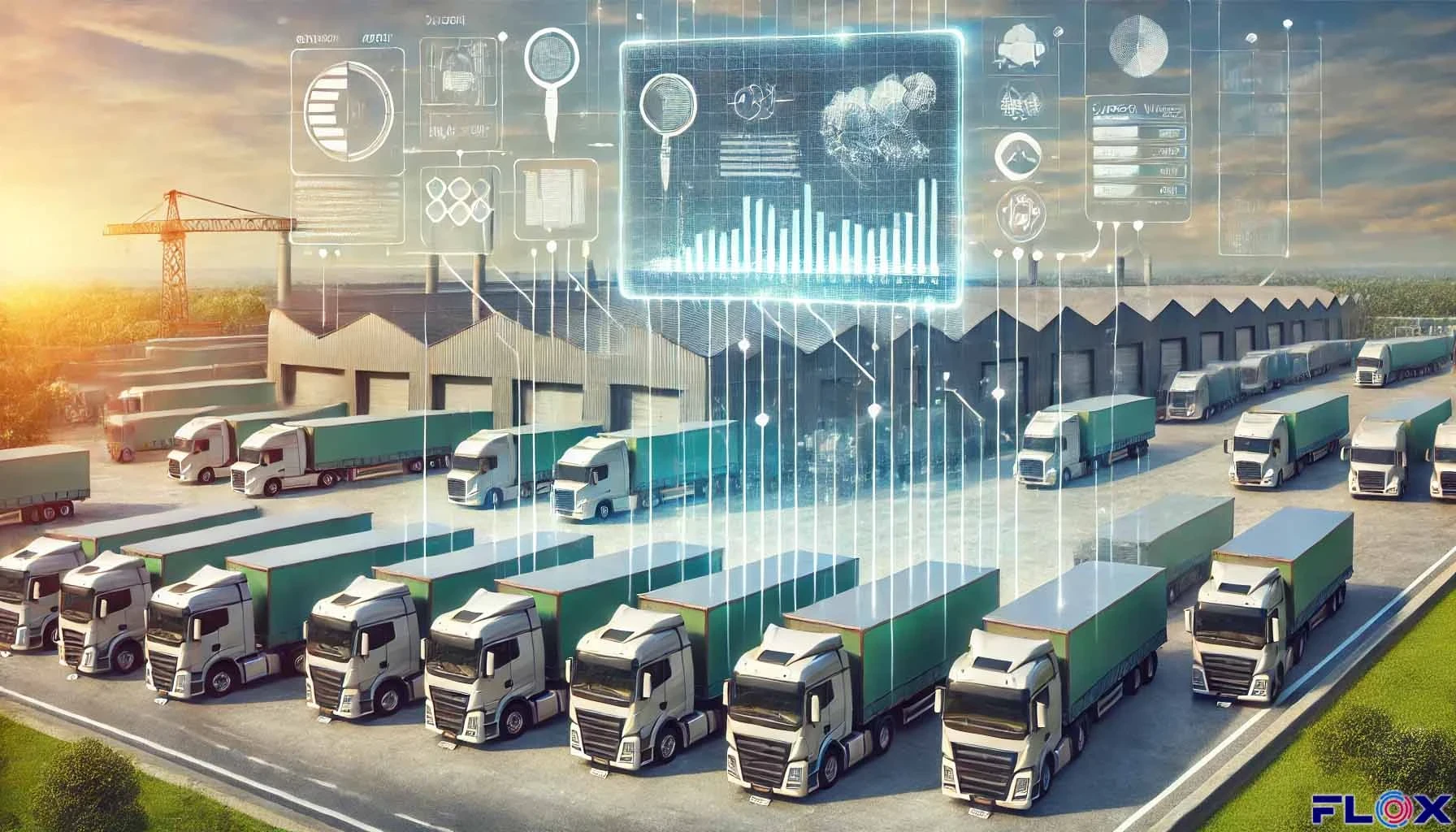
The dataset came from a local English council and covered five working days. ANPR cameras record vehicle plates as they pass fixed points, which means the data captures real vehicle movements across a road network without any tracking device fitted to the vehicles themselves. The data is genuinely independent of individual shipper reporting.
FLOX's data team applied graph network analysis to reconstruct the movement paths of each vehicle in the sample. A network, in this context, is a collection of nodes (the camera sighting points) connected by edges (the paths between them). The timestamps between sightings establish the direction of travel. Once individual paths were reconstructed, the full dataset was aggregated for population-level analysis across the five-day window.
Three vehicle categories were examined: vans (light goods vehicles), rigids (medium delivery trucks) and articulated vehicles (artics). The analysis applied two variables. First, capacity utilisation: how full is the vehicle, modelled from 50% through to 95%? Second, journey type: is the comparison based on vehicles following identical routes, or on vehicles sharing the same start and end points, which may travel different roads in between?
The 70% capacity band was treated as the most realistic baseline, based on broadly understood average UK vehicle utilisation levels. A custom simulation tool was developed for path optimisation modelling. It allows users to define assumed vehicle capacity and the number of stops in each route segment, then calculates how many trips are identical and how many share matching start and end points. Mathematical optimisation then identifies potential trip-saving opportunities given those inputs.
“The logistics industry is a unique industry because by default, de facto, it has to collaborate. FLOX is built to enable exactly that.”
Paul Brooks, MD or GFC, Author

What the data found
At 50% capacity utilisation, the results were consistent across vehicle types. For vehicles on identical routes, the number of trips that could be eliminated through load consolidation ranged from 20.04% to 25.07%. When the analysis extended to vehicles sharing the same start and end point, rather than the exact same road, the figure rose to between 40.63% and 47.16%.
At 70% capacity, which represents a more realistic baseline, the collaboration opportunity ranged from 8.53% to 12.17% on identical routes. That range sounds modest in isolation. Applied to the scale of UK road freight, it is not.
According to Department for Transport road traffic statistics, light goods vehicles and HGVs together travelled 74.9B miles on UK roads in 2022. A 10% reduction in trips through load consolidation would remove approximately 7.49B miles of road travel per year. That is not a marginal efficiency gain. It is a structural change in the operating model for road freight.
One pattern that held across every scenario was the lower collaboration potential for rigid vehicles. Regardless of capacity assumption or journey type, rigids showed an opportunity consistently around 5% lower than vans and artics. One plausible explanation is that rigids tend to serve more specialised routes with less network overlap. The data does not resolve this definitively, but it suggests vehicle type matters when modelling consolidation potential for a specific fleet or sector.
Why co-loading has not happened at scale
The numbers make a clear case for load consolidation. The adoption has not followed. Three distinct barriers explain most of it.
The first is commercial. Shippers are reluctant to share their distribution patterns, even with non-competing businesses, when any third party in the chain might pass that information on. Horizontal collaboration requires a degree of trust, and a clear governance model for who sees what, that most industries have not built at scale. Even when the economics are clear, the information risk is not.
The second barrier is operational. Load consolidation requires precise coordination on timing, vehicle specifications, liability allocation and supply chain documentation. When a consolidated shipment is delayed or damaged, responsibility is harder to assign than it would be on a dedicated vehicle. Shippers and 3PLs have generally preferred the certainty of their own vehicles, even at lower utilisation, over the coordination overhead of a shared arrangement.
The third is structural. Most freight matching still happens through phone calls, bilateral relationships or load boards designed for full truck loads on single lanes. These mechanisms work for what they were built for. They are poorly suited to identifying consolidation opportunities across a population of vehicles in near-real time, which is exactly what the ANPR analysis models.
What changes when you have the data infrastructure to identify matches at population scale is not the idea of co-loading. It is the economics of finding and acting on each specific match. The problem has never been whether co-loading makes sense. It has been whether the information to act on it is available in a usable form.


Chris Clowes
COO of FLOX
Chain Reaction Podcasts
The Real State of Logistics, Looking Beyond the Headlines
Headlines say logistics is recovering. The data tells a different story — stable volumes, compressed margins, and an industry quietly deciding its next move.
What this means for shippers, 3PLs and the road freight market
For shippers, the ANPR findings suggest there is almost certainly underused consolidation potential in any regular lane network. At a realistic 70% capacity baseline, a 10% collaboration opportunity represents real cost reduction on lanes that run week in, week out. For any shipper running dedicated haulage on routes that overlap with other shippers in the same sector, co-loading is a conversation worth having with their logistics service provider.
For 3PLs and hauliers, consolidation is a revenue and capacity management question as much as a cost question. A vehicle running at 90% capacity rather than 60% on the same lane earns more revenue per kilometre for the same fixed cost. For 3PLs managing shared-user networks, the ability to offer co-loading systematically, backed by data rather than bilateral negotiation, is a more defensible position than rate competition alone.
For the broader road freight market, the environmental argument for load collaboration does not rest on brand statements or sustainability targets. Every empty mile is fuel burned and emissions produced for no commercial purpose. A 7.49B mile reduction in UK road freight travel is a substantive contribution to decarbonisation, achieved through better use of existing capacity rather than new infrastructure or mode shift.
FLOX's Load Matching Capacity Allocation (LMCA) algorithms are designed to identify consolidation matches across multiple shippers and lanes. The ANPR analysis was part of the data work to validate real-world consolidation potential in actual vehicle movements, not in a modelled scenario. The data confirms the opportunity exists at meaningful scale. Converting it into actual consolidated journeys is an operational and information problem, and one that is now solvable with the right platform infrastructure.

Move products with greater speed and control by picking services that fit your route, timing and delivery needs.
Subscribe to our newsletter.
Stay up to date with practical insights and useful logistics content
FAQs
Co-loading is the practice of combining loads from two or more shippers into a single vehicle for a shared journey. Also called co-shipment or horizontal collaboration, it allows each shipper to pay for only the capacity they use rather than running a vehicle that is part empty. The arrangement reduces the total number of vehicles on the road, lowers cost per unit for shippers, and cuts fuel consumption and emissions per tonne moved. It is common in groupage and Less-than-Truckload (LTL) freight but less established in full-load planning.