


Most third-party logistics relationships plateau. The 3PL ships the orders, files the bills, hits the service level. The buyer pays the invoice and keeps quietly complaining about the same three issues. The contract value goes up by the supplier's escalator clause. Neither party gets to the value that the original RFP promised. This piece is about how to break that pattern from the buyer side.

Why most 3PL relationships plateau at transactional
The pattern is consistent across sectors. A buyer runs a thorough selection process, signs a three or five-year master service agreement, onboards into the 3PL's warehouse management system, and lands in a steady state by month six. From that point onward the relationship narrows to operational meetings about exception rates, missed picks and damaged-on-arrival claims. Quarterly business reviews happen but generate few changes. The 3PL's commercial team is in the room twice a year. The buyer's supply chain team is in the room once a fortnight.
The cause is rarely contract design. The cause is that neither side actually invested in the strategic layer of the relationship after the ink dried. A 3PL responding to an RFP often shows its best work in the pitch: network modelling, scenario analysis, technology roadmap. Once live, those capabilities recede because the buyer never created the operating cadence to ask for them again. By the time the buyer realises they have a transactional supplier where they wanted a strategic partner, the renewal is twelve months out and the cost of switching looks unattractive.
Industry research backs the pattern. Reports from large 3PL operators and analyst houses consistently find that most retailers say they are satisfied with their current 3PL, while at the same time roughly half are actively considering a switch within three years. That apparent contradiction is the relationship dynamic above: tolerable steady-state performance, persistent strategic disappointment. The buyers are not unhappy with what the 3PL delivers. They are unhappy with what they are not getting. The wider commercial backdrop is the one we set out in our analysis of the UK 3PL sector.
“Today’s logistics manager has almost become a stockbroker — guessing when they should buy”
Chris Clowes, COO of FLOX

What strategic actually means in this context
The word strategic gets diluted in 3PL discussions because every provider claims to be one. The useful definition is narrower. A 3PL is operating strategically when it does at least three of the following: contributes to network design changes the buyer would not have made alone, signals upcoming capacity, cost or labour-market shifts before they hit the next quarter, runs scenario analysis on the buyer's stock and service profile, brings benchmarks from comparable buyers, and proposes contract structure changes that suit the buyer's evolving business rather than the original agreement.
That list looks ambitious until you notice none of it is exotic. Every mid-sized 3PL has analysts who do this work for the largest accounts. The pattern is that this work flows toward whichever accounts ask for it consistently and give the analyst team something to work with. The accounts that get the most strategic input are not always the biggest. They are the ones that share data, ask the right questions and give the 3PL time to respond.
The follow-up insight is that strategic value is highly recoverable from an existing relationship without renegotiating the contract. The disciplines that recover it (regular data-sharing, a senior commercial cadence, written briefs into the 3PL's analyst team) cost the buyer almost nothing and can be in place within a quarter. The shift in operating model needed to make this work is the same one we wrote about in why backhaul and reverse loads are outdated: the old habits no longer fit the operating environment.

3PL or 4PL: when to add a layer
The 3PL versus 4PL question lands on most logistics buyers at some point in their growth, and the answer is more nuanced than the standard explainer suggests. A 3PL handles a defined slice of the supply chain (warehousing, transport, fulfilment) under direct contract. A 4PL sits one layer up and orchestrates across multiple providers, taking accountability for end-to-end execution while not necessarily owning any of the assets.
The case for adding a 4PL is strongest in three operating conditions. First, when the buyer's network spans more than five logistics providers and the coordination overhead is consuming senior supply chain time that would be better spent elsewhere. Second, when end-to-end visibility is hampered by inconsistent data flowing from different 3PL systems. Third, when the buyer wants to retain commercial relationships with multiple providers for capacity and resilience reasons, but does not want to be the integrator.
The case against is also worth stating. A 4PL adds a layer of cost, a layer of contractual complexity and a layer of decision rights between the buyer and the operational reality. For buyers with one or two strong 3PL relationships, the right answer is usually to upgrade the operating model with those 3PLs rather than insert a new player. The honest test: if your existing 3PLs were operating strategically, would you still need a 4PL? For many buyers the answer is no, and the better investment is in the cadence and data-sharing disciplines that turn a 3PL strategic in the first place.


Chris Clowes
COO of FLOX
Chain Reaction Podcasts
The Real State of Logistics, Looking Beyond the Headlines
Headlines say logistics is recovering. The data tells a different story — stable volumes, compressed margins, and an industry quietly deciding its next move.
How to brief and onboard so the 3PL can deliver more than the contract
The discipline that separates strategic 3PL relationships from transactional ones is concentrated in the first ninety days of go-live. Buyers that get this period right reset the relationship for the full contract term. Buyers that under-invest in onboarding spend the next three years operating in the rut they accepted in month two.
The first ninety days should produce four artefacts. A documented baseline of cost-to-serve by SKU and customer segment, agreed jointly with the 3PL. A scenario register listing the operational shifts the buyer expects in the next 12-24 months and what each one would mean for the 3PL setup. A data-sharing protocol covering volume forecasts, sales pipeline by region, and changes to product specifications that affect handling. A review cadence with the right people in the room: monthly operational, quarterly commercial, half-yearly strategic with the 3PL's analyst team and the buyer's supply chain leadership both present.
What this delivers is the conditions under which the 3PL can do its analyst work on the account. Once those conditions are in place, the buyer should expect proactive analysis, not respond to it. If a year in, the 3PL has not proposed a structural improvement, the discipline is on the buyer to ask why. The 3PLs that grow accounts are the ones whose analyst teams find buyers easy to work with. Buyers can choose to be that kind of customer or not. For a fuller view of the operational discipline gap this often exposes, our piece on hitting the Excel spreadsheet wall is the practitioner-side story.
Why marketplace and orchestration is changing the 3PL calculus
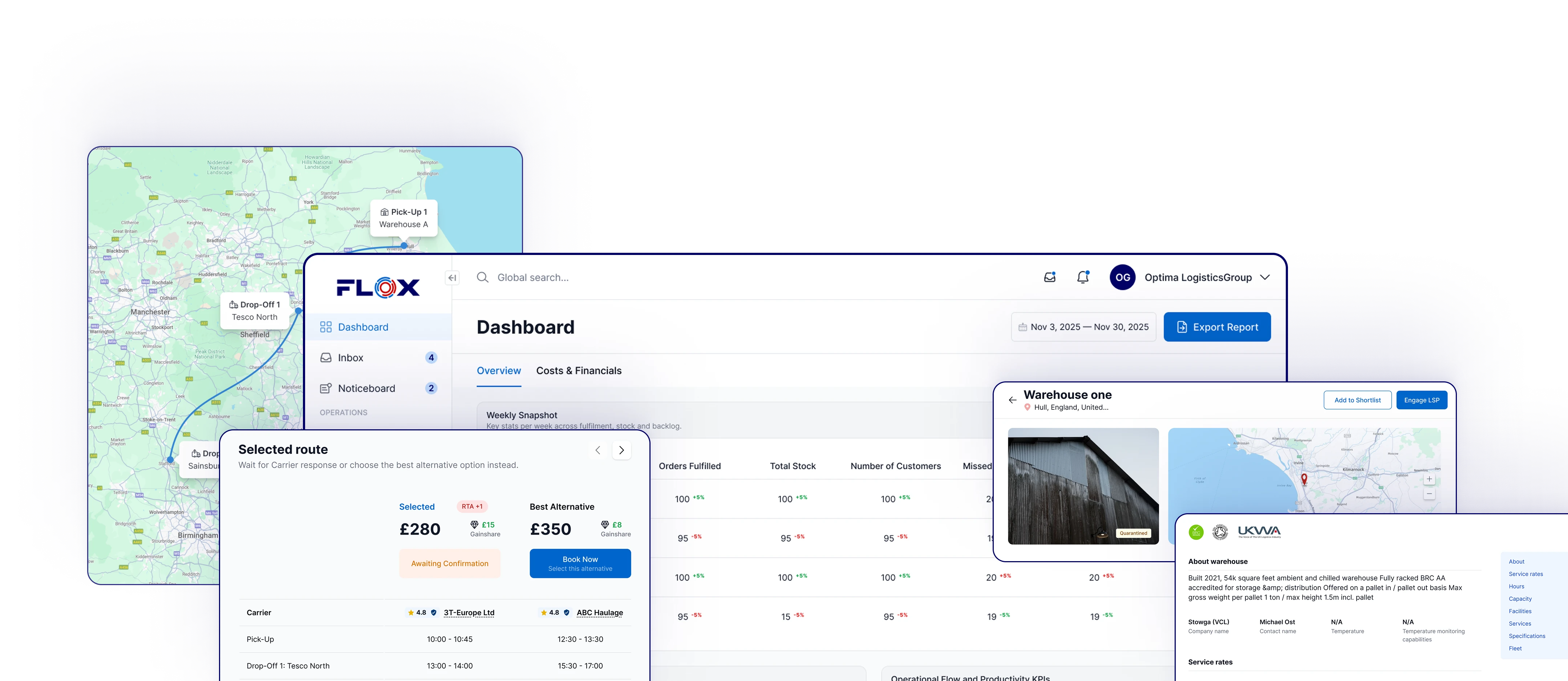
The discipline above assumes the buyer is running with one or two 3PLs. The newer pattern is buyers running with a wider set of providers, drawn from a marketplace, with orchestration sitting above the individual relationships. This is the operating model FLOX is built on, and it changes the strategic 3PL conversation in three ways.
First, the marketplace layer makes the comparison set wider and the cost of switching lower. A buyer who used to default to the incumbent because retendering was painful now has visibility of regional capacity, specialism and pricing in a way the old RFP cycle never delivered. Second, orchestration removes the integration tax. The buyer no longer has to choose between deep relationships with a few providers or wide coverage with weak coordination. The orchestration layer runs the shipment across whichever combination of providers makes sense, with the visibility and exception management held centrally. Third, the analyst question gets answered differently. Strategic input that used to live inside a single 3PL relationship now lives in the orchestration data, which surfaces patterns no individual 3PL would see because each only sees its share of the buyer's network. The wider context for this shift on the warehouse provider side is in new ways for warehouses to acquire customers.
None of this replaces the operational discipline of running good 3PL relationships. It expands the set of relationships the buyer can sensibly run. For a buyer historically constrained to two or three deep partnerships, that is the genuine commercial shift.

Explore storage and fulfilment solutions that give your business flexibility and the support it needs to grow.
Subscribe to our newsletter.
Stay up to date with practical insights and useful logistics content
FAQs
Because neither side keeps the strategic layer alive after onboarding. The 3PL shows its best analytical work during the RFP, then settles into operational rhythm once live. The buyer establishes a cadence of operational meetings about exceptions and SLAs, but rarely creates space for design conversations. Within six months, the relationship is running on transactional muscle memory. Breaking the pattern usually means re-establishing a senior commercial cadence with the right people in the room, not retendering the contract.