


On-demand warehousing has moved from an experimental commercial format to a recognisable category in UK logistics. The structure is simple: storage priced by the pallet or by the cubic foot, billed monthly, with short notice periods and the option to scale up and down with the buyer's volume. The mechanics are a long way from the standard three-to-five-year industrial lease. This piece sets out how the model actually works, where it fits, where it does not, and what to look for when assessing a provider.
What on-demand warehousing actually is
On-demand warehousing is a commercial model in which the buyer pays for what they actually use rather than committing to a fixed amount of space for a fixed term. The provider holds the building, the racking, the Warehouse Management System (WMS) and the operational team. The buyer holds the stock, the data, the customer relationships and the commercial decisions. Payment is per pallet per month, plus per-pick handling, plus carrier-rate pass-through on outbound shipments.
The contractual mechanics matter and are where most of the day-to-day variation between providers sits. A genuine on-demand contract has three features. The minimum commitment is short (monthly billing, typically a 30-day notice period). The pricing is granular enough to map directly to the buyer's volume profile (per pallet, per cubic foot, per pick, not bundled). And the buyer can leave or scale down without exit penalties beyond the agreed notice period. Providers that miss any one of these are usually traditional 3PLs using the on-demand label for marketing reasons.
The other defining characteristic is the technology layer. On-demand only works commercially because the provider's WMS, order management, despatch reporting and integration tooling are mature enough to onboard a new buyer in weeks rather than months. This was the bottleneck that kept the category small for most of the 2010s, and the bottleneck that has loosened over the past five years as WMS platforms have moved to the cloud, integration patterns have standardised and the orchestration tooling above individual sites has improved.
“It’s not a divorced partnership … it’s got to be a homogenous relationship between us (providers) and the brands themselves.”
Joshua Hegarty, Founder and CEO of Cloud9 Fulfillment

How on-demand differs from a traditional 3PL
The two models look superficially similar (both involve a third party handling warehousing and fulfilment) but the commercial and operational realities are different in three concrete ways.
The first is the contract structure. A traditional 3PL agreement is a master service agreement of typically three to five years, with annual price reviews and significant exit costs. An on-demand agreement is closer to a service subscription: short notice period, transparent rate card, no committed volume. The traditional 3PL takes commercial risk in exchange for revenue certainty; the on-demand provider takes operational flexibility in exchange for revenue volatility.
The second is the network model. A traditional 3PL typically allocates a buyer to a specific facility (or a small set of facilities) and onboards the buyer's stock onto that footprint. An on-demand provider, especially one operating through a marketplace, can place a buyer's stock across any of multiple sites depending on capacity and geography. The buyer gets access to a larger effective network without committing to it.
The third is the operating cadence. A traditional 3PL relationship goes through a long procurement process, an extended onboarding period (often six to twelve weeks for a meaningful volume) and a strategic relationship with quarterly business reviews. An on-demand relationship is faster and more transactional: onboard in days to a couple of weeks, run on standardised processes, swap providers without major operational rebuild. Both models have a place. They serve different commercial profiles and they imply different operating disciplines on the buyer side. We explored the strategic side of the traditional 3PL relationship in more depth in how to get the most value from a 3PL.
The use cases where on-demand warehousing wins
Five operational profiles consistently show on-demand outperforming a traditional warehouse lease or a long-form 3PL contract.
The first is seasonal businesses. Garden products, BBQ supplies, Christmas-only categories, summer drinks brands. Operations that need four times the steady-state space for ten weeks of the year and almost nothing the rest of the time. The economics of leasing peak-week capacity year-round rarely work. On-demand absorbs the seasonal swing without carrying empty space through the trough.
The second is fast-growing businesses. A brand whose volume might double inside eighteen months cannot commit to a five-year lease based on today's footprint without either over-leasing (carrying cost for headroom they may or may not use) or under-leasing (committing to a footprint they will outgrow in twelve months). On-demand keeps the optionality.
The third is geographic experimentation. A brand wanting to test whether it can serve a new region (Scotland, Northern Ireland, the South West) does not need to commit to a permanent footprint before the test concludes. On-demand allows the brand to place a small amount of stock in a regional facility on a short-term basis, run the experiment, and either expand or withdraw with minimal switching cost. We covered the broader geography decision in finding the perfect UK warehouse location.
The fourth is short-term project work: product launches, promotional campaigns, recall handling, bonded duty-suspended overflow. Anything that needs warehouse space for a defined period with a clear end date is a natural fit. Traditional leases price these projects badly because the lessor cannot recover their commitment cost over a few weeks.
The fifth is buyers who are already running a primary warehouse but need flexible overflow capacity for peak weeks or unexpected demand. The on-demand layer acts as a buffer above the steady-state primary site, absorbing the volatility without forcing the primary site to be sized for the peak. The wider startup-side framing of this argument is in storage services for growing startups.


Malcolm Pope
Founder of Loguro
Chain Reaction Podcasts
Transform Logistics or Be Left Behind
Up to 30% of UK lorries run empty. Malcolm argues the logistics industry's biggest problem isn't technology — it's a stubborn refusal to collaborate.
Where on-demand is not the answer
Honesty about the limits of the model matters. On-demand warehousing is not the right answer in three operating profiles.
The first is steady-state, predictable, high-volume operations. A buyer running 50,000 pallets through a single facility on stable lanes has commercial leverage in a long-term lease that they cannot replicate in an on-demand contract. The per-unit cost premium of on-demand only pays back when the flexibility is actually used. For operations with no flexibility need, that premium is dead weight. The trade-off is the same one we set out in should you invest in your own warehousing or outsource it.
The second is operations with deeply bespoke handling requirements. Pharmaceutical cold chain, hazardous materials, secure or audit-heavy product categories, kitting and assembly work that requires dedicated labour and equipment. These can sit inside a properly equipped on-demand facility, but the buyer is paying a setup cost each time they onboard with a new provider, which erodes the model's flexibility advantage. For genuinely specialist requirements, a long-term contract with a specialist 3PL usually beats the on-demand option.
The third is regulated workflows that require deep system integration with the buyer's ERP, traceability stack or customer-facing tooling. Connecting an on-demand provider to such systems takes the same time and cost as connecting a traditional 3PL, which erases the onboarding-speed advantage that makes on-demand attractive in the first place. The pattern in this case is usually a hybrid: a primary traditional contract for the core regulated flow, an on-demand layer for the simpler overflow.

How marketplace platforms make on-demand work at scale
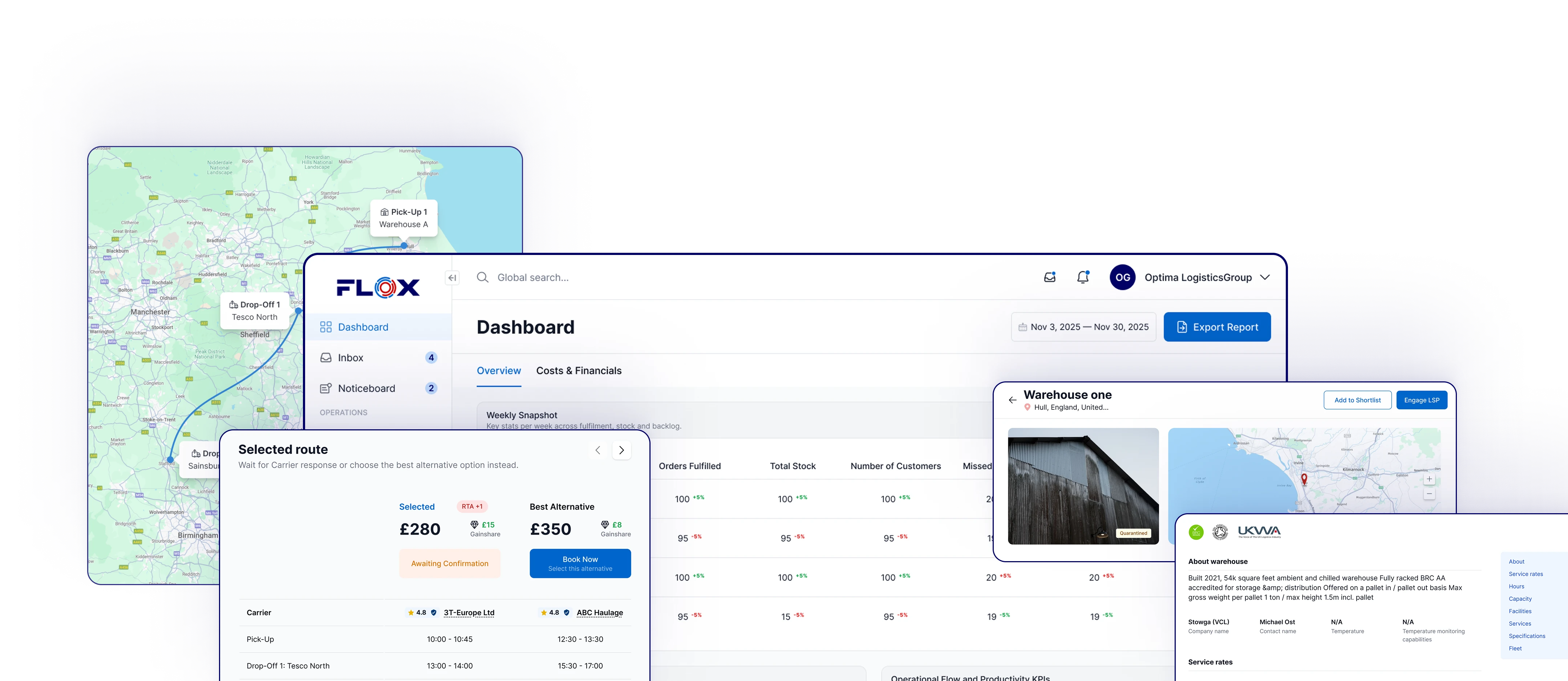
The cleanest implementation of on-demand warehousing in the UK now runs through marketplace platforms that connect many warehouse providers with many buyers, with an orchestration layer above. The marketplace makes capacity visible and bookable without a bilateral procurement process for each provider. The orchestration layer holds the integration, visibility and financial flows above the individual sites, so the buyer's operating experience stays consistent even when stock sits across multiple providers.
This is the operating model FLOX is built around. For the on-demand category specifically, the marketplace plus orchestration approach solves three problems that bilateral on-demand relationships still struggle with. The first is comparability: the marketplace presents capacity options on consistent rate-card terms, so the buyer can compare on like-for-like rather than working through bespoke quotes. The second is switching cost: with the orchestration layer holding the data and the integration, switching one underlying provider does not require rebuilding the buyer's reporting or systems. The third is scale: a single on-demand provider can offer flexibility within their own footprint, but only a marketplace can offer flexibility across the broader UK warehouse network.
The honest summary is that on-demand warehousing has become a genuine category, not a marketing label, and that the marketplace plus orchestration layer is what turned it from a niche option into a mainstream operating model. For buyers with seasonal, growing or geographically variable volume profiles, it is now the default starting position. For buyers running deeply specialist or steady-state operations, a traditional contract usually still wins. The skill is in matching the model to the volume profile honestly, and revisiting that match as the business changes.

Explore storage and fulfilment solutions that give your business flexibility and the support it needs to grow.
Subscribe to our newsletter.
Stay up to date with practical insights and useful logistics content
FAQs
It is a commercial model in which the buyer pays for the warehouse space and handling they actually use, rather than committing to a fixed amount of space for a fixed term. The provider holds the building, the racking, the WMS and the operational team; the buyer holds the stock and the data. Storage is priced per pallet (or per cubic foot) per month, with picking and packing charged per movement. Notice periods are typically 30 days, and the buyer can scale up, scale down or leave without major exit costs.