Table of Contents
GXO's latest Future of Transport report paints a fairly stark picture of UK transport operations. Costs are rising, investment is increasing and technology is becoming more sophisticated, yet inefficiency remains stubbornly embedded.
The headline numbers certainly grab attention. 89% of respondents expect logistics operating costs to increase over the next 12 months. 41% report increased costs as a result of operational inefficiencies and 33% say they have lost customers or market share because of them. At the same time, 85% have increased investment in fleet optimisation.
That creates an interesting question. If businesses are investing more heavily in transport optimisation, why are the consequences of inefficiency getting worse?
From our work across supply chains and logistics operations, we think the answer is that transport optimisation is too often treated as a technology problem when it is really an end-to-end supply chain problem.
Transport inefficiency can start anywhere in the supply chain
It is easy to look at a transport operation and focus on obvious measures such as vehicle fill, empty mileage, driver productivity and route efficiency.
They are important, but they are often symptoms rather than causes.
A poorly utilised vehicle may have been created by an inefficient warehouse schedule. An unnecessary delivery may originate in a customer's ordering behaviour. Excess mileage can result from an outdated network design. Extended waiting time may be caused by poor coordination between production, warehousing and transport.
As we explore in our guide to choosing the right UK warehouse location, where facilities sit within the wider supply chain can have a significant impact on transport distances and costs. Even the best routing system cannot optimise away fundamentally poor planning.
This is why we strongly agree with GXO's conclusion that organisations need to move away from isolated optimisation initiatives towards a coordinated, end-to-end approach.
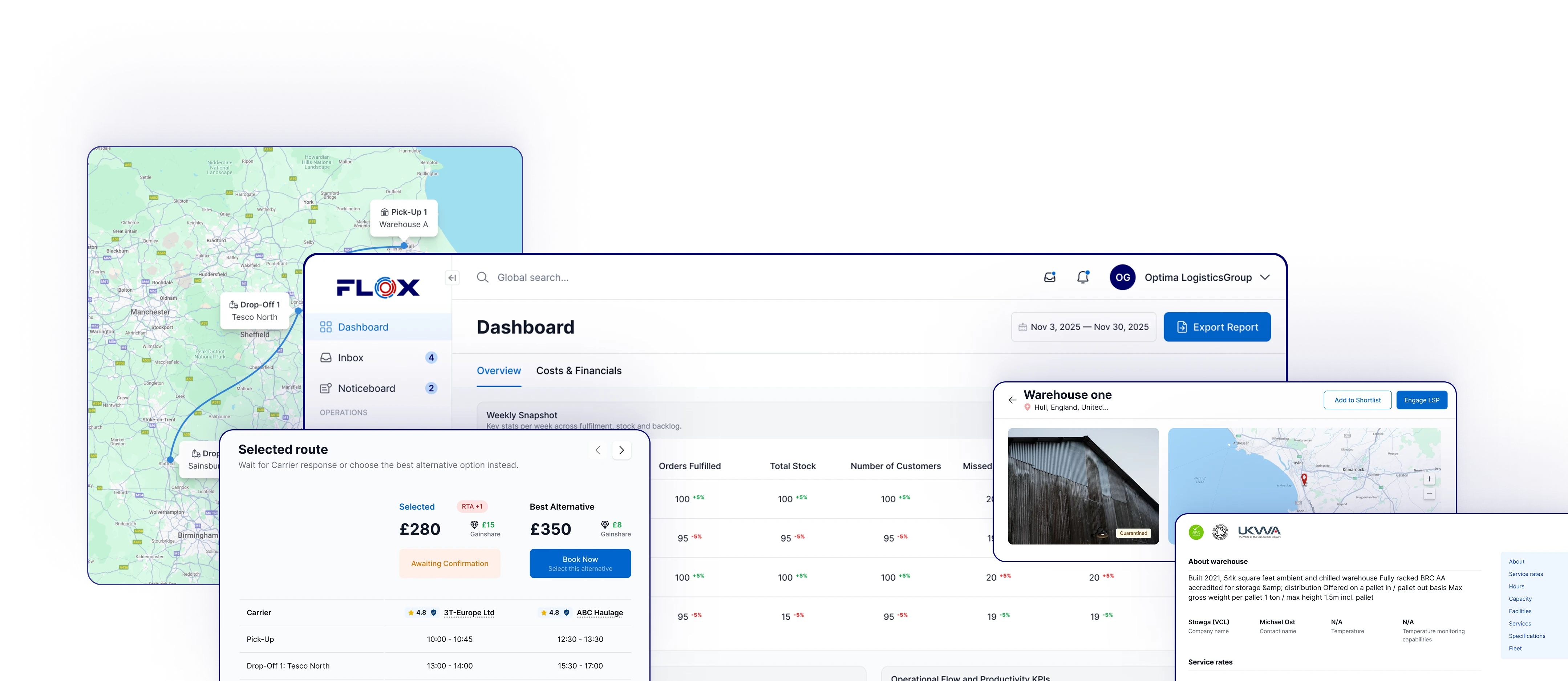
FLOX's approach to logistics orchestration shows how connecting transport demand, capacity and providers across a wider network can create opportunities that isolated optimisation can miss.
The report notes that organisations are investing in routing tools, fleet upgrades and driver performance initiatives but are not always seeing consistent or measurable returns.
Our experience suggests businesses need to go one stage further.
Before asking "How do we optimise our transport?", ask "Why are we creating these transport movements in the first place?"
Start transport optimisation with supply chain network design
Transport costs are ultimately generated by the design and behaviour of the wider supply chain.
Where are the warehouses? Where are suppliers and customers? How frequently are customers ordering? What service levels are being promised? What delivery windows have been agreed? How much inventory is positioned in each location?
These decisions determine a significant proportion of the transport requirement before a planner ever starts building a route.
Network design therefore remains one of the biggest opportunities available to businesses.
We regularly find supply chain networks that have evolved incrementally over many years. New customers have been added, acquisitions made, warehouses opened and service levels changed. Each decision may have made sense individually, but the resulting network is rarely optimal.
Transport optimisation needs to begin at this strategic level.
“The biggest barrier to that 30% is collaboration within the industry. It's not the technology.”
Richard Smith, Managing Director of the Road Haulage Association

Use cost-to-serve analysis to uncover transport costs
Another important point in GXO's research is the need to connect operational improvement with financial outcomes.
We strongly support this.
Too many businesses understand their total transport spend without properly understanding what is driving it.
A customer generating £1 million of revenue is not necessarily more valuable than one generating £500,000. If they order frequently, require small drops, demand narrow delivery windows and regularly request expedited deliveries, the cost of serving them can be dramatically different.
The same applies to products, channels and geographies.
A robust cost-to-serve model makes these differences visible.
It allows businesses to move the transport conversation beyond simply negotiating another percentage point from a haulier and towards more fundamental questions about minimum order quantities, delivery frequency, customer service policies, consolidation and network design.
That can create substantially greater value.
Make logistics technology part of your transport optimisation strategy
The report makes a strong case for optimisation technology and real-time visibility. FLOX's end-to-end supply chain visibility helps businesses connect data across their wider operations, providing a clearer view of performance and where inefficiencies are occurring.
44% of respondents identify technology integration as a barrier to transformation, while organisations without effective optimisation technology report consequences including higher maintenance costs, longer delivery times and increased CO₂ emissions.
Modern transport technology unquestionably creates opportunities that simply did not exist a decade ago.
Better TMS platforms, control towers, telematics, dynamic routing and increasingly AI can process enormous amounts of operational information and respond far faster than traditional manual planning.
But buying technology alone does not create an optimised operation.
Automating a poor process simply produces the wrong answer more efficiently.
The sequence matters.
Understand the operation. Establish the baseline. Identify the sources of inefficiency. Redesign where necessary. Then determine where technology adds value.
That also creates a much stronger investment case because the expected benefit can be measured against a genuine baseline rather than a theoretical business case.


Chris Clowes
COO of FLOX
Chain Reaction Podcasts
The Real State of Logistics, Looking Beyond the Headlines
Headlines say logistics is recovering. The data tells a different story — stable volumes, compressed margins, and an industry quietly deciding its next move.
Unlock transport efficiency through supply chain collaboration
Perhaps one of the most interesting statistics in the report is that 86% of respondents now believe collaboration is key to the future of logistics, up from 65% in 2024.
We agree, although genuine collaboration remains much easier to discuss than implement. As we've explored in our article on logistics collaboration and sustainability, there is enormous theoretical capacity within UK transport networks. Vehicles travel partially loaded, return empty or pass other vehicles performing complementary journeys every day.
Shared-user networks, backhauling and collaboration between suppliers, retailers and logistics providers can unlock some of that capacity. However, as we explain in our article on why traditional backhauling and reverse loads are outdated,there is an opportunity to think more broadly. That's why FLOX's approach to load matching looks across the wider transport network to identify opportunities to consolidate compatible journeys.
The challenge is commercial as much as operational.
Who owns the saving? Who carries the service risk? How is information shared? What happens when volumes change?
Successful collaboration therefore requires governance and commercial models alongside technology.
The GXO case study in the report illustrates the potential. Through an integrated logistics network, increased double-deck utilisation and supplier collaboration, GXO reports eliminating more than 4.7 million road kilometres and 4.3 million kg of CO₂e.
Those are significant efficiencies, but importantly they come from redesigning and combining flows, not simply making individual vehicles marginally more efficient.
Build a more efficient and resilient transport operating model
For us, the central message from the research is not that businesses need more technology.
It is that they need greater control over their transport operations.
Too many logistics teams spend their time reacting: finding a vehicle, solving today's capacity problem, expediting an urgent order or explaining yesterday's failed delivery.
Technology can certainly help break that cycle, but sustainable improvement requires a structured approach.
Understand the network and demand. Establish a reliable operational and financial baseline. Identify where cost and inefficiency are actually being generated. Challenge the operating model. Then use technology, collaboration and optimisation to address the right problems.
With transport costs expected to continue rising, simply asking carriers to work harder or cheaper is unlikely to provide the answer.
The organisations that perform best will be those that understand why they are creating transport cost in the first place and systematically design it out.
That is where we believe the next major wave of transport productivity will come from.
If you're looking to understand where transport inefficiency is really coming from and where the biggest opportunities for improvement lie, book a demo and get a more connected view of your transport operation.

Move products with greater speed and control by picking services that fit your route, timing and delivery needs.
Subscribe to our newsletter.
Stay up to date with practical insights and useful logistics content
FAQs
Transport optimisation is often treated as a technology problem when the causes sit across the wider supply chain. GXO's Future of Transport report found that 85% of respondents have increased investment in fleet optimisation. Yet 41% still report higher costs as a result of operational inefficiencies.