

Table of Contents
The UK food industry moves at a pace that most sectors never have to match. Every day, millions of deliveries leave farms, factories and distribution centres — chilled, frozen, ambient — bound for supermarkets, restaurants, convenience stores and doorsteps. The margin for error is measured in hours, not days. Spoilage is costly; a missed delivery window can empty a shelf by lunchtime. At the centre of all of it is logistics: the decisions, infrastructure and expertise that keep food safe, fresh and available.
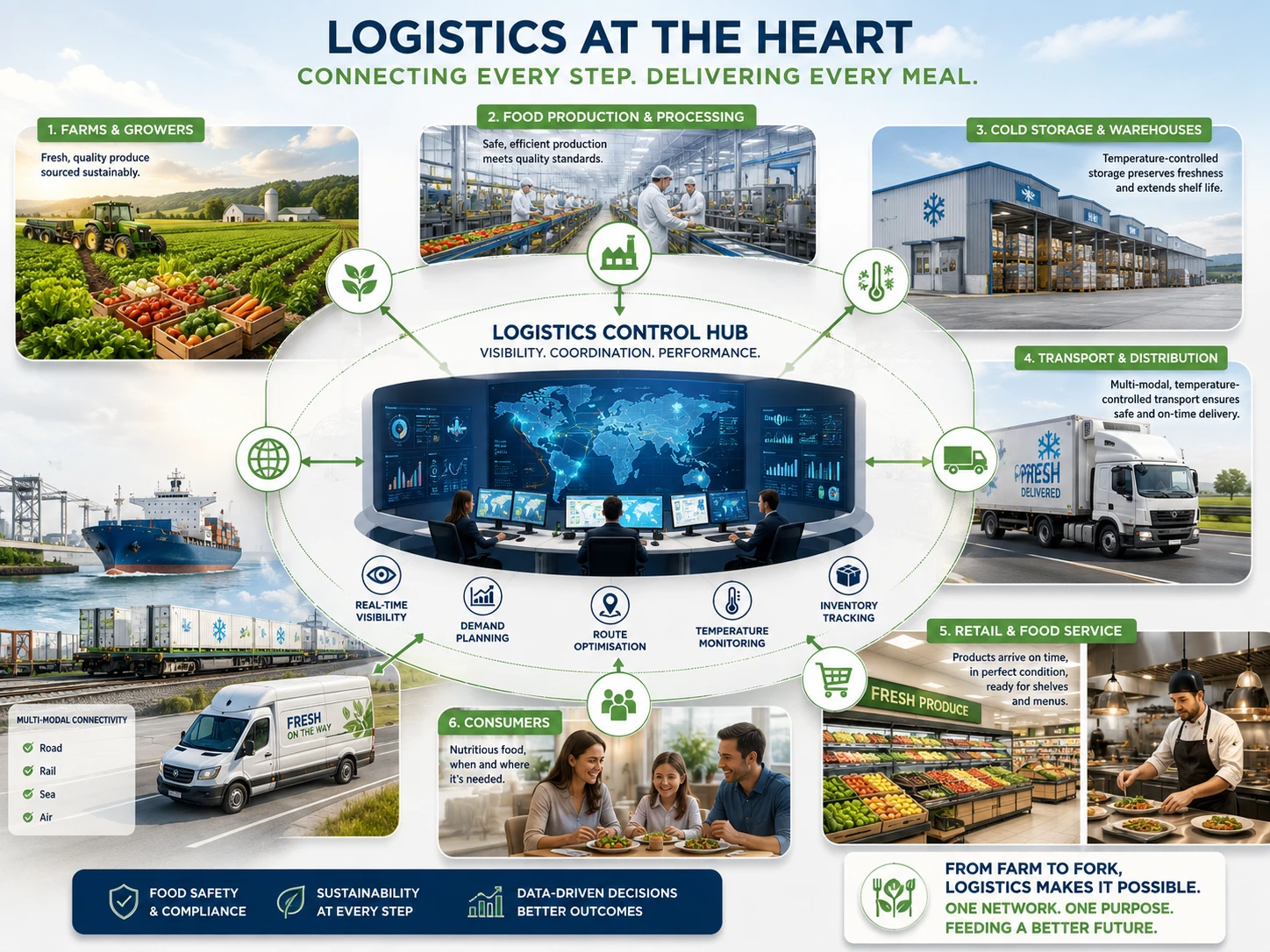
Food logistics is not simply a version of general logistics with a few extra rules. It is a fundamentally different discipline — one where temperature, time, compliance and traceability intersect on every consignment. Understanding why logistics is the beating heart of the food supply chain means understanding what breaks down when any one of those factors fails.
Why Food Logistics Differs from General Logistics
General logistics deals with products that can wait. A consignment of electronics or clothing tolerates delays, rerouting and consolidation without losing value. Food cannot. From the moment produce leaves a farm or a processing facility, a countdown begins. Every extra hour in transit, every temperature excursion, every delay at a loading bay shortens shelf life and raises the risk of waste or, worse, a food safety incident.
The UK wastes approximately 9.5 million tonnes of food per year, with a significant proportion occurring in the supply chain before food even reaches the consumer. Poor logistics decisions — wrong storage temperatures, missed collection windows, suboptimal routing — contribute directly to that figure. The commercial and reputational consequences of a cold chain failure extend far beyond a single wasted pallet.
Food logistics also operates under a level of regulatory scrutiny that most industries do not face. The Food Safety Act, temperature control regulations and traceability requirements under the Food Traceability Regulation mean that every link in the chain must be documented, auditable and compliant. This is not optional overhead — it is the baseline.
Cold Chain and Temperature Control
The cold chain is the most technically demanding element of food logistics. It refers to the unbroken sequence of temperature-controlled environments that perishable products move through from production to consumption. Break that chain — even briefly — and the consequences range from accelerated spoilage to bacterial growth that renders a product unsafe.
In the UK, chilled food must be kept below 8°C, with many products requiring tighter tolerances between 0°C and 5°C. Frozen goods must remain at or below -18°C. Maintaining these conditions through warehouse storage, vehicle loading, transit and delivery requires precise coordination between facilities, equipment and people.
Temperature-controlled warehouse space costs 30–40% more to build and operate than ambient equivalents, and it remains undersupplied across the UK. That shortage creates pressure on operators to make the most of available capacity — which in turn raises the importance of efficient scheduling, load optimisation and accurate demand forecasting. A warehouse that runs warm because it is overloaded, or one that wastes energy cooling near-empty racks, is failing at the core of its function.
Monitoring technology has advanced considerably. IoT sensors now provide real-time temperature data across vehicles and facilities. But technology only works when processes are built around it. Alerts mean nothing without trained staff who know how to act on them, escalation procedures that move quickly and carrier agreements that include clear temperature breach protocols.
“Today’s logistics manager has almost become a stockbroker — guessing when they should buy”
Chris Clowes, COO of FLOX

Transportation and the Last Mile
Moving food from a distribution centre to its destination is where many supply chains either excel or unravel. The UK's road network carries the vast majority of food freight — over 80% of all food transport miles are by road. That dependence on road haulage makes the sector acutely sensitive to driver shortages, fuel costs and traffic disruption.
Refrigerated transport adds further complexity. Reefer vehicles are expensive to run, require specialist maintenance and consume significantly more fuel than ambient equivalents due to the cooling units. Operators must balance load fill rates against the need for temperature segregation when carrying mixed loads — chilled and ambient goods on the same vehicle require careful management to avoid cross-contamination and temperature creep.
The growth of direct-to-consumer food delivery has extended the cold chain all the way to the doorstep, adding a layer of complexity that traditional logistics models were not designed to handle. Delivering a chilled grocery order to a residential address between 7pm and 9pm, with a narrow delivery window and no guarantee the customer will be home, is a very different challenge from delivering a full pallet to a retail distribution centre.
Urban logistics compounds these pressures. Many UK city centres have restricted access for HGVs, low-emission zones that older reefer vehicles cannot enter and limited unloading space. The solution for many operators is consolidation — using city-edge depots to break bulk into smaller, cleaner vehicles for final delivery. This adds a handling step and a cost, but it is increasingly unavoidable as urban food retail density grows.
UK Food Logistics Infrastructure
The UK's food logistics network is built around a handful of major distribution corridors. The Midlands Golden Triangle — centred on Northampton, Coventry and Leicester — provides national reach to around 90% of the UK population within a four-hour drive. It is home to some of the largest food distribution operations in the country, including facilities for major supermarket chains and third-party logistics providers.
Port proximity matters significantly for imported food. The UK imports roughly 46% of its food, with a large proportion arriving through Felixstowe, Dover and Southampton. Chilled and frozen imports require cold store facilities close to ports to avoid temperature chain interruptions during customs clearance — a process that can take hours and, in periods of high volume or port disruption, considerably longer.
The Grimsby and Humber region has developed as a specialist hub for chilled and frozen food, particularly seafood and imported protein. Its concentration of cold store capacity, proximity to fishing ports and road connections to major population centres make it an efficient location for certain product categories. Similar specialisation exists in the South West for fresh produce, and in Scotland for salmon and dairy.
For food businesses choosing warehouse locations, infrastructure fit is a strategic decision, not just an operational one. Being one junction further from the motorway network, or sited in a region with limited cold store availability, cascades into higher transport costs, longer lead times and reduced flexibility.


Neil Powell
Founder & MD of The NX Group
Chain Reaction Podcasts
Secure Logistics, Trusted Partnerships
Trust in logistics is easy to promise and hard to prove. Neil built a niche 3PL on one principle: security starts with people, not technology.
Regulations and Compliance
Food logistics in the UK operates within a dense regulatory framework. The Food Safety Act 1990 establishes the core legal obligations for businesses handling food. The Food Hygiene Regulations 2006 set out specific requirements for temperature control, vehicle hygiene and staff training. Traceability obligations mean that every business in the food chain must be able to identify where food came from and where it went — one step back and one step forward — within hours of a request.
HACCP (Hazard Analysis and Critical Control Points) is the internationally recognised methodology for managing food safety risks. For logistics operators, applying HACCP means identifying the points in the supply chain where contamination or temperature failure could occur, setting controls for each, and maintaining records that demonstrate compliance. This is not a one-time exercise — it is an ongoing operational commitment.
Certification schemes add another layer. BRC Global Standards for Storage and Distribution, ISO 22000 and SALSA are among the accreditations that food manufacturers and retailers require from their logistics partners. These schemes are audited annually and require documented procedures, trained staff and consistent performance across the operation.
Brexit added new complexity for imports. Products arriving from the EU now face sanitary and phytosanitary checks at the border, with chilled and fresh products subject to additional documentation requirements. The administrative burden, and the risk of delays at ports, has made reliable import logistics more operationally demanding than it was before 2021.
Building Supply Chain Resilience
The food supply chain has faced sustained pressure over the past several years — from the disruption of the pandemic, through the driver shortage crisis of 2021, to the energy cost spike of 2022 and ongoing port congestion. Each event has exposed different vulnerabilities in how food moves through the UK supply chain.
Resilience in food logistics is not a single capability — it is a combination of factors. Stock buffering at critical points in the chain provides time when distribution is disrupted. Diversified carrier relationships prevent over-reliance on a single haulier. Flexible warehouse agreements that allow capacity to be scaled up during demand peaks reduce the risk of fulfilment failure. Real-time visibility across the supply chain enables faster decision-making when something goes wrong.
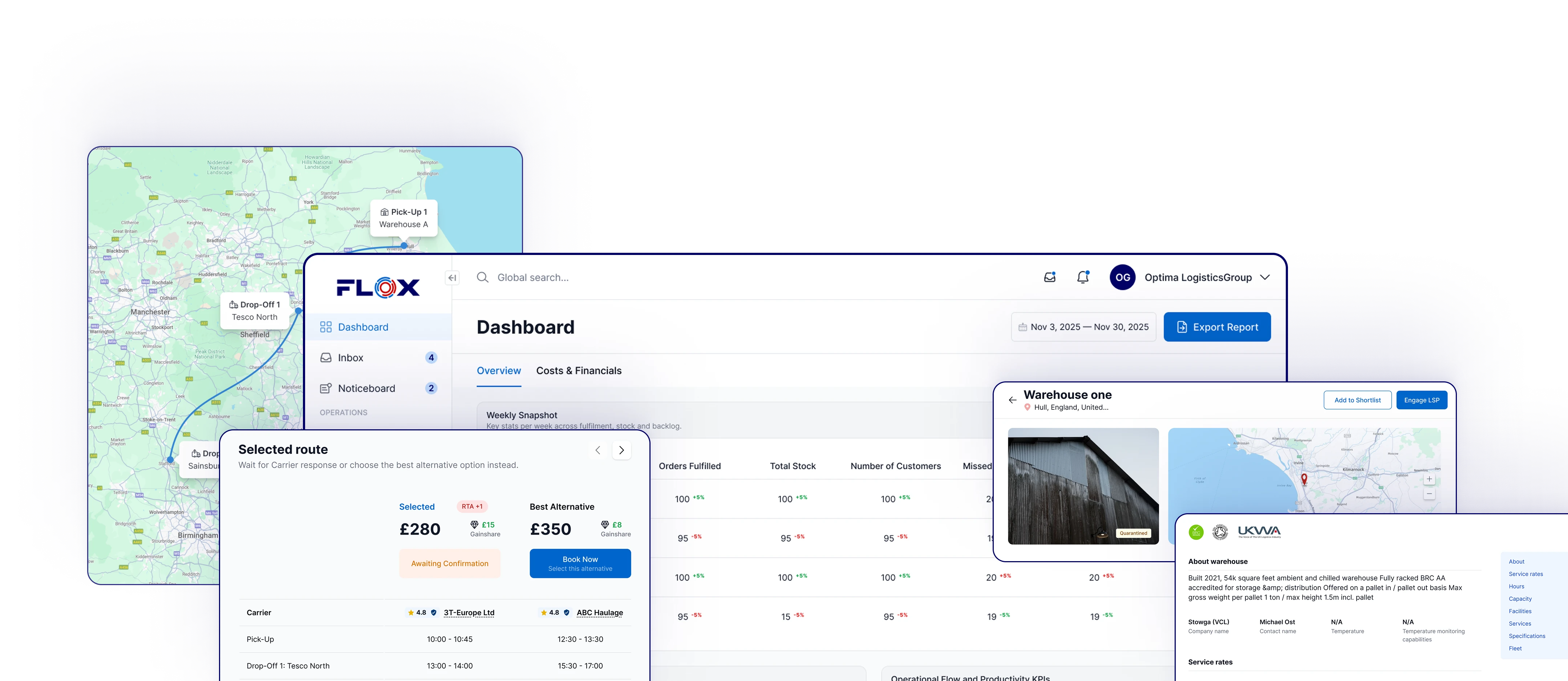
Collaboration is increasingly central to resilience. Sharing capacity, data and demand forecasts across supply chain partners reduces waste and improves response times. Logistics platforms that connect buyers and sellers of warehousing and transport capacity make it easier to find and activate contingency options quickly, without having to manage a complex web of bilateral relationships manually.

Explore storage and fulfilment solutions that give your business flexibility and the support it needs to grow.
The Future of Food Logistics
Several forces are reshaping food logistics over the coming decade. Automation is advancing rapidly in warehousing — robotic picking systems, automated storage and retrieval, and AI-driven demand forecasting are moving from pilot to mainstream. For food, the challenge is adapting these technologies to the variable packaging, weights and temperatures that characterise food products, where ambient warehousing automation has moved faster.
Sustainability is shifting from a reporting obligation to an operational imperative. Refrigerant regulations are tightening, pushing operators towards lower-GWP alternatives. Electric refrigerated vehicles are becoming commercially viable for urban distribution, and the pressure on operators to reduce scope 3 emissions is growing from both regulators and large food retailers with net-zero commitments.
Data will increasingly define competitive advantage. Businesses that can see their entire supply chain in real time — temperature, location, dwell time, utilisation — will make better decisions faster. Those still relying on phone calls and spreadsheets to manage chilled distribution will find the gap between them and more connected competitors widening with each passing year.
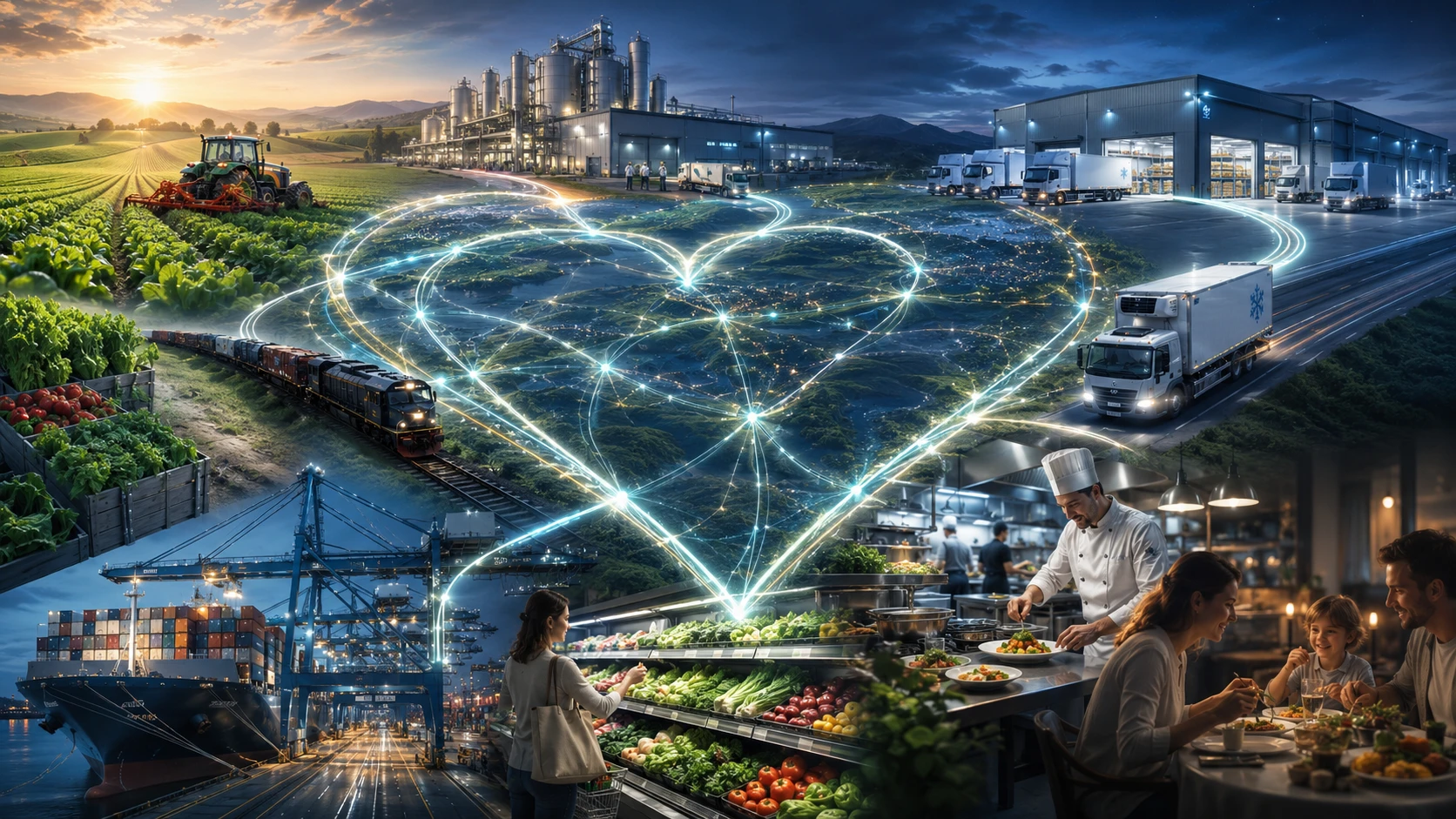
Logistics is the beating heart of the food supply chain because everything else depends on it. Growers produce, factories process, retailers sell — but none of it reaches the consumer without a cold chain that works, vehicles that arrive on time and a logistics network that can absorb disruption without letting food spoil. Getting that right is not a support function. It is the core of the business.
Collaboration Across the Chain
Food supply chains involve many participants — growers, processors, packers, distributors, logistics providers and retailers — each with their own systems, incentives and constraints. Where those participants operate in silos, inefficiency compounds. Where they share information and coordinate planning, the whole chain performs better.
Forecasting is a primary example. A retailer with accurate demand data can share it upstream with their logistics provider, who can then plan vehicle routing and load scheduling more efficiently. A manufacturer who knows when a retailer's DC will be available for delivery can optimise production scheduling. These improvements are straightforward in theory but require trust, data sharing agreements and compatible technology in practice.
The UK food industry has made progress on collaboration, particularly within large retailer supply chains where the commercial leverage to mandate data sharing exists. But for smaller brands and independent logistics providers, fragmented systems and legacy ways of working remain barriers. The businesses that invest in collaborative logistics relationships — and in the technology that enables them — are building a structural advantage that compounds over time.
Subscribe to our newsletter.
Stay up to date with practical insights and useful logistics content
FAQs
Food logistics is fundamentally different because perishable products have a time limit from the moment they leave production. Temperature control, food safety compliance, traceability obligations and strict delivery windows create a set of operational demands that do not apply to most other product categories. A delay that is a minor inconvenience in general logistics can result in spoilage, a food safety incident or a regulatory breach in food supply chains.