How FLOX Works



Table of Contents
AI adoption in logistics ROI is poor and the gap between expectation and reality is not closing. Only a small fraction of logistics firms report meaningful returns from AI investment and that pattern has held for several years despite growing spend. The default explanation is that logistics is a laggard industry, too fragmented, too operationally complex, too resistant to change. That explanation is wrong. The real problem is that most AI projects are designed to impress a board rather than fix a shift.
For 3PL and general warehousing operators, the stakes are immediate. Utilisation rates, OTIF performance, seasonal capacity planning, labour allocation across a multi-bay facility: these are measurable, daily problems. An AI project that addresses none of them directly is not a strategic investment. It is deferred cost with a technology label. The operators actually seeing returns are not running transformation programmes. They are automating one thing, measuring it and moving on.
Key takeaways
• Most AI projects in logistics fail because they are scoped as strategy exercises rather than fixes to specific, measurable operational problems.
• Narrow AI use cases in logistics, such as slot optimisation, inbound scheduling and labour demand forecasting, deliver faster ROI than broad platform deployments.
• 3PL warehouse utilisation rates improve most reliably when AI is applied to a single constraint first, not to the whole operation simultaneously.
• Freight AI implementation succeeds when it changes a decision that was previously made manually or not made at all, not when it replaces a system that was already working.
• Multi-party logistics orchestration creates the conditions for AI to function: shared data, agreed handoffs and visible exceptions that the technology can actually act on.

Why do most AI projects in logistics fail to deliver ROI?
Most AI projects in logistics fail because the scope is set at the wrong level. A project brief that reads 'improve supply chain visibility' or 'optimise network performance' has no natural finish line, no single owner and no operational moment where success or failure becomes obvious. When the brief is that wide, the project drifts into dashboard building, data governance work and stakeholder alignment. None of that changes what happens on the dock at 06:00.
Freight AI implementation fails at the point where abstraction meets operations. The technology may be sound. The data integration may be complete. But if the output does not change a specific decision, it does not change anything. A model that produces a utilisation forecast that the warehouse manager ignores because it conflicts with a long-standing customer commitment has not delivered ROI. It has delivered a number that goes unread.
The second failure mode is organisational. Logistics operations run on tight margins, fast handoffs and people who solve exceptions quickly from experience. Deploying AI into that environment as a top-down platform implementation asks experienced operators to change their decision-making process before they have any evidence the new process is better. Resistance is rational. The technology gets bypassed or it gets used selectively in ways that never appear in the business case.
The projects that work start with a different question: not 'how do we apply AI to our operation' but 'which specific decision is made badly, repeatedly and what does it cost us.' That reframe changes everything about how the project is scoped, who owns it and how fast it returns value.
What narrow AI use cases in logistics actually look like
Narrow AI use cases in logistics are defined by their specificity: one input, one output, one decision improved. That is not a limitation. It is exactly what makes them deployable without a transformation programme.
Inbound scheduling and slot management
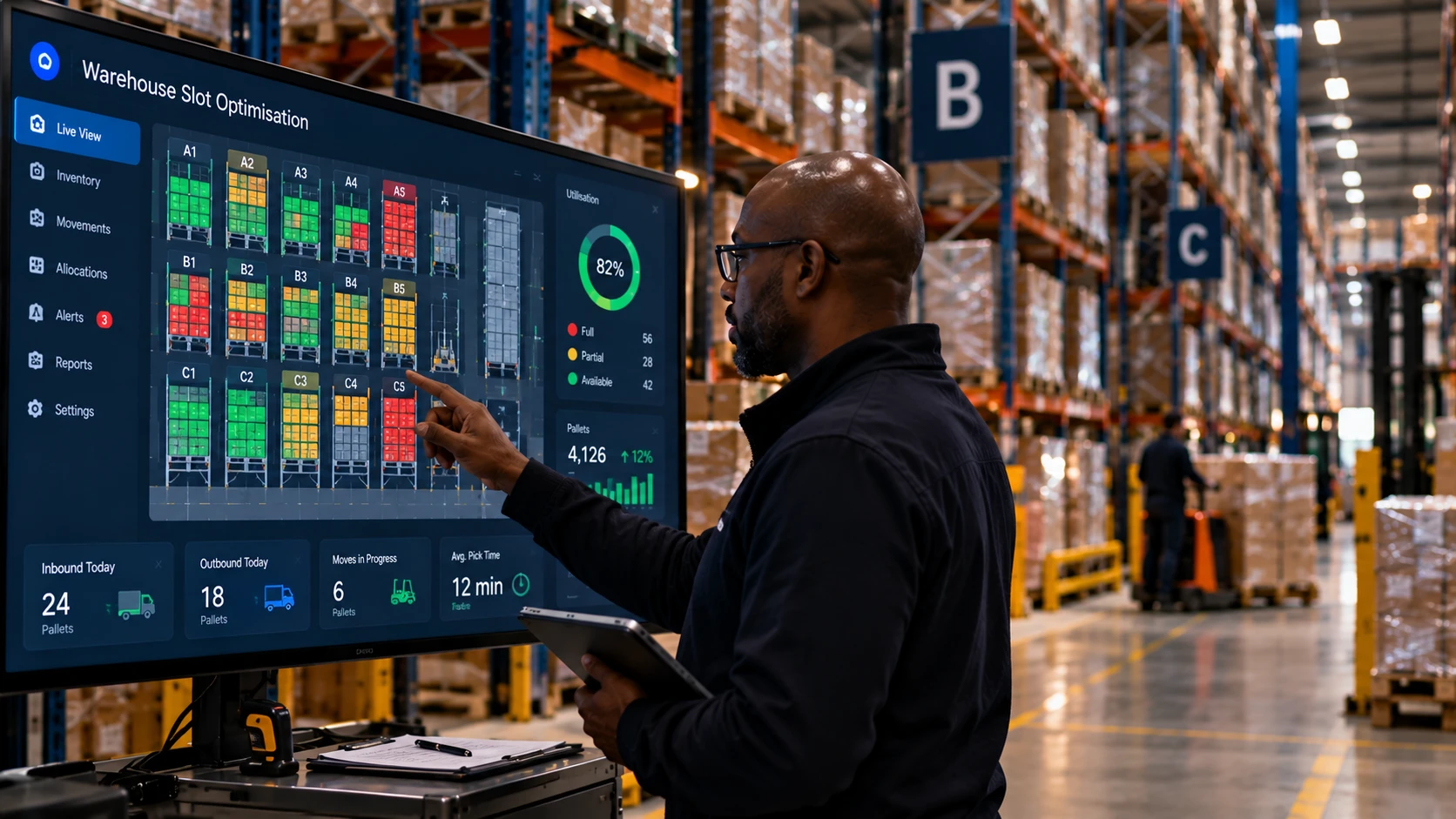
For a general 3PL facility, inbound vehicle scheduling is a chronic source of waste. Arrivals cluster at the same slots because customers book on habit, not on actual dock availability. Labour is either standing idle or overwhelmed depending on the hour. A narrow AI model that predicts likely arrival patterns and recommends slot rebalancing does one thing: it smooths labour demand. The warehouse manager sees a revised schedule, agrees or adjusts it and runs the shift differently. That is a change in a decision. That is where ROI lives.
Labour demand forecasting for seasonal capacity
Seasonal capacity planning for 3PL operators is partly a commercial problem (filling the facility at the right price in Q4) and partly a labour problem (having the right headcount at the right cost when volume arrives). AI does not solve the commercial problem, but it can make the labour problem less expensive. A model trained on order intake patterns, lead times and historical volume curves can give a two-week forward signal on staffing requirements that is materially more accurate than a spreadsheet built on last year's actuals. That is warehousing automation ROI that shows up in the P&L as reduced agency spend.
“If you want a machine to help you here, you have to be able to codify the decision making process in such a way that a good decision becomes a natural outcome.”
Sean Culey, Director of Supply Chain at The MTC

SKU slotting optimisation
SKU slotting is another narrow, high-return use case. In a facility running mixed clients and variable SKU velocity, static slotting decisions made at onboarding degrade quickly. Fast-moving lines end up in awkward pick locations. Travel time increases. Pick rates drop. A slotting algorithm that re-ranks SKU positions against actual velocity data every week is not transformational. It is maintenance. But the productivity gain compounds over months and it requires no change to the WMS, no new hardware and no retraining of the picking team beyond a new bay allocation sheet.
The common thread across all three is that the AI is doing something the operator was already trying to do manually. It is not introducing a new process. It is making the existing process faster and less dependent on individual experience to get right. Understanding how technology investments actually shift supply chain operations in practice helps frame which of these use cases belongs first on the roadmap.
How can 3PL providers improve warehouse utilisation with AI?
3PL warehouse utilisation rates are the most direct measure of commercial performance for a general warehousing operator. Empty rack costs money. Underused dock hours cost money. Inefficient labour allocation costs money. AI improves utilisation most reliably when it is applied to the constraint that is actually causing the gap, rather than to the operation as a whole.
The starting point is identifying where utilisation loss is concentrated. For most general 3PL facilities, the answer is not a shortage of customers. It is a mismatch between when capacity is available and when customers want to use it. Customers cluster demand at predictable points in the month and at predictable times of year. The facility runs at 95% for two weeks and at 60% for the other two. AI does not fix that structural pattern, but it can make the operator more confident about offering variable-term capacity to fill the gaps, because the forward demand signal is clearer.
This is where multi-party logistics orchestration creates an advantage that single-operator AI cannot replicate. When a facility is part of a networked environment where demand signals from multiple buyers are visible, the AI has more signal to work with. Seasonal capacity planning for 3PL operators becomes less of a guess when the model can see enquiry patterns across a broader pool of potential customers, not just within the existing client base. The operator fills short-term slots with confidence rather than holding out for a long contract that may not materialise in time.
Utilisation gains from AI are not dramatic in isolation. They compound. A facility that improves average utilisation by a few percentage points through better slot management, labour forecasting and dynamic pricing of short-term capacity is running a materially better business over twelve months. The ROI is real, but it requires patience and accurate baseline measurement to see it clearly.


Sean Culey
Director of Supply Chain at MTC
Chain Reaction Podcasts
Chain Reaction ep 43: Your Supply Chain Problem Is Psychological
Anti-fragile supply chains do more than withstand disruption. They use stress, volatility and failure signals to improve. Firefighting, silos and poor decision models keep companies fragile despite better technology, visibility and automation.
What is the difference between AI strategy and AI deployment in logistics?
AI strategy in logistics is a document. AI deployment is a change in what an operator does on Tuesday morning. The gap between the two is where most budgets disappear.
Strategy exercises tend to produce architecture diagrams, vendor assessments and capability roadmaps. These are not worthless, but they are not the work. The work is choosing the first narrow use case, instrumenting the process well enough to measure before and after, running the model with a real operator on a real shift and deciding whether the output improved the decision. That sequence takes weeks, not quarters. It does not require a transformation office.
Freight AI implementation that starts with deployment rather than strategy looks different in practice. The brief is short. The owner is an operational manager, not a technology team. The success metric is defined before the project starts, in operational terms: dock idle time, agency labour hours, OTIF variance, pick errors per 1,000 SKUs. If the metric does not move, the model is wrong or the scope was wrong and that becomes clear quickly enough to change course without sunk cost at scale.
The strategic thinking still matters, but it belongs after the first deployment, not before. Once an operator has seen a narrow AI use case work on one constraint, the question of where to apply it next has a practical answer. The roadmap is built from evidence, not from a consultant's framework. The principles behind digital twin technology in logistics illustrate what it looks like when simulation and real operational data are connected properly and why that connection has to precede any claim about AI-driven decisions.
How do you scope an AI project for warehouse operations?
Scoping a warehouse AI project starts with a constraint, not a capability. The right opening question is: what is the most expensive recurring decision made with the least reliable information in this facility? That question has a specific answer in every operation. The answer is the scope.
Define the decision, not the technology
A scope that reads 'implement AI-driven labour management' is still too wide. A scope that reads 'reduce agency labour variance in weeks 48 to 52 by improving the two-week demand forecast' is a project. One has a metric, a time horizon and a named constraint. The technology choice follows from the problem definition, not the other way around.
Instrument before you model
The most common reason warehousing automation ROI fails to materialise is that the data needed to train and validate the model does not exist in clean form. Before any model is built, the process needs to be instrumented: arrival times logged, labour hours by bay recorded, pick rates by SKU tracked. This instrumentation phase is usually unglamorous and often reveals that the process itself is less consistent than the operation believed. That is useful information on its own.
Set the baseline and the threshold
Before go-live, agree what 'working' looks like in numerical terms. Not 'improved' but: agency hours in the target weeks fall by at least X or dock idle time drops below Y minutes per shift. If the threshold is not met after a defined period, the project is either extended with a specific change or stopped. A clear stop condition is as important as a success metric. It prevents a failing project from becoming a sunk cost that nobody wants to cancel.
Operators who want to understand where AI fits within a broader set of technology decisions that are actually reshaping logistics right now will find the considerations around autonomous freight and its effect on how operators position inventory a useful parallel for thinking about sequencing technology bets.
Filling capacity is the operator's real test
For a 3PL or general warehousing operator, AI adoption in logistics ROI ultimately proves itself at the utilisation line. Technology that does not help fill the facility more consistently, at better margin, across a wider range of contract lengths is not earning its place in the operation. Most of what is marketed as logistics AI does not meet that standard because it is designed to be impressive rather than operational.
The operators building genuine advantage are doing the opposite. They are picking one problem, scoping it tightly, deploying something that works on a real shift and building from there. They are also placing their capacity where demand can find it, not waiting for inbound calls from existing relationships to fill seasonal gaps.
That is exactly the dynamic that multi-party logistics orchestration addresses. When a 3PL lists capacity on a platform where buyers are actively looking for short-term, flexible and specialist warehousing, the AI use cases described above start paying for themselves faster because the facility runs fuller. The technology is not separate from the commercial model. It supports it. Listing capacity on FLOX and joining the provider network is the practical next step for operators who want the volume to make narrow AI investments worth running.

Explore storage and fulfilment solutions that give your business flexibility and the support it needs to grow.
Subscribe to our newsletter.
Stay up to date with practical insights and useful logistics content
FAQs
Most logistics AI projects fail because they are scoped as strategy exercises rather than fixes to specific operational problems. When the output does not change a particular decision made on a particular shift, the technology produces no measurable return regardless of how sophisticated the underlying model is.