


The UK logistics sector has been through several difficult years. Insolvency data, M&A activity and the disappearance of household names from the market all tell the same story: operating a logistics business has become structurally harder, and not every operator is making it through.
The "survival of the fittest" framing is uncomfortable but accurate. In an evolutionary sense, fitness does not mean largest or most aggressive. It means best adapted to a particular environment. The businesses that have kept running through high fuel costs, driver shortages, wage inflation and softening freight demand tend to share specific characteristics. The ones that have not tend to share a different set.
This piece examines three of those characteristics in detail: financial resilience, capacity flexibility and technology adoption. None of them is a surprise. But understanding the mechanism behind each reveals something more useful than a checklist of things to do.
What the businesses that failed had in common
Several high-profile haulage and logistics collapses in recent years share a recognisable pattern. A business grows quickly during a strong demand period, takes on fixed costs, extends its asset base and builds a cost structure that makes sense at high volume and high rates. When conditions change, the margin cushion disappears and the business runs out of options faster than anyone expected.
The common thread is not incompetence. Most of the operators who went under were run by experienced people who knew their markets well. The common thread is structural fragility: a cost base with limited variable components, a customer base concentrated in too few contracts, working capital stretched thin and limited access to short-term funding when things went wrong.
Financial fragility is particularly dangerous in logistics because the sector operates on thin margins under normal conditions. When something external shifts, whether fuel prices, interest rates or the demand cycle, there is little room to absorb the shock. Operators who survived recent pressures tend to have kept more of a financial buffer than seemed necessary when conditions were good. That choice, which looked conservative at the time, proved to be the right one.
A second pattern is customer concentration. Operators running on two or three large contracts have very limited commercial flexibility if one of those customers reduces volume, renegotiates rates or fails. Businesses with a broader, more distributed customer base lose more individually when things shift but face fewer existential moments. Diversification is slow and sometimes uncomfortable to pursue when a single large contract is easy revenue. Its absence is felt sharply in a downturn.
“It’s about data. You measure how long does it take to pre-pack a gift, how long does it take to dispatch a gift. And you try and optimise that.”
Johannes Kloess, Head of Operations at Thortful

Financial buffers and why operators underestimate them
Margins in UK road haulage have historically been thin. The Road Haulage Association has reported average operating margins in the sector sitting in low single digits for many years. At those levels, a modest cost shock can move a business from profitable to loss-making quickly. An unexpected fuel price spike, a major vehicle repair bill or a key customer entering administration can all do it.
The operators who have weathered recent shocks tend to have two characteristics that struggling businesses lack. First, a genuine cash reserve rather than a credit facility. Credit can be withdrawn precisely when you need it most. Cash on the balance sheet is unambiguous. Second, a cost base with meaningful variable components. Operators who lease flexible capacity through third parties, use owner-drivers for overflow or have contracts structured with volume bands tend to have more room to manoeuvre when demand drops than those running a fully owned and fully fixed fleet.
This is not an argument against asset ownership. Owning assets can lower unit costs significantly in a sustained high-volume environment. The argument is about knowing what you are buying when you commit to a fixed cost base: efficiency at volume, and fragility when volume falls. Most operators understand this abstractly. Fewer build it into how they think about financial headroom on a day-to-day basis.
The businesses that have coped best in recent years held more cash than they thought they needed during the up-cycle and were conservative about fixed-cost commitments even when growth was strong. That looks like leaving money on the table when conditions are good. It looks different two years later. A rule of thumb used by resilient operators: hold at least 60 to 90 days of operating costs as liquid reserves before committing to significant additional fixed-cost assets.

Capacity flexibility as a deliberate strategy
Fixed asset ownership is not the only way to run a logistics operation. It has traditionally been the default in UK haulage and warehousing, partly because owned assets convey reliability to customers and partly because financing models have made acquisition accessible. But fixed assets create fixed costs, and fixed costs create fragility when demand shifts.
The logistics businesses showing the most operational resilience tend to run a deliberate mix of owned and accessed capacity. They own the assets required for predictable baseline demand. They access additional capacity through networks, sub-contractors and marketplaces when demand spikes or when customers need capabilities they have not built in-house. The flexibility this creates has real commercial value beyond just cost management.
This model requires more sophisticated coordination than simply deploying owned assets. It also requires relationships and access that need to be built well before you actually need them. An operator who only turns to the spot market or sub-contract network when already under pressure will find it harder and more expensive than one who has maintained those relationships continuously and used them regularly in normal conditions.
You can read more about how UK logistics capacity markets have been shifting in our piece on the current state of the UK logistics and 3PL sector. The warehousing side of the market has seen similar dynamics. Operators who offer flexible, shorter-term capacity through platforms find that demand smooths out more effectively across the year compared to those relying entirely on long-term contracted customers. The flexibility is a product feature for buyers, which means operators who offer it can often access a different segment of demand that purely fixed-cost operators cannot serve.
Backhaul and load-sharing networks are a simpler version of the same principle. An operator running empty on a return lane because they did not have access to available loads on that corridor is absorbing a cost that could have been avoided. The information to solve this has existed for years through load exchanges and networks. Operators who have built those connections into their regular operations run structurally lower empty-mile ratios than those who have not. Access to capacity markets is part of financial resilience, not just an operational convenience.


Malcolm Pope
Founder of Loguro
Chain Reaction Podcasts
Transform Logistics or Be Left Behind
Up to 30% of UK lorries run empty. Malcolm argues the logistics industry's biggest problem isn't technology — it's a stubborn refusal to collaborate.
Technology adoption: what the gap actually looks like
The technology divide in UK logistics is not primarily about automation or artificial intelligence. Most small and mid-sized operators are not debating warehouse robotics. The gap is more practical: whether a business has real-time visibility into its own operations and whether it can use that data to make decisions faster than competitors running on spreadsheets and phone calls.
The operational difference between those two approaches is significant. An operator running on manual processes finds out about inefficiencies retrospectively, at the end of the week or the end of the month. An operator running transport management software finds out in real time and can often correct problems before they reach the customer. That difference accumulates into a persistent cost and service gap over time.
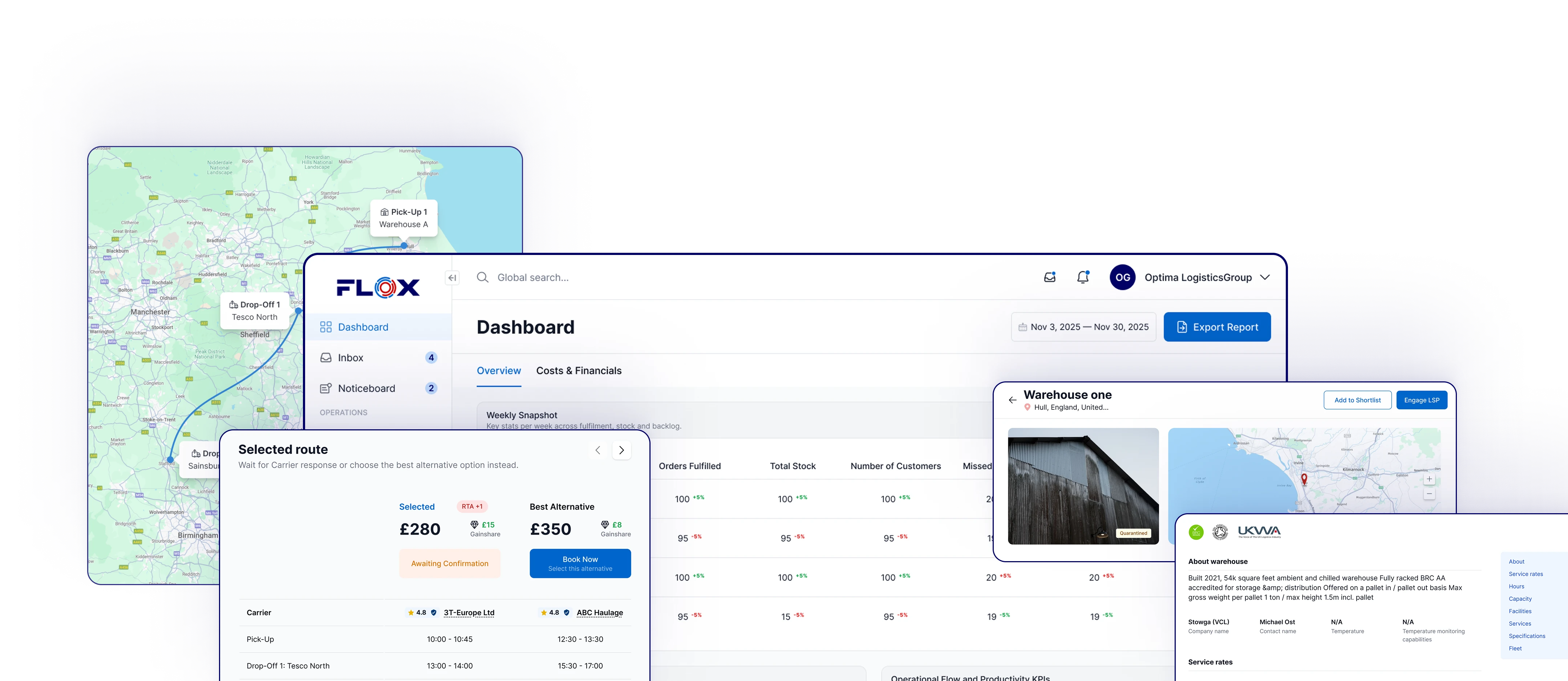
Route optimisation is a measurable example. Software that processes real-time traffic, delivery windows, vehicle capacity and available backhaul loads consistently outperforms manual planning on fuel costs and vehicle utilisation. The technology has been accessible to SME operators for years. The gap is adoption discipline, not access. Operators who have built the tools into their daily process rather than treating them as optional enhancements see the results in their cost per kilometre. You can find a detailed examination of why spreadsheet-based logistics management reaches its limits and what operators do next.
Customer-facing visibility is equally important from a commercial resilience perspective. Customers who can track shipments, receive automated delivery updates and raise issues through a structured digital channel are stickier than those who have to call or email for information. Building that capability is an investment, but the retention effect tends to pay it back relatively quickly. And in a competitive market where large customers have more options than they did previously, service differentiation through visibility has become a baseline expectation rather than a premium feature.
The hardest gap to close is management information. Many operators cannot quickly answer questions like which lanes are actually profitable after full cost allocation, which customers generate disproportionate support overhead or what their utilisation numbers look like week by week across the fleet. Businesses that have this information make better allocation and pricing decisions than those working from month-end reports. The broader application of AI and data analytics in supply chain operations is relevant here, not as a technology statement but as a practical management capability question.

Explore storage and fulfilment solutions that give your business flexibility and the support it needs to grow.
Building resilience before the pressure arrives
The pattern is consistent across different sizes and types of UK logistics business. The operators who navigated the difficult conditions of the past few years well had built their resilience during the good years, not in response to the crisis.
Financial discipline in an up-market feels conservative and possibly unnecessary. Maintaining a sub-contractor network costs time and relationship management when you have enough owned capacity to cover current demand. Investing in TMS or visibility tools when the existing process seems to be working is hard to justify as a standalone project. These decisions only look obviously correct in retrospect.
Resilience cannot be purchased quickly when conditions deteriorate. The financial cushion, the capacity relationships and the operational tools all take time to establish, and they work best when they have been tested before the pressure is on. An operator who tries to build their sub-contractor network during a capacity crunch or establish credit lines during a cash flow squeeze finds both harder and more expensive than they anticipated.
The UK logistics market will continue to consolidate. Operators that have built financial buffers, flexible capacity access and genuine operational visibility will be better positioned to absorb that consolidation, whether by surviving pressures that eliminate competitors or by acquiring businesses that could not adapt. Those without these characteristics face a narrowing set of options when the next shock arrives, and in a sector exposed to fuel price volatility, economic cycles and geopolitical disruption, the question is not whether another shock will come but when.
Darwin's framing, applied carefully, holds: it is not the strongest that survive, nor the fastest, but those most responsive to change. Building that responsiveness while conditions are manageable is what resilience actually looks like in practice.
Subscribe to our newsletter.
Stay up to date with practical insights and useful logistics content
FAQs
Most UK logistics failures share the same structural pattern: thin operating margins, high fixed costs and insufficient cash reserves. When conditions shift, whether through a fuel price spike, loss of a major customer or tightening credit, operators without a financial buffer run out of options quickly. Driver cost inflation and the post-pandemic demand correction added further pressure to businesses that had grown aggressively during strong years. The common factor is not poor management but structural fragility built up during a good period.