

Supply chain management is the coordination of everything that moves a product from raw material to end customer. It covers procurement, production scheduling, inventory management, warehousing, transport and the information flows that connect each stage. Most definitions make it sound straightforward. The 2020s demonstrated it is not.
The disruptions of the past few years exposed structural weaknesses that had been present for decades but invisible during stable conditions. Understanding what happened and why is useful context for operators making decisions about how to build supply chains that function under pressure. This piece covers the main lessons from the disruption period and the capabilities that matter most for operators today.
How the bullwhip effect exposed the limits of traditional supply chains
The bullwhip effect describes what happens when demand signal distortion amplifies at each tier of a supply chain. A small change in consumer demand becomes a larger change in retailer orders, a still larger change in distributor orders and an even larger swing in manufacturer or supplier orders. The effect is well understood in theory. Between 2020 and 2023, it played out at a scale that exposed how poorly most supply chains were positioned to absorb it.
In sea freight, the consequences were stark. Container shipping costs on the Asia-US route peaked at over $20,000 per FEU in September 2021, driven by a combination of Covid-related port closures, surging consumer demand following the 2020 lockdowns and limited vessel capacity to absorb the volume. By October 2022, the same route had fallen to approximately $2,720, near pre-Covid norms, as demand fell back and excess capacity came to market. Shippers who had locked in two- and three-year contracts at rates between $5,000 and $7,000 per FEU were left trying to exit those commitments as the spot market collapsed beneath them.
Road transport experienced parallel pressures. An ageing driver workforce, a recruitment pipeline that had not kept pace with retirements and post-Brexit departures from the UK driver market combined to create persistent capacity constraints. Wage inflation, fuel price rises and increasing regulatory burden on operators compounded the problem. The industry had been managing these pressures before the pandemic. The demand spikes of 2021 and 2022 made them acute. For more on how these workforce dynamics continue to affect logistics, see our piece on people in the supply chain.
In warehousing, the bullwhip effect hit last. Amazon announced in 2022 that it was looking to offload 10 to 30 million square feet of US warehouse space, as much as 15% of its US capacity, after over-extending during the demand spike. At the same time, UK availability of grade A warehouse space stood at roughly 24 million square feet, equivalent to two months of demand based on the previous three years. As James Short, a senior surveyor at Avison Young, noted at the time: "Availability of grade A space across the UK stands at 24 million sq ft, equating to only two months' worth of supply based on demand of the last three years." The same market was simultaneously over-supplied in some categories and critically constrained in others.
“One carrier is not going to give you everything you need in terms of types of services. And they’re not going to be equally good even if they did in all of those services.”
Bobbie Ttooulis, Group Marketing Director at GFS

Supply chain visibility: the operational baseline
Supply chain visibility means having a live, shared picture of what is happening at every stage of the chain. It covers the location and condition of inventory in transit, the status of orders at each supplier tier, the capacity position of key carriers and the financial flows between all parties. Without this baseline, every other supply chain improvement is operating on incomplete information.
The constraint has historically been integration. Most organisations have visibility within their own systems. The gap is across the network: between buyers and their suppliers, between shippers and their carriers, between warehouses and the dispatch systems feeding them. Closing that gap requires shared platforms rather than parallel reporting, and it requires all parties to operate from a consistent view of the same underlying data rather than reconciling differences after the fact.
IoT sensor deployment has extended visibility into previously opaque areas. Temperature-controlled goods in transit, high-value electronics in multi-leg shipments and pharmaceutical products subject to cold chain requirements can now be monitored continuously rather than tracked at handoff points. As sensor costs have fallen, the economic case for live monitoring has extended beyond regulated industries into general freight. The application of AI to supply chain data depends on the quality of the underlying visibility infrastructure. Predictive tools that anticipate disruption or optimise inventory positioning perform better when the data feeding them is live and complete rather than delayed or partial.
The gap between organisations running integrated visibility platforms and those still reconciling data manually across disconnected systems is widening. The cost of the latter shows up in excess safety stock, late exception management, slow response to disruption and the overhead of manual data reconciliation across every party in the chain.

Supply chain resilience: the three risk categories operators face
Supply chain resilience is the ability to prepare for, respond to and recover from disruption while maintaining continuity of operations. Building it requires understanding the categories of risk that threaten a supply chain, because the mitigations are different for each.
Disruption risks are the category most operators focus on after a crisis. Natural disasters, port closures, geopolitical events and pandemics all fall here. The common thread is that they are difficult to predict and hit multiple parts of the chain simultaneously. Effective preparation involves scenario planning and maintaining enough flexibility in the network to reroute when a primary path becomes unavailable. The operators who responded best to the 2020-2022 period were those who had already mapped their alternative options before they needed them. For practical approaches to building flexibility, see our guide to supply chain agility.
Supplier risks are where single-source dependency creates hidden fragility. Supplier insolvency, quality failures and delivery delays can cascade through the chain in ways that take weeks to surface and months to recover from. The standard mitigation is supplier diversification: maintaining relationships with alternative sources on key inputs, even at a cost premium, so that no single supplier failure creates a production stoppage. The 2020-2022 period exposed how many businesses had concentrated supplier relationships beyond what their risk assessment had acknowledged.
Transport risks have become more varied as the modes, routes and regulatory contexts of international supply chains have expanded. Fuel price volatility, driver shortages, regulatory changes and extreme weather events all affect transport availability and cost. Over-reliance on a single mode or a single carrier relationship concentrates the exposure. Resilient transport strategies typically combine multi-modal options, standing capacity agreements with key carriers and active monitoring of emerging constraints on key routes.


Stephen Holcomb
Director of Logistics at Refeyn
Chain Reaction Podcasts
Choose Partners, Not Just Providers
There's a world of difference between a logistics provider and a logistics partner. Stephen explains what he looks for — and why most companies get the distinction wrong.
Supply chain partners: how collaboration affects performance
A supply chain is only as strong as the information flowing between its participants. Suppliers, manufacturers, distributors, carriers and third-party logistics providers each hold a different part of the operational picture, and the friction between those views is where most supply chain cost accumulates. Manual reconciliation between disconnected systems, delayed exception reporting and misaligned expectations between parties are all symptoms of the same underlying problem: the parties in a supply chain are not working from a shared view of the same data.
The relationship between shippers and their logistics service providers is where this shows up most clearly in practice. A shipper's planning system may show a confirmed collection, while the carrier's system shows a capacity constraint that has not yet been communicated. A warehouse may be running at 95% utilisation while the buyer's replenishment model is still treating it as available. Each of these gaps creates cost, but the cost accumulates in exception management overhead rather than showing up as a line item in any system.
Technology has made it possible to close these gaps at scale. Cloud-based planning platforms and shared visibility layers let buyers, suppliers and logistics providers operate from a consistent operational picture without requiring all parties to use the same internal systems. The practical barrier is less technical than it is organisational: sharing operational data requires trust between parties who have historically operated in parallel rather than in collaboration. Operators who have built these information bridges report lower exception costs, faster disruption response and better service levels across all parties in the chain.

Explore storage and fulfilment solutions that give your business flexibility and the support it needs to grow.
Utilisation, sustainability and what links them
The framing of sustainability in logistics tends to focus on what vehicles run on. Electric vehicles, hydrogen fuel cells and lower-emission fuels are all part of the picture. But the more immediate opportunity sits in a different question: how full are the vehicles already running?
UK road freight capacity utilisation has been persistently below 60% on many standard routes. A vehicle producing emissions to cover a route at 45% load is producing more emissions per unit of freight moved than one running at 80%. The same logic applies to warehousing, sea freight and air freight. Improving utilisation reduces cost and reduces emissions as a direct mechanical outcome, without requiring new infrastructure or technology. The problem is that utilisation improvement requires information sharing across operators who currently plan independently.
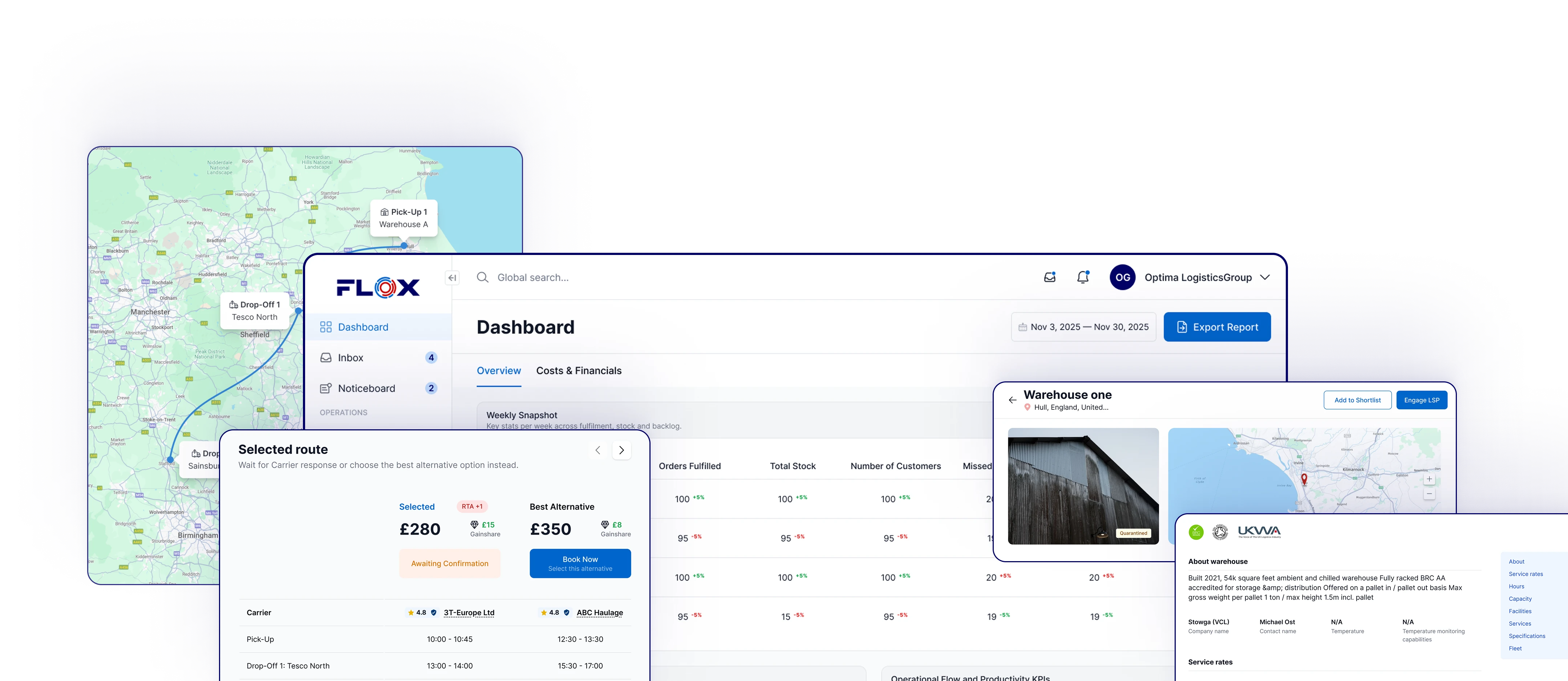
This is the problem that FLOX's analysis of ANPR data quantified directly: the latent co-loading opportunity on UK road freight routes is significant, but it is invisible without the data infrastructure to identify and match overlapping movements. FLOX's marketplace and orchestration platform is built around this: connecting buyers, shippers and logistics service providers with a shared operational layer that covers execution status, exceptions and financial flows across every party in each shipment. The platform creates the conditions for utilisation improvement by making the data visible to all parties who need it.
Supply chain management in practice is the discipline of balancing cost, service and risk across all the parties and movements that connect supply to demand. The disruptions of the 2020s made the structural weaknesses in how that balance was being managed impossible to ignore. The operators who have responded well are those who have used the disruption period as an argument for the investments in visibility, collaboration and resilience that the stable years never quite justified.
Subscribe to our newsletter.
Stay up to date with practical insights and useful logistics content
FAQs
Supply chain visibility means having a live, shared picture of what is happening at every stage of the supply chain. This includes the movement of inventory from raw materials through production, warehousing and delivery to the end customer, along with the information and financial flows between all parties. Most operators have visibility within their own systems. The gap is across the wider network: between buyers and suppliers, shippers and carriers, and between warehouse operations and the planning systems directing them. Closing that gap reduces exception costs and speeds up disruption response.