


The UK supply chain is under pressure from two directions at once. On one side, a structural labour shortage that pre-dates the pandemic and has not resolved. On the other, a wave of automation that is changing what roles exist and what skills they require. The industries caught between these forces need to respond on both fronts.
This piece works through the workforce challenge as it stands in 2026: where the shortages sit, how technology is changing the shape of work, where the industry is losing talent it cannot afford to lose and what operators can do about it. The focus is practical rather than predictive. Most of the dynamics described here are already visible in real operations today.
The labour shortage is structural, not cyclical
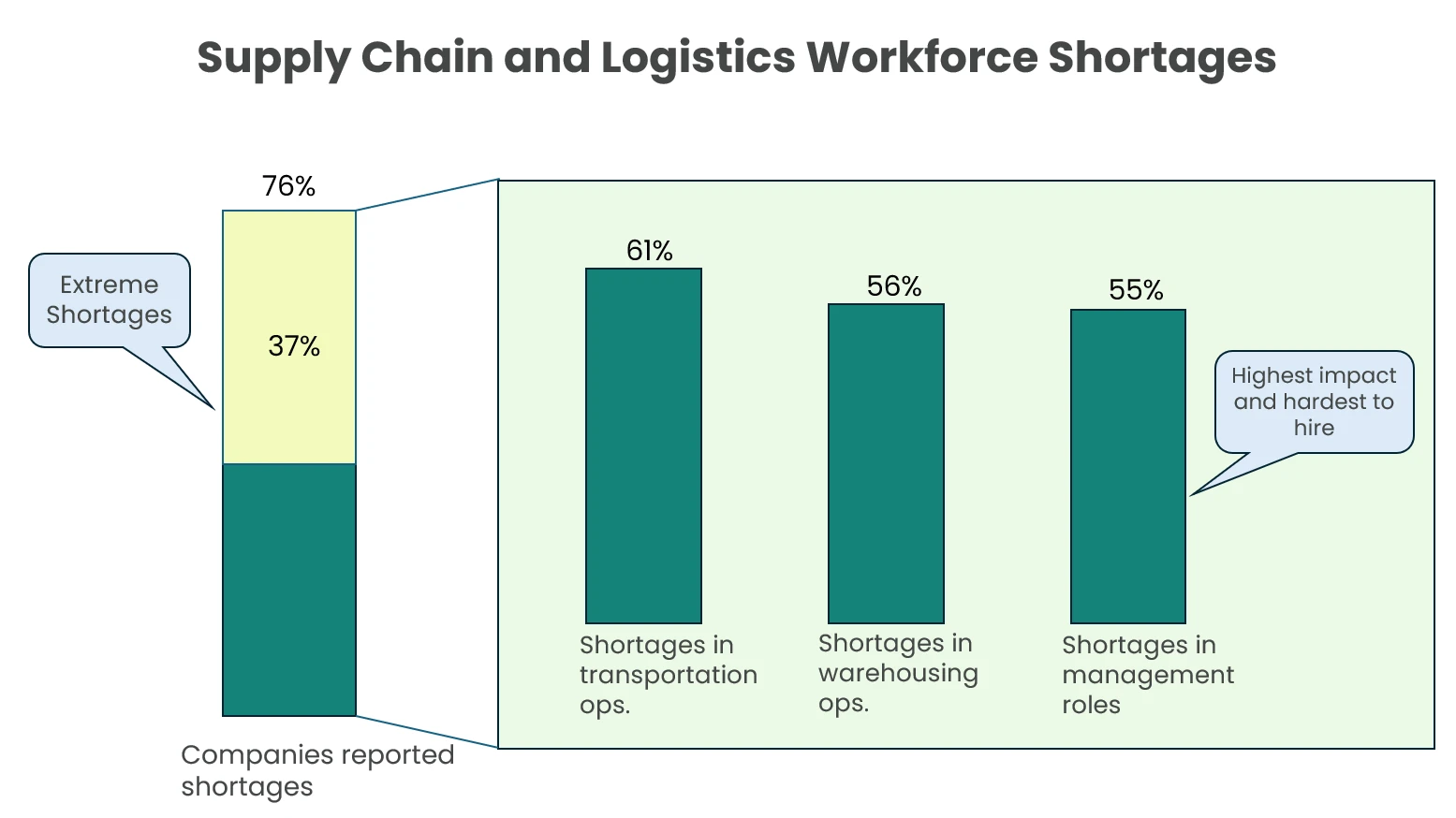
The UK logistics sector entered the 2020s with a well-documented driver shortage. The Road Haulage Association estimated a shortfall of around 100,000 truck drivers in 2021. That figure became widely cited during the supply chain disruptions of that year, but it reflected pressures that had been building for over a decade. An ageing workforce, a gap in new entrants and the post-Brexit loss of a significant cohort of EU drivers had combined into a structural problem rather than a temporary one.
The driver shortage is the most visible symptom of a broader pattern. Across warehousing, freight forwarding, port operations and logistics management, the industry is not replacing people at the rate it is losing them. The mix of factors varies by role, but the common thread is a pipeline that is not producing enough qualified entrants.
Automation has changed the picture in specific areas, particularly in warehouse operations. Amazon had deployed approximately 200,000 robots in its global fulfilment network by the early 2020s, and that figure has continued to grow. Systems from AutoStore and similar providers are now standard infrastructure in high-throughput distribution centres across Europe. These deployments reduce the headcount required in some warehouse functions. They do not eliminate the need for people. They shift the skill requirements and the role profile.
The workforce problem and the technology investment question are therefore not separable. Understanding the terminology and operating models behind modern supply chain management is the starting point for any operator trying to plan both sides of this simultaneously.
“The logistics industry is a unique industry because by default, de facto, it has to collaborate. FLOX is built to enable exactly that.”
Paul Brooks, MD or GFC, Author

How automation is reshaping the roles that remain
A Deloitte survey found that 75% of supply chain executives expected digital technologies to significantly disrupt their operations within five years. That expectation has translated into real deployments. AI-driven demand forecasting, robotic picking and automated document processing are no longer pilots in leading organisations. They are standard infrastructure.
The effect on roles is not straightforwardly one of replacement. It is more accurately a shift in the composition of the workforce. Roles that involve routine physical processing are reducing. Roles that require the ability to work alongside automated systems, interpret data outputs and manage exceptions are growing. A warehouse operator today is as likely to be monitoring a robotic picking system and intervening when it encounters an anomaly as they are to be picking manually.
This creates a challenge for recruitment and retention. The skills required for evolving roles are not widely available in the existing workforce, and the training infrastructure to develop them at scale is still maturing. The industry is asking entry-level workers to operate in environments that require a different set of capabilities than the roles that existed ten years ago. The adjustment period for both individual workers and the organisations employing them is longer than most technology deployment timelines assume.
AI applications in logistics are advancing across demand planning, route optimisation and freight matching. Each application changes what the humans working alongside those systems need to understand and be able to do. The workforce challenge and the technology challenge are not separate problems. They are the same problem from different angles.

The skills gap and how the industry is responding
The UK supply chain industry needs significantly more new entrants than the current graduate and apprenticeship pipeline is producing. Estimates suggest the industry needs around 25% more new entrants each year than existing recruitment channels are delivering. The gap is most acute in roles that require both operational knowledge and digital capability. Those entering the industry need to understand how a distribution network functions and be able to work effectively with the data systems managing it.
Several responses are underway. The logistics apprenticeship landscape has expanded, with new standards covering freight forwarding, supply chain operations and warehousing technology. Major operators including DHL and XPO have structured internal development programmes to build talent rather than compete for a limited external supply. The Chartered Institute of Logistics and Transport has updated its qualifications to reflect changing skill requirements across the sector.
Progress is real but the pace is not matching the scale of the shortfall. Training pipelines take years to produce results at volume, and the industry continues to lose experienced workers at a rate that structured development programmes are not yet replacing. The organisations seeing the best outcomes are those that have integrated workforce development into operational planning rather than treating it as a separate HR function.


Helen Hardy
CEO of CILT
Chain Reaction Podcasts
Logistics Has a Talent Problem - This CEO Knows Why
Logistics moves everything, yet struggles to attract talent. Helen explains why the sector needs to reposition itself as a modern, purpose-driven profession — not just a job.
Diversity gaps and what they cost the industry
Women make up approximately 22% of the UK logistics workforce. That figure has been broadly stable for several years. It reflects an industry that has not made the structural changes necessary to attract and retain a broader demographic, and it represents a significant constraint on the available talent pool. An industry drawing from less than a quarter of the adult population for its core workforce has a smaller candidate pool than its competitors for that talent, which puts sustained upward pressure on hiring costs and time-to-fill.
Young people are similarly underrepresented relative to other sectors. Perception plays a significant role: logistics is still widely associated with driving and manual handling, even as the reality of roles in the industry has shifted toward technology management, data analysis and customer-facing operations. The gap between what the industry actually offers and how it is understood by school leavers and graduates is a recruitment problem that sits upstream of any individual operator's hiring decisions.
Operators who have addressed this directly report better results. Flexible working patterns, visible career pathways and structured mentoring have contributed to improved retention among groups the industry has historically struggled to hold. The economic case is straightforward: a wider talent pool means better hiring outcomes and lower cost-per-hire over time.

Ask anything to learn how FLOX works and helps buyers and sellers of logistics run more efficient and profitable operations.
What operators should focus on now
The workforce challenge in supply chain has no single lever. It requires parallel action across several areas, and the sequencing matters. Organisations that have handled this well have been deliberate about what they addressed first and why.
For operators with significant manual processing environments, the automation question and the workforce question need to be addressed together. Deploying automated systems without a plan for workforce transition creates operational disruption and damages retention. The organisations that have managed this well commit to explicit communication about which roles are changing, what new capabilities they need from their people and how they intend to support the development of those capabilities before the new systems go live.
For operators competing for scarce skilled workers, the employer value proposition matters more than it has historically. Pay is a factor but it is rarely the decisive one for candidates who have options. Career development visibility, the quality of the working environment and the sense that the organisation is investing in its people are consistently reported as more important to logistics candidates than compensation alone.
For 3PLs and service providers managing complex networks, supply chain agility depends on the quality of the people operating the network as much as on the technology they are using. Staff turnover in key operational roles is one of the most common sources of service failure in logistics, and one of the most avoidable. High turnover is rarely just a recruitment problem. It usually reflects something about the structure of the role or the quality of the working environment that hiring volume cannot fix.
FLOX's marketplace and orchestration platform connects buyers, shippers and logistics service providers with a shared operational layer that covers execution status, exceptions and financial flows across every party in each shipment. The platform reduces the manual reconciliation burden that falls on operational staff, creating space for the workforce to focus on work that requires judgement rather than data entry. That shift in how time is spent is part of how technology investment and workforce investment compound on each other rather than working at cross-purposes.
Subscribe to our newsletter.
Stay up to date with practical insights and useful logistics content
FAQs
The UK logistics labour shortage is structural rather than temporary. It reflects an ageing workforce not being replaced quickly enough, the post-Brexit loss of EU drivers who had been filling gaps in domestic supply and a persistent failure to attract new entrants at the entry level. The Road Haulage Association estimated a shortfall of around 100,000 truck drivers in 2021. The underlying pipeline problem has not resolved, and it affects roles across warehousing, freight forwarding and logistics management as well as driving.