

The trust problem in logistics is not new. When five or six parties share responsibility for moving a shipment, disputes about what happened, who confirmed what and who owes whom are as old as the trade routes themselves. Blockchain and distributed ledger technology entered logistics as a proposed solution: a shared, tamper-proof record that every participant could read and no single party could alter. The case for this was always compelling. The adoption story has been more complicated.
What blockchain and distributed ledgers actually do
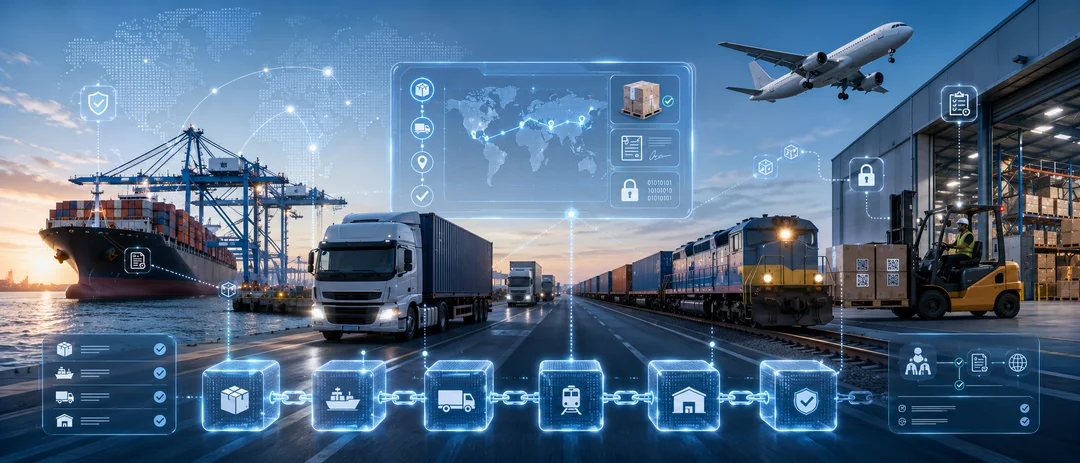
A blockchain is a distributed ledger: a record of transactions maintained simultaneously across multiple nodes, where each entry is linked cryptographically to the one before it. The key properties are that the record is shared between all participants, that no single party controls it and that entries, once made, cannot be changed without the network detecting the alteration.
For logistics, this matters because the information that governs freight movement is currently fragmented across the systems of every party involved. A buyer holds the purchase order. A freight forwarder holds the booking confirmation. A carrier holds the load plan. A warehouse holds the goods receipt. A bank holds the payment terms. Each is a separate record, held in a separate system, reconciled manually when disputes arise. A shared distributed ledger, in principle, gives every party access to the same version of events.
Smart contracts extend this further. A smart contract is a set of rules encoded on the ledger that executes automatically when specified conditions are met. A payment that releases when a confirmed delivery is recorded. An insurance claim that activates when a temperature excursion is logged. A penalty that triggers when a collection window is missed. The logic that currently lives in contract documents, pursued by accounts teams weeks after the event, could be embedded in the record itself.
“Technology is the future and it's the future, particularly for supply chain, because we spend a lot of time focusing in on little bits of things that actually technology could do for us.”
Leanne Parkin, Operations Director at Ramsden International

Where distributed ledger technology has found genuine traction
Blockchain has made the most progress in logistics use cases where traceability is the core requirement and the number of participating parties is finite.
Food provenance is the clearest example. Tracking the origin of food through a supply chain with multiple processing stages, geographies and suppliers has a direct food safety application: when contamination occurs, the speed at which the source can be identified determines how much product needs to be recalled. Distributed ledger systems that capture data at each stage, from farm to distribution centre, have been deployed by major retailers and food manufacturers to compress that identification window from days to hours.
Pharmaceutical track-and-trace has a regulatory dimension. The Drug Supply Chain Security Act in the United States requires electronic traceability of prescription drugs through the supply chain. That legislative mandate has driven adoption of serialisation and shared record systems across manufacturers, distributors and dispensers in a way that commercial incentives alone did not produce.
Trade finance and bills of lading represent the largest commercial opportunity. The bill of lading is the foundational document of international trade: it controls ownership of goods in transit and is required to release payment and customs. A traditional paper bill of lading takes days to move through the chain. The Electronic Trade Documents Act 2023 in England and Wales gave electronic trade documents, including the electronic bill of lading (eBL), the same legal standing as paper equivalents, removing a major barrier to eBL adoption on UK trade lanes. Platforms including WaveBL and essDOCS have grown their eBL volumes materially in the years since.

Why adoption has been slower than the technology promised
The most cited example of blockchain ambition in logistics is also the most instructive cautionary tale. TradeLens, a joint venture between Maersk and IBM, launched in 2018 with the goal of digitising global container shipping documentation on a shared blockchain. It attracted major carriers and port operators. It shut down in November 2022, with both partners citing an inability to achieve the commercial viability needed to sustain it as an independent industry platform.
The TradeLens story is not primarily a technology story. The blockchain itself functioned. The problem was network economics. A distributed ledger delivers value in direct proportion to how many parties participate. A shared ledger used by three parties is useful. A shared ledger used by three hundred parties changes the economics of coordination at a different scale entirely. Getting all parties in a global supply chain to adopt a single platform, governed by competitors who are suspicious of each other's data access, proved harder than building the technology. The network effect that makes distributed ledgers powerful is also the barrier to getting them started.
Data quality presents a separate challenge. A blockchain records what parties report, not what actually happened. If a delivery is confirmed as complete before all goods have been checked, the smart contract releases payment for goods that may later be disputed. The trust properties of the ledger apply to the record; they do not validate the accuracy of the underlying input. In a network where data capture is partly manual and partner systems vary widely, this limits the reliability of the shared record.
The coordination deficit that blockchain aimed to address manifests most acutely under operational pressure. When speed expectations mean exceptions cannot wait days for manual reconciliation, the gap between a record-keeping system and a real-time execution layer becomes significant. We cover how speed pressure amplifies coordination risk in our piece on modern supply chain speed pressure.

Smart contracts and the financial flows problem in freight
The most commercially compelling use case for smart contracts in logistics is payment automation. Freight payment in a multi-party supply chain involves significant manual reconciliation. An invoice arrives, is checked against the load plan, the proof of delivery, the rate confirmation and any accessorial charges. Discrepancies are queried, resolved and re-invoiced. This process takes weeks in many operations and its administrative cost is substantial.
A smart contract that releases payment on confirmed delivery eliminates most of this manual process. The conditions are defined at booking. The proof of delivery triggers the payment. Disputes about whether delivery occurred are resolved by the shared record rather than by bilateral argument. This is the direction that financial flows in logistics are moving, whether or not the underlying infrastructure is a public blockchain, a private distributed ledger or a centralised platform that delivers equivalent transparency.
The distinction matters. Much of what operators need from blockchain, specifically shared visibility, automated payment triggers and an auditable transaction record, can be delivered by a well-designed centralised coordination platform that maintains a shared operational record across parties. The cryptographic properties of a public blockchain add value where parties are genuinely untrusted and unknown to each other. In a logistics network where parties have existing commercial relationships, a trusted operational platform can deliver the practical benefits with fewer of the adoption barriers.


Rosana Fuentes
Implementation Consultant at Baxter Planning
Chain Reaction Podcasts
Speed Vs Stability: The Hidden Cost Of Automation
Automation doesn't fail because of technology — it fails because of dirty data, unclear processes, and teams who weren't ready. Rosana has seen it firsthand.
What the distributed ledger framing gets right
Whatever the adoption challenges, the distributed ledger framing correctly identifies the structural problem in multi-party logistics. The problem is not that individual systems are inadequate. It is that individual systems do not connect, and the gaps between them are where disputes, delays and costs accumulate.
A buyer, their 3PL, the haulier, the warehouse and the final receiver each hold their own version of what happened. These versions diverge whenever an exception occurs: a missed collection, a delayed delivery, a damaged item, a short payment. Reconciling these versions takes time, absorbs management attention and produces friction in commercial relationships. The shared ledger concept, whatever the underlying technology, is a response to this structural fragmentation.
The key insight is that logistics operations need a shared record of what was agreed, what happened and what is owed. That record should be accessible to all parties in real time, should capture exceptions as they occur rather than after the fact, and should connect operational events to financial flows automatically. These requirements are equally well met by a well-designed multi-party execution platform as by a blockchain. The architecture matters less than whether the outcome is achieved. We explore the structural coordination problem further in our piece on the UK logistics market state of play.

Explore storage and fulfilment solutions that give your business flexibility and the support it needs to grow.
From shared ledger to shared execution
The direction of travel in logistics technology is towards shared operational layers that reduce the information gap between parties. Whether that layer is built on blockchain, private distributed ledger or a trusted centralised platform is a technical question. The commercial question, which is the more important one, is whether every party in a shipment is working from the same operational picture and whether exceptions and financial flows are resolved at the speed the market now requires.
Distributed ledger technology will continue to find adoption where the use case justifies it: eBLs in trade finance, track-and-trace in food and pharmaceutical supply chains, serialisation in regulated industries. For the broader problem of coordinating day-to-day execution across multiple parties, the immediate need is a shared operational layer that captures what is happening now, surfaces exceptions to all affected parties and connects delivery events to payment without manual reconciliation.
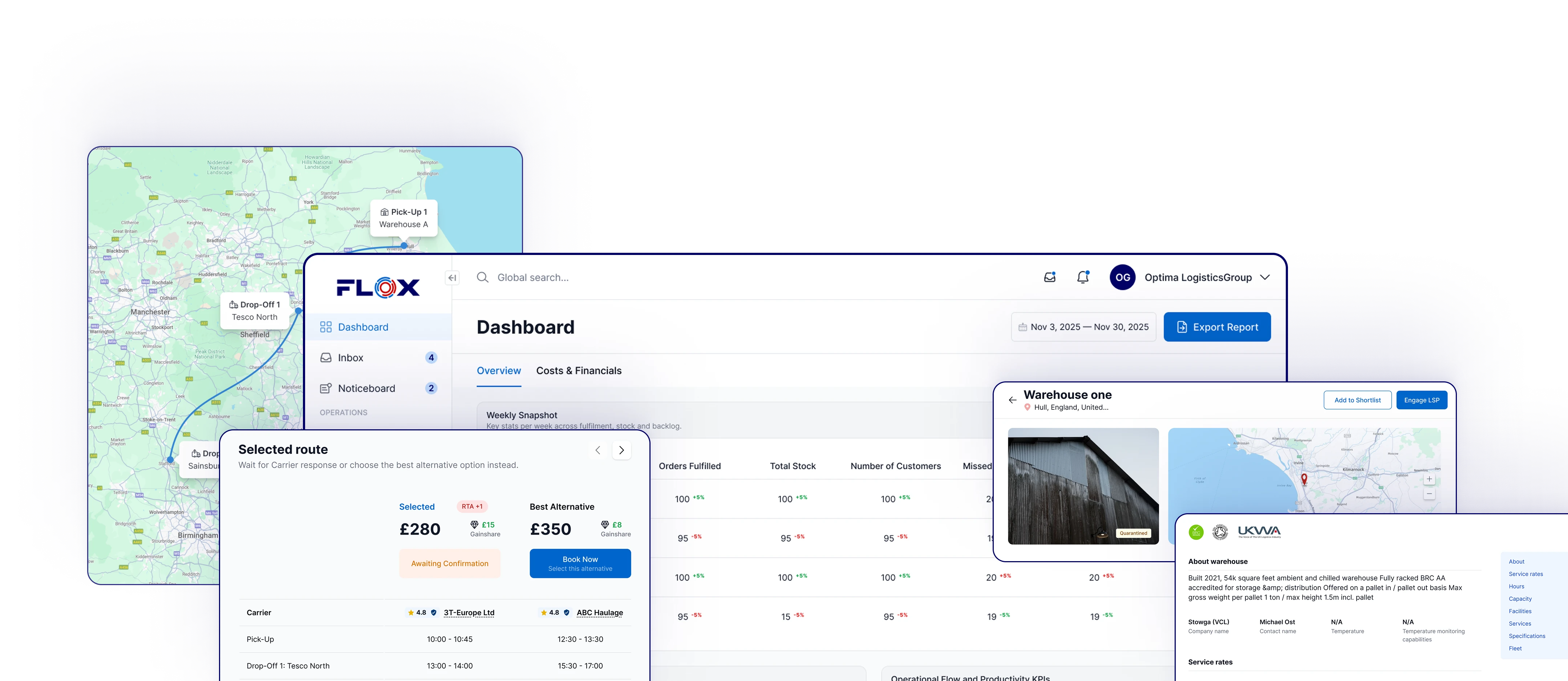
FLOX addresses this as a marketplace and orchestration platform. The marketplace layer connects buyers, warehouse providers, 3PLs and hauliers, making capacity visible and transactable across the network. The orchestration layer coordinates execution, exceptions and financial flows across every party in every shipment. The transparency and payment automation that distributed ledger advocates identified as the goal are built into the operational layer of the platform, applied to the moment of execution rather than as a post-hoc record. Neither layer works without the other: marketplace access without orchestration depth produces spot transactions; orchestration without marketplace access limits the network to parties already connected.
Subscribe to our newsletter.
Stay up to date with practical insights and useful logistics content
FAQs
Blockchain in logistics is a shared, tamper-proof digital ledger that records transactions across a network of parties, where no single participant controls the record. Every entry is cryptographically linked to the one before it, making alteration detectable across the network. In a logistics context, it allows buyers, carriers, warehouses and customs authorities to access the same record of what was agreed, shipped and received. Smart contracts built on top of the ledger can automate payment and compliance actions when specified conditions are met, reducing manual reconciliation.