

Mid-market businesses occupy a difficult position in inventory management. They have enough volume and SKU complexity to make informal systems unreliable, but rarely the dedicated resource and specialist teams that large operators take for granted.
Getting inventory right at this scale has a direct effect on cash flow, fulfilment performance and operating costs. Getting it wrong shows up in stockouts, dead stock and the management time absorbed in firefighting consequences that better processes would have prevented.
This guide works through the core concepts, the most common failure modes and the practical responses available to businesses with between 50 and 250 employees managing physical stock.
What inventory management involves for a mid-market business
Medium-sized enterprises are typically defined as having between 50 and 250 employees. That scale brings operational complexity that outgrows informal processes well before the organisation is large enough to build dedicated inventory teams or invest heavily in enterprise systems.
Inventory management at this level covers several connected functions: tracking stock across locations, setting reorder points, managing inbound flows from suppliers and ensuring that what the business holds reflects what it actually needs. Each function compounds the others. A gap in any one of them tends to show up across all of them.
The financial stakes are significant. Excess stock ties up working capital. Insufficient stock leads to missed orders, emergency procurement and the cost of lost customers. For a business with tight margins and limited cash reserves, the difference between well-managed and poorly managed inventory often maps directly onto profitability.
Inventory management also connects upstream. Demand patterns drive procurement decisions, which drive supplier relationships, which affect lead times and minimum order quantities. Operators who treat inventory as a standalone function tend to find the benefits are smaller than expected. Understanding how inventory sits within the broader supply chain is the foundation for decisions that compound rather than cancel each other out.
“If a business doesn’t have a Chief Supply Chain Officer at the boardroom table, then it probably has an underperforming supply chain or an underutilised supply chain.”
Rob Field, Development Director at Advanced People Strategies

Where mid-market businesses lose ground on inventory
The challenges specific to this scale are worth identifying clearly, because the solutions available to large businesses often do not translate directly.
Economies of scale are limited. A business with 50 to 250 employees cannot negotiate the same terms or minimum order quantities as a national operator. This affects how much flexibility it has in managing stock levels. A high MOQ from a key supplier can force a business to hold more stock than its demand patterns justify, locking up capital in stock that moves slowly.
SKU diversity compounds the problem. Mid-market businesses often serve varied customers across multiple product lines. That creates a long tail of slower-moving stock that is expensive to manage and easy to neglect. Without a clear categorisation system, operational focus drifts toward the most visible or most recent stock rather than the most economically significant.
IT systems at this scale are frequently inadequate. Many mid-market businesses run inventory on spreadsheets or on ERP systems implemented for accounting purposes and adapted for warehouse use. The result is data that is hard to trust and harder to act on quickly. The cost of that unreliability is not always visible in the system, but it shows up in stock discrepancies, poor reorder decisions and fulfilment failures.

The fundamentals: tracking, checking and systemisation
Three capabilities underpin reliable inventory management at any scale. They are also the three most commonly neglected when businesses are growing quickly and operational processes have not kept pace.
Tracking means knowing what stock you hold, where it is and how it moves. Barcodes and RFID scanning are the practical tools here. Both reduce the error rate in receiving, picking and dispatching. The technology is not expensive at this scale. The discipline to use it consistently is harder to establish than the technology itself.
Checking means regular stock counts and reconciliation. Perpetual inventory systems update in real time as stock moves. Periodic systems rely on manual counts at intervals. Most mid-market businesses use a hybrid in practice: a system that should be updating in real time but is verified against physical counts regularly. The frequency and rigour of those checks determines how much the system can be trusted.
Systemisation means standardising receiving processes. Most inventory errors enter the system at the inbound stage: wrong quantities accepted, damaged items processed as full, supplier discrepancies not recorded. A consistent receiving process, enforced rather than aspirational, eliminates a significant proportion of the problems that show up later as stock discrepancies. Understanding the terminology around demand-driven procurement and replenishment helps teams apply these processes with the same vocabulary across the operation.


Simon Eagle
Supply Chain Consultant
Chain Reaction Podcasts
The Demand Planning Mistake Everyone's Making
Most companies invest heavily in forecasting and planning tech. Yet service levels still struggle, costs stay high, and planners spend their time firefighting. The problem isn't just bad forecasts, it's how those forecasts are being used.
Optimising stock levels: ABC/XYZ analysis, EOQ and system choice
Once the fundamentals are in place, the focus moves to optimising how much stock to hold and when to reorder it.
ABC analysis divides stock into three categories based on economic value. A-class items account for the largest share of total inventory value, typically a small proportion of total SKUs. B-class items sit in the mid-range of value and volume. C-class items are high in number but low in individual value. The classification directs management attention: A-class items warrant frequent review, tight reorder controls and close supplier relationships. C-class items can often run on more automated replenishment with less oversight.
XYZ analysis adds a demand predictability dimension. X-class items have stable, predictable demand. Y-class items are seasonal or irregular. Z-class items are unpredictable. Combining ABC and XYZ gives a more complete picture of where to invest management attention and where looser controls are acceptable.
Economic order quantity (EOQ) is a formula that calculates the reorder quantity that minimises the combined cost of ordering and holding stock. It requires reliable data on demand rate, order cost and holding cost. For businesses with that data, it provides a defensible baseline for reorder decisions. For businesses without it, the first task is building the data quality needed to make EOQ calculations meaningful.
The choice between perpetual and periodic inventory systems matters less than it once did. Most modern warehouse management and ERP systems support perpetual tracking as standard. The practical question is whether the business has the physical processes to keep the system accurate. A perpetual system fed by unreliable data is less useful than a periodic system managed well.

Explore storage and fulfilment solutions that give your business flexibility and the support it needs to grow.
Storage solutions and connecting them to the rest of the operation
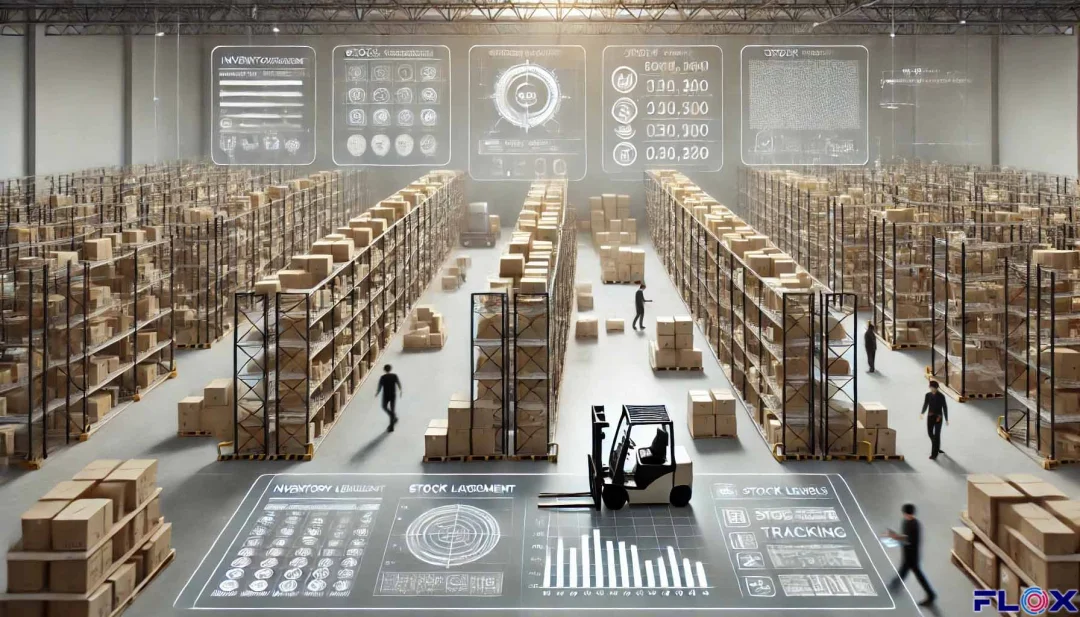
Physical storage choices have a direct effect on inventory management performance. A warehouse layout designed for efficient picking reduces error rates and time cost per order. A layout that has grown organically around whatever space was available typically makes both harder. Reviewing layout whenever pick rates or error rates increase is a straightforward diagnostic step that often surfaces improvements without requiring additional spend.
On-demand warehousing gives mid-market businesses access to additional space without long-term commitments. For businesses with seasonal peaks, product launches or unexpected volume, flexing storage capacity without renegotiating leases is a meaningful option. The constraint has historically been the management overhead of operating across multiple sites. That overhead falls when stock visibility and order orchestration run through a shared platform.
For businesses outsourcing part of their fulfilment or managing multiple storage locations, the challenge is connecting the physical inventory picture to the financial and operational picture. Stock that is accurate in the warehouse but opaque in the system creates the same problems as stock that was never counted. Understanding what to look for in a third-party logistics provider starts with whether they can give you the visibility you need to keep inventory decisions current.
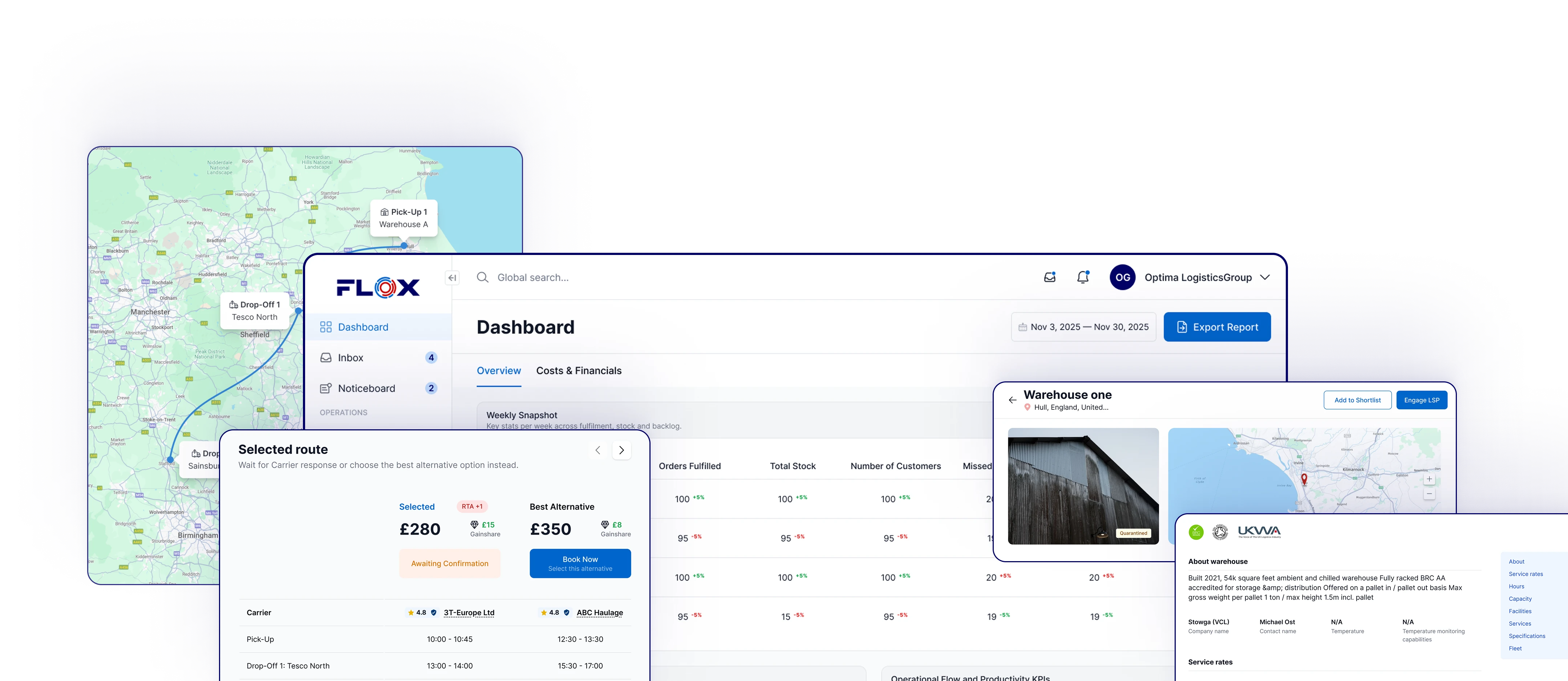
FLOX's marketplace and orchestration platform connects buyers, shippers and logistics service providers through a shared operational layer covering execution status, exceptions and financial flows. For mid-market businesses using third-party logistics providers or multiple storage locations, that shared layer reduces the reconciliation work that otherwise falls to operational staff and creates a more reliable basis for the inventory decisions that affect cash flow and customer service.
Subscribe to our newsletter.
Stay up to date with practical insights and useful logistics content
FAQs
Inventory management for a mid-market business covers the processes for tracking stock levels, setting reorder points, managing inbound flows from suppliers and ensuring that what is held in storage reflects current demand. At the 50 to 250 employee scale, it sits at the point where informal approaches become unreliable but the business is not yet large enough to absorb the cost of enterprise-grade systems easily. The goal is to avoid both excess stock that ties up capital and insufficient stock that leads to missed orders.