


Table of Contents
As a logistics manager searching for the best warehouse rental in the UK, it pays to recognise that not all warehouse space is created equal. Industrial units serve many purposes from storage to production to distribution and each unit you consider comes with its own specifications and its own set of trade-offs. Doing the research up front is what separates a rental that supports your growth from one that quietly constrains it. The number of warehouses on the market has never been higher, which means the array to choose from is vast and varied.
The Growth of the UK Warehousing Sector
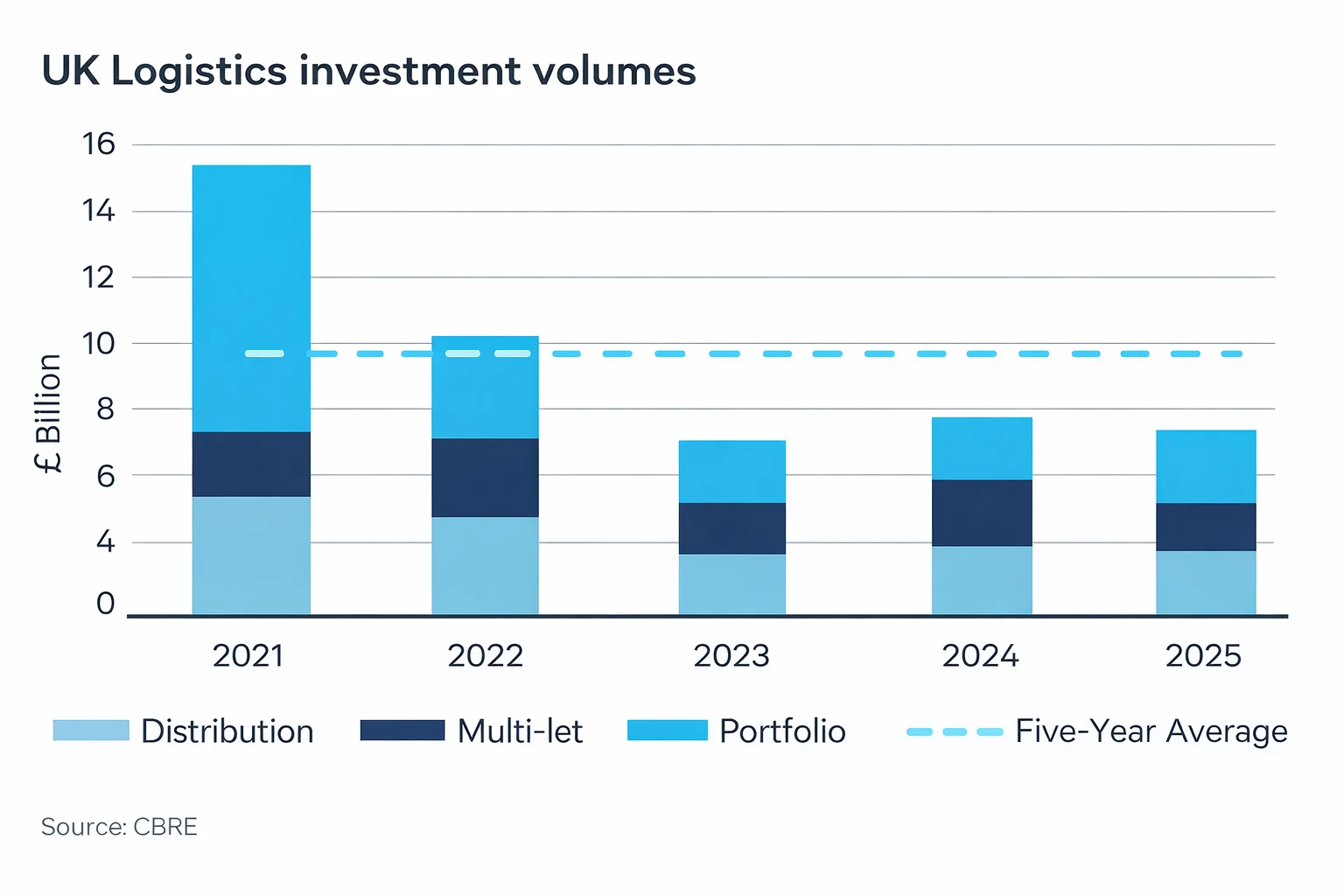
The UK warehousing story is still one of expansion over the long run, but the picture has become more mixed in the last two years. The sector is structurally larger than it was a decade ago. The rapid post-pandemic surge in business formations, lettings and rents has clearly cooled.
The Office for National Statistics reported that the strong growth in transport and storage businesses seen in 2020 and 2021 was followed by declines. The number of VAT and PAYE registered businesses in the sector fell to 117,000 in March 2024, down 9.1 per cent on the year before. The ONS 2021 figure referred to business premises in transport and storage while the 2024 figure refers to registered businesses. Those are two different measures. The headline is not that warehousing has shrunk. It is that the rapid business-count expansion has paused while the underlying stock of warehouse space has kept growing.
The stock story is where expansion is most visible. Savills and the UK Warehousing Association reported in 2024 that UK warehouses above 100,000 sq ft had grown from about 428 million sq ft in 2015 to 566 million sq ft in 2021 and to just under 690 million sq ft by 2024. On that measure the sector expanded by 61 per cent over the decade and by 22 per cent in the three years after the 2021 edition of the same report.
Geography has widened with the scale. The Golden Triangle has spread eastward and warehouse space developed there grew by 104 per cent over the last ten years. The East Midlands remains the largest single market by total inventory at 130 million sq ft, which keeps the Midlands as the core national distribution location even as demand has broadened into adjacent markets.
Occupier demand has cooled from the post-pandemic peak but has not fallen away. CBRE reported UK logistics take-up of 25.6 million sq ft in 2025, up 22 per cent on 2024, with vacancy at 7.1 per cent in Q4 2025 driven largely by second-hand space. DTRE described 2025 as the best year for take-up since the Covid period ended at just under 31 million sq ft. The gap reflects differences in market coverage and methodology, so it is safer to treat them as a range than to force a single number.
That balance matters in negotiations. Vacancy around 7 per cent is no longer the ultra-tight market seen at the peak but it is not loose either. CBRE expects vacancy to stay broadly stable or edge slightly higher in early 2026 before falling in the medium term. Occupiers should find more room to negotiate than they had during the 2021 to 2022 squeeze but not across every size band or every sub-market.
Rents still point upward, though the pace has moderated. JLL reported prime headline logistics rents up 4.7 per cent over the twelve months to the end of 2025. Savills expects rental growth of 2.7 per cent across UK industrial and logistics in 2026, a calmer pace than the exceptional run-up after Covid.
The near-term outlook is constrained new supply rather than another demand spike. CBRE says the logistics development pipeline declined through 2025 and will keep falling in 2026 as current schemes complete. Savills survey work points to take-up near 30 million sq ft with continued focus on the East and West Midlands and a quieter South East starting to recover. The honest read is a steadier market with moderate take-up, less speculative development and rents that keep rising but more slowly.

“One carrier is not going to give you everything you need in terms of types of services. And they’re not going to be equally good even if they did in all of those services.”
Bobbie Ttooulis, Group Marketing Director at GFS

Best Practices to Find and Rent Warehouse Space Near You
The right warehouse in the right location can streamline your distribution, improve service levels and take real cost out of the supply chain. Getting there means setting a clear brief before you start shortlisting buildings. The six practices below will help you cut through a crowded market and pick a space that fits the operation you are running now and the one you expect to run in three years.
1. Sizing Up Your Needs
The ideal warehouse size depends on what the space needs to do: storage, distribution, light manufacturing or some combination. Start with a straight audit of current inventory volume and factor in anticipated growth across a two to three year horizon. Product dimensions, pallet build, storage configuration and aisle widths all shape the footprint.
As a rough guide, manufacturers, exporters and wholesalers typically need medium to large units in the 25,000 to 50,000 sq ft band. Smaller businesses and ecommerce operations often fit comfortably in 1,000 to 5,000 sq ft. A useful rule of thumb is to target 70 to 80 per cent utilisation at normal volumes, leaving room for peak uplift and seasonal stock without paying for headroom you will never use.
2. Lease Duration: Striking the Right Balance
As your business evolves, so will your space requirements. Weigh the length of the lease against the flexibility you actually need. Longer leases usually bring lower rent and stronger fit-out incentives. Shorter leases cost more per square foot but keep optionality if your volumes are volatile or your network is still taking shape. Typical warehouse lease terms run 3 to 10 years, with break clauses at year three or five common enough to negotiate for.
If your volumes are genuinely unpredictable, short-term flexible space or on-demand warehousing can carry the swing capacity while a core site handles steady-state flow. That split is now standard practice in ecommerce and FMCG, where a long lease is signed for the base load and the peak is outsourced.
3. Strategic Location: The Foundation of Efficient Operations
Location shapes your supply chain, operational costs, rent, delivery times, legal compliance and overall business performance. Accessibility and ease of goods movement should drive the shortlist. A well-located warehouse offers convenient access to major motorways, rail terminals, ports and airports and sits within a reasonable drive of the urban areas you serve.
Two test questions help. Where are your inbound goods coming from? And how many drops and how far apart, do you make on outbound? The answer often points to one of the UK logistics corridors: the Midlands triangle for national coverage, the south east for proximity to London or a port-adjacent site if you import in volume. Labour availability is now part of the same calculation. A location that looks cheap on rent can be more expensive on wages, staff turnover and recruitment lead time.
4. Timely Move-In: Seamless Transition to Your New Space
Warehouse availability varies. Some units are ready for immediate occupancy while others need renovation, racking or fit-out to work for your operation. Plan your move-in timeframe properly and communicate it to your agent or landlord early. Legal documentation, licences and any consents around loading hours, vehicle movements or environmental conditions should be worked through in parallel, not after the deal is signed.
5. Uncompromising Security: Protecting Your Valuables
Security is non-negotiable. If you are storing high-value or attractive goods, the site should have 24-hour CCTV with adequate coverage and recording, perimeter fencing, access-controlled entry, intrudusion alarms and, for higher-risk cargo, on-site security or accreditation to standards such as TAPA or BRCGS. Insurance premiums move with the quality of these controls, so the investment is rarely abstract. Ask for the site risk assessment and any prior claims history before signing.
6. Tailoring Your Warehouse to Your Needs: Amenities to Consider
When selecting a warehouse, the specific amenities need to match your operational requirements. For industrial production and consumer goods companies, dock levellers, turning space and road access for articulated vehicles are central to efficient product movement.
Essential amenities include:
- Loading docks: enough dock-door count and dock levellers for your peak inbound and outbound flow, with sufficient canopy and side access for curtainsiders.
- Yard depth and turning space: enough hardstanding for 16.5 metre articulated trailers to turn without shunting, plus trailer parking for pre-loaded stock.
- Eaves height and floor loading: modern operations want 12 to 15 metres clear and 50 kN per square metre or better for tall racking and heavy pallets.
Additional amenities to look for:
- Warehouse equipment: forklifts, pallet trucks, conveyors and mezzanines already in place can shorten ramp-up time and cut capital expenditure.
- Office and welfare space: dedicated offices, meeting rooms and welfare facilities make a clear difference to productivity and staff retention.
- Power, data and sustainability features: LED lighting, rooftop solar capacity, EV charging, rainwater harvesting and strong grid connection are increasingly expected by tenants pursuing their own net-zero commitments.
By evaluating specific requirements and matching them to a warehouse that offers the right amenities, you set the operation up to run well rather than forcing it to work around the building.


Stephen Holcomb
Director of Logistics at Refeyn
Chain Reaction Podcasts
Choose Partners, Not Just Providers
There's a world of difference between a logistics provider and a logistics partner. Stephen explains what he looks for — and why most companies get the distinction wrong.
Flexible Versus Fixed: Rethinking Warehouse Tenure
Most advice on warehouse rental still assumes a single long lease as the default answer. That default is fraying. Demand volatility, peak seasonality and shorter product life cycles have pushed buyers to mix tenure types rather than commit every pallet to a 10 year agreement. The practical question is no longer "how big a warehouse do we need?" but "what share of our volume belongs on a fixed lease and what share should sit on flexible, on-demand space?"
Traditional leases still make sense for steady-state volume. They offer the lowest unit cost per pallet, stable occupancy and the ability to invest in fit-out and automation. But they lock you in when demand drops and expansion means either overflowing into third-party sites or taking on extra space before the growth arrives.
On-demand warehousing occupies the other end of the spectrum. Capacity is purchased by the pallet, the square foot or the week. There is no long lease and no capital commitment. The unit cost is higher but the flexibility is complete, which suits peak overflow, new market entry, seasonal inventory and product launches. Between the two sits short-term flexible space: 12 to 36 month terms, usually on standardised terms, often in shared or multi-occupancy buildings.
A useful shorthand is the 70-20-10 split that a growing number of UK shippers now use: around 70 per cent of volume on a fixed lease, 20 per cent on flexible space of 1 to 3 years and 10 per cent on pure on-demand capacity for peak and exception flow. The exact ratio varies by sector, but the principle holds. Match the tenure to the volatility of the demand it is covering.
The decision point is simple: if the inventory is steady and the product is stable, buy fixed. If either moves, buy flexibility and pay for the optionality it gives you.

Explore storage and fulfilment solutions that give your business flexibility and the support it needs to grow.
Find the Perfect Warehouse Space with FLOX
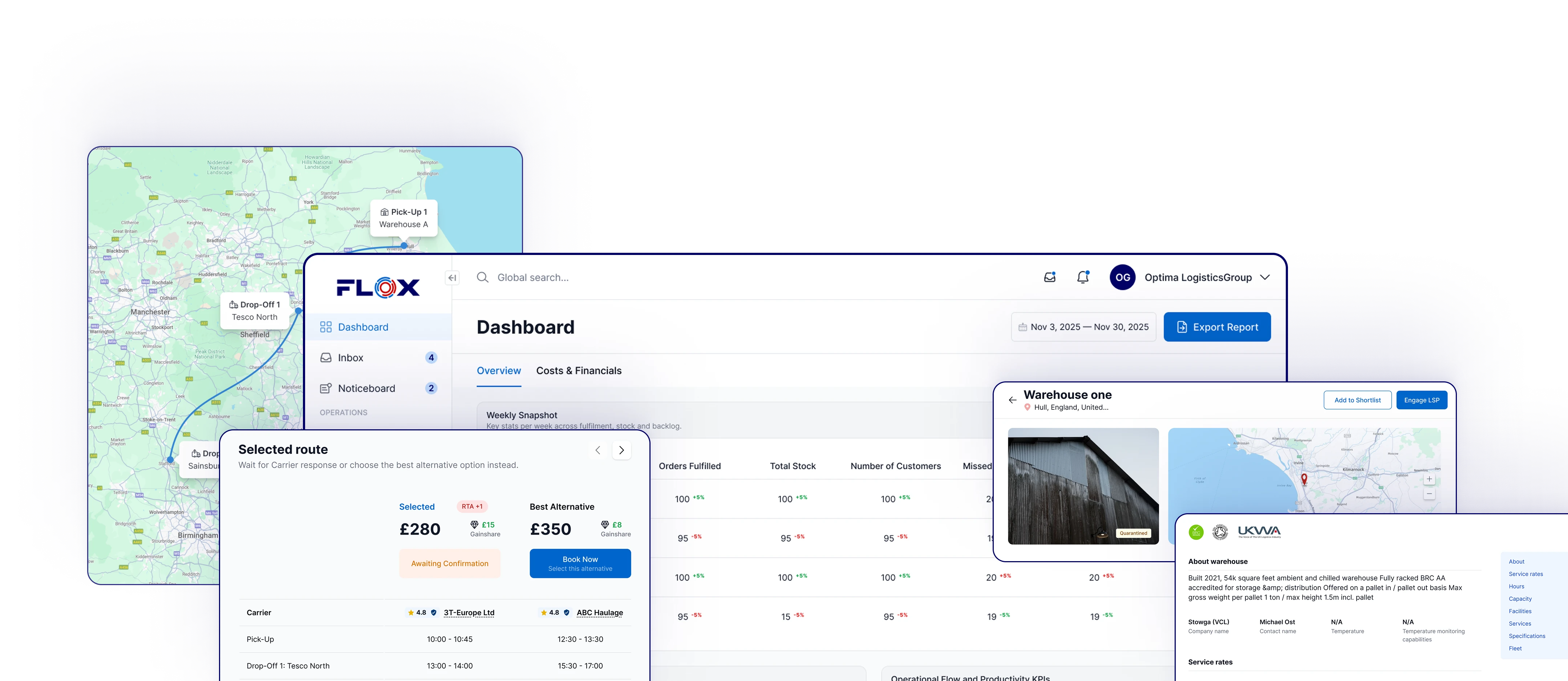
FLOX is built for shippers who want a single route into the UK warehousing market without signing direct leases with every site they use. The platform combines discovery, execution, visibility and financial control into one environment. Instead of a separate contract for every provider, FLOX clients sign a standardised three-way agreement between the warehouse provider, FLOX and themselves. That agreement governs pay-as-you-go utilisation of warehousing space across the network, so flexibility is built in from day one.
For shippers, that means a shorter path from requirement to running operation. You describe what you need, where and for how long. The platform matches you with warehouse providers that have the right fit in terms of size, location, certifications and value-added services. For warehouse operators, FLOX fills otherwise idle capacity and smooths seasonal swings without the cost of chasing customers individually.
The multi-party model is the genuine difference. FLOX is not a load board or a price-comparison tool. It is a collaborative layer that connects buyers, warehouse providers, 3PLs and hauliers on shared data. That same thinking sits behind our work on choosing the right UK warehouse location, our view on the current state of the UK 3PL sector and the practical playbook for on-demand warehousing for SMEs.
Whether you are optimising an existing network or sourcing your first rented warehouse, FLOX gives you a cleaner way to find capacity, contract for it and run against it.

Subscribe to our newsletter.
Stay up to date with practical insights and useful logistics content
FAQs
Small warehouse rental in the UK typically runs £5 to £9 per sq ft, before business rates and service charges. A 1,000 sq ft unit in a regional market usually costs £500 to £800 per month on the base rent. London and the south east run higher, with comparable space often £12 to £18 per sq ft or more. Total occupancy cost also includes utilities, insurance, security, rates and any fit-out, so budget on a total cost basis rather than rent alone.