


Table of Contents
The rate card arrives as a PDF. The columns look clean. The per-pallet figure is lower than the incumbent's. A procurement team ticks the box and the contract gets signed.
Six months later, volumes spike, a key lane goes dark and the 3PL's account manager stops returning calls on the same day they are needed most. The rate card said nothing about any of that.
Mid-market shippers sit in a genuinely difficult position. They are large enough that logistics costs move the P&L, but not so large that carriers and 3PLs will bend over backwards to retain them. That asymmetry means the evaluation process has to be smarter, not just harder. Price is one input. The decision quality a 3PL enables or destroys, is what actually compounds over time.
Why the rate card misleads more than it guides
A rate card is a snapshot. It captures a provider's pricing at a specific moment, against a specific volume profile, in market conditions that will not persist. The moment your freight mix changes, seasonal demand peaks or a key lane tightens, the rate card becomes a historical document. Evaluating a 3PL primarily on that document is the equivalent of hiring a driver based entirely on their fuel receipt.
The number that actually matters is the total cost of a logistics relationship, which includes the time your team spends chasing information, reacting to exceptions that were not flagged in advance and rebuilding plans that broke because the 3PL had no contingency to offer. Those costs are real. They do not appear on any rate card.
For mid-market shippers specifically, the hidden cost problem is acute. Smaller teams mean fewer people absorbing the operational noise a poor provider generates. A single unreliable lane or an unresponsive account manager can consume a disproportionate share of a logistics manager's week. That is before any service failure reaches the customer.
“It’s not a divorced partnership … it’s got to be a homogenous relationship between us (providers) and the brands themselves.”
Joshua Hegarty, Founder and CEO of Cloud9 Fulfillment

The five dimensions worth scrutinising
Evaluating a 3PL properly means working through a set of dimensions that a rate card will never capture. Each one signals something different about how the relationship will perform under pressure.
Network depth and real coverage
A 3PL's network looks impressive in a pitch deck. The question is whether that network holds when a specific lane, at a specific time, with a specific service requirement is needed. Ask for evidence of coverage in the regions you actually use. A provider with genuine density in your lanes is worth more than one with nominal national coverage that thins out in practice. Probe what happens when primary capacity is unavailable on a given day. The answer to that question tells you far more than the lane rate.
Visibility that connects to action
Visibility has become a selling point for almost every 3PL operating today. The real test is not whether they have a tracking portal, but whether the data that portal surfaces actually changes what you can do. Visibility that arrives after the decision window has closed is just a record of what went wrong. What you need is information early enough that you can reroute, reprioritise or inform a customer before the failure lands.
Ask a prospective 3PL to walk you through a real exception scenario. How does information flow? Who calls whom? At what point does an account manager get involved versus an automated alert? The answers reveal whether their visibility infrastructure is built around your decisions or around their own reporting.

Capacity resilience, not just capacity
Every 3PL has capacity on a good week. The differentiator is what happens on a bad one. A provider who owns or has contracted access to diverse capacity types, vehicle categories and carrier relationships across different geographies will behave very differently in a tight market than one who relies on spot procurement when their primary network is full.
For mid-market shippers, this matters disproportionately. You do not have the volume to command priority treatment from every carrier in the network. That means your 3PL's ability to call in relationships, activate secondary capacity or shift modes quickly is not a nice-to-have. It is the margin between a shipment that moves and one that sits.
Commercial flexibility across the contract term
Volume commitments that made sense at signing can become millstones when a business changes. Seasonal spikes, product launches, customer losses and supply disruptions all change freight profiles in ways that a fixed-structure contract does not accommodate well. A 3PL that builds in review mechanisms, escalation triggers and genuine flexibility provisions is signalling that they expect the relationship to evolve. One that resists those provisions is telling you how they will behave when reality diverges from the forecast.
Account management that operates at decision speed
Account management is often treated as a relationship function. It is actually a decision-support function. When something goes wrong or a choice needs to be made quickly, the quality of the person holding the account determines whether you have useful input or a ticket number. Ask directly who will manage your account, what their operational background is and how many accounts they currently hold. A commercially trained account manager with 40 relationships cannot give your escalations the attention they require.


Ross Jermy
Managing Director & Co-Founder of Move Parcel
Chain Reaction Podcasts
First-Time Delivery: Logistics' Biggest Challenge
First-time delivery failure is the single biggest cost driver in parcel networks — and it's an information problem, not a transport one. Ross explains why.
The information you should request before signing
Due diligence on a 3PL should follow the same logic as due diligence on any operational dependency. You are assessing the probability that this provider will perform under conditions that differ from the conditions in the pitch.
Request references from customers whose volume profile and lane mix resemble yours, not their largest account. Ask how the provider handled a service failure in the past twelve months, specifically what information reached the customer, when and what alternatives were offered. Ask for their subcontractor or carrier tiering policy and what percentage of your freight would move on primary versus secondary carriers.
If the provider hesitates on any of these, that is itself informative. Operational confidence shows in willingness to be specific. Vagueness in a sales process usually maps to vagueness in execution.

Move products with greater speed and control by picking services that fit your route, timing and delivery needs.
How procurement and operations need to share the evaluation
One of the structural problems in 3PL selection is that the evaluation is often led by procurement and completed before operations has had meaningful input. Procurement optimises for the number on the rate card. Operations lives with everything else.
The decisions that hurt mid-market shippers are not usually the ones where procurement paid too much. They are the ones where a provider was selected on price and then failed to perform, leaving the logistics team to manage the fallout with tools that were never provisioned in the contract.
Building operations into the evaluation from the start, including the account management assessment, the visibility walk-through and the resilience conversation, means the team that will depend on the relationship has shaped the selection criteria. That alignment is not a process nicety. It is what produces a contract that reflects how the relationship will actually be used.
> "The rate card tells you what a 3PL costs when everything goes to plan. Everything else tells you what they cost when it does not."
The shift worth making is from a procurement event to a risk assessment. What is the probability that this provider performs in the scenarios that would most damage your operation? That question has a very different answer structure than a comparative rate table.
What a stronger evaluation actually produces
A 3PL selected on depth rather than headline price tends to generate fewer exceptions, faster resolution when exceptions do occur and better information earlier in the decision cycle. Those outcomes compound. A logistics team that is not permanently firefighting has the capacity to plan proactively, which in turn reduces the frequency of the situations that require emergency responses.
For mid-market shippers, the 3PL relationship is also a data relationship. A provider with genuine orchestration depth, rather than one operating as a simple pass-through, generates information about network performance, lane behaviour and cost drivers that feeds better internal decisions. That information has value well beyond the transaction it describes.
The rate card is not irrelevant. Commercial terms matter and should be negotiated properly. But they should come at the end of an evaluation that has already established that the provider can do the job. Reversing that sequence, leading with price and hoping for capability, is the single most common way mid-market shippers end up in a logistics relationship they cannot easily exit and cannot fully rely on.
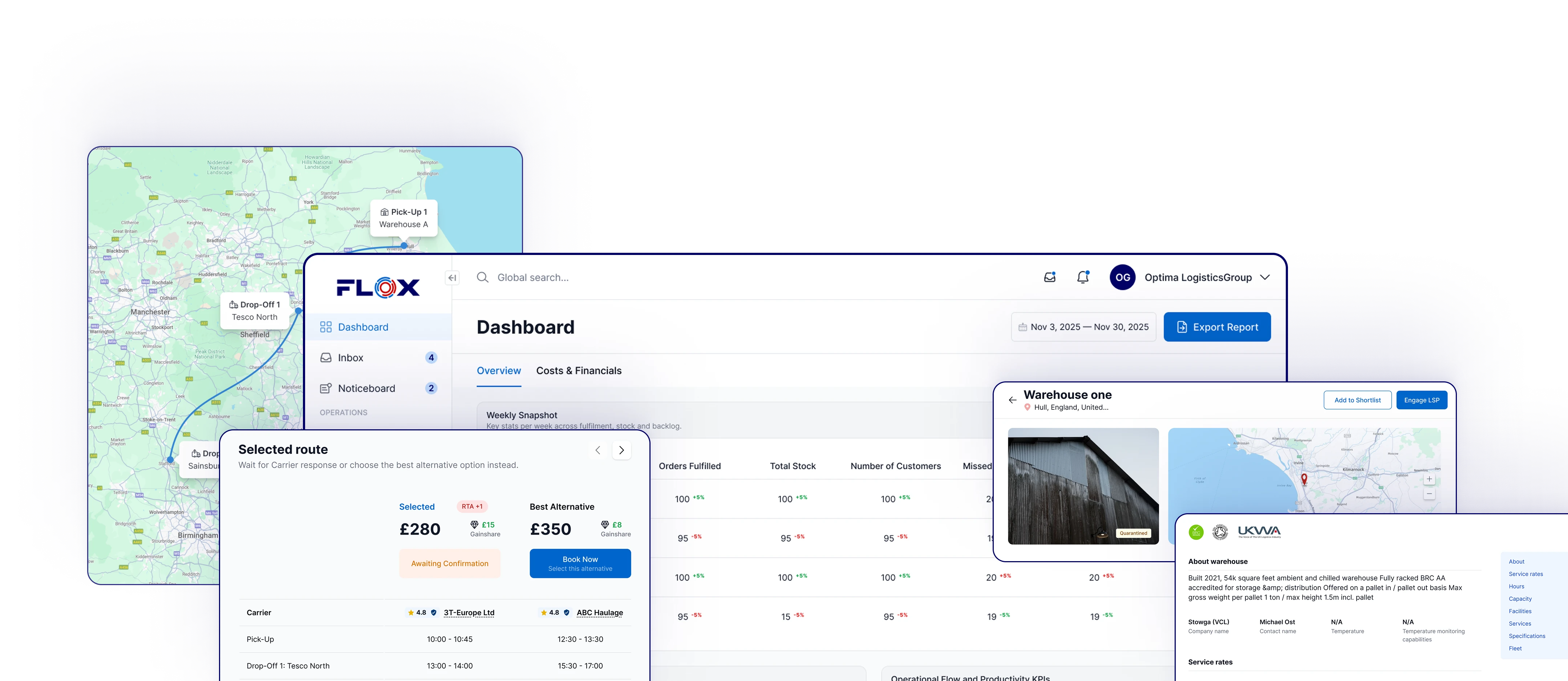
A multi-party logistics marketplace with orchestration depth, like FLOX, exists precisely because that sequence needed to be inverted. Matching on capability first, then on commercial terms, produces relationships that hold when it matters rather than ones that looked efficient on paper until the first real test.
Subscribe to our newsletter.
Stay up to date with practical insights and useful logistics content
FAQs
Ask for customer references whose lane mix and volume profile closely matches yours. Request specific evidence of carrier coverage on your key routes, including secondary options. A provider with genuine depth in your lanes will answer these questions with specifics rather than generalities.