

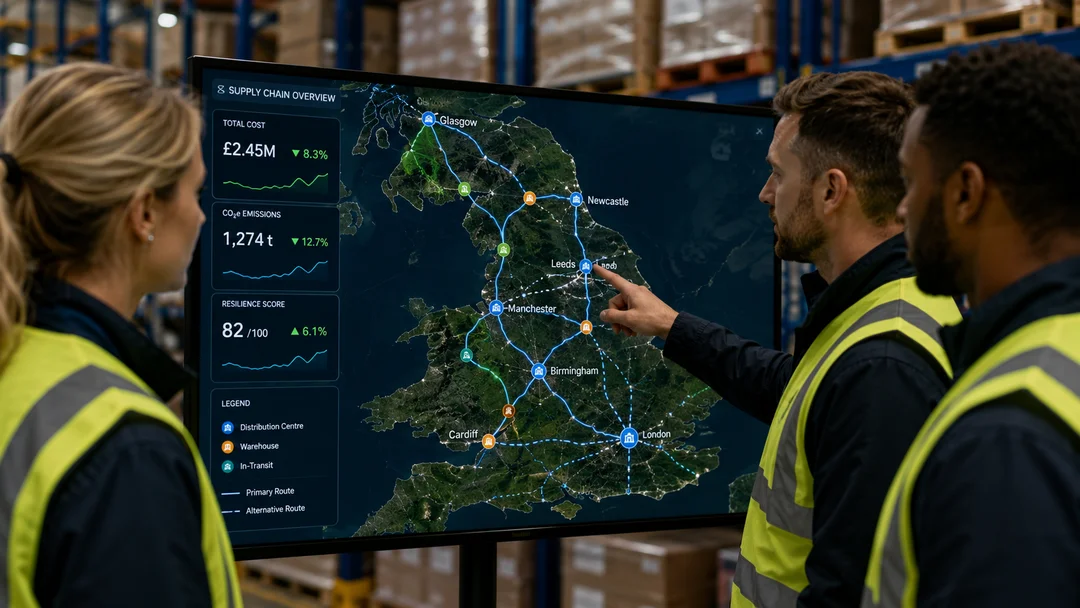
CEVA, DP World and Mountain Warehouse have all framed recent supply chain programmes around that same trio of objectives: lower cost, lower carbon, higher resilience. Each goal is legitimate. The problem is that pursuing all three simultaneously, without ranking them, means the conflicts between them surface at the worst possible moment: mid-execution, when a lane disruption or a carbon-reporting deadline forces a choice nobody has formally made.
The trade-offs are structural. Buffer stock improves resilience but raises holding cost and often working capital. Near-shoring cuts transport emissions but typically increases unit cost. Lowest-cost routing frequently means high-utilisation lanes with no spare capacity when volumes spike. Pretending these tensions don't exist doesn't resolve them; it just transfers the decision from a planning meeting to an operator on a Friday afternoon.
Decision quality degrades when the framework is left implicit. A shipper who hasn't ranked those three priorities will default to cost when the pressure is on, because cost is the most visible number in the room. That default may be the right call, but making it by default rather than by design means nobody has weighed what resilience or carbon headroom was actually worth.
Structuring the conversation explicitly changes that.