

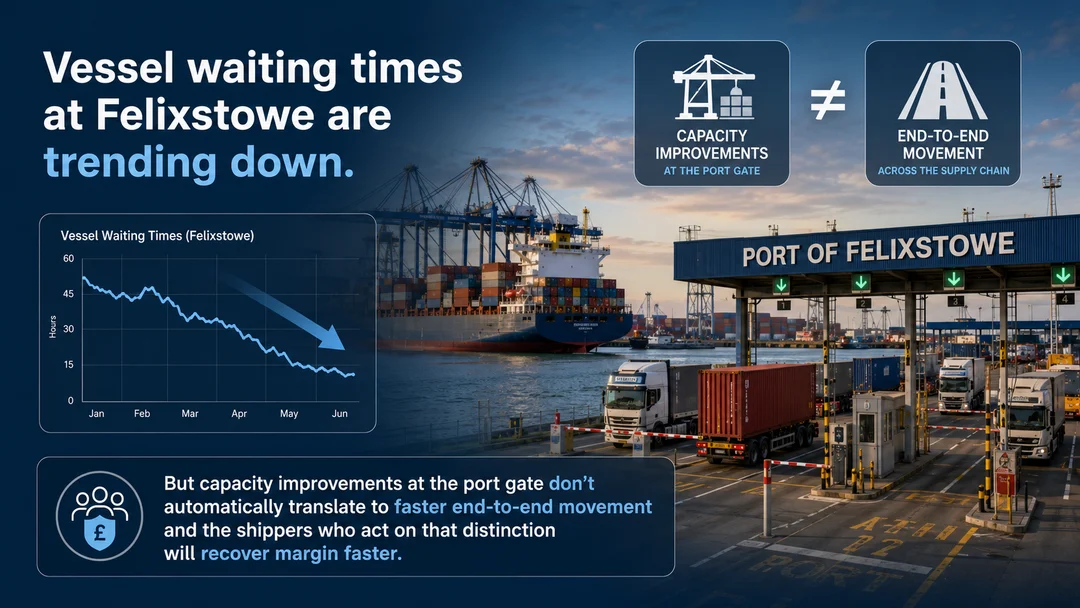
Third-party congestion tracker Portcast recorded a median vessel waiting time of 0.21 days at Felixstowe in late June 2026, down from 0.33 days the previous week, a 36% week-on-week improvement. UK Government Port Freight Statistics confirm the broader direction of travel. The port is loosening. The question is who captures that upside first.
Capacity additions are a lagging fix. More berths and yard space reduce the ceiling on throughput, but they don't tell a shipper where their container actually is, which inland lane is moving or whether the warehouse at the other end is ready to receive. A container pulled from a congested port without a confirmed slot downstream simply relocates the problem. That lesson recurs every cycle.
The gap between port-level improvement and supply chain improvement is where orchestration matters. When a shipper has live dwell data, they can resequence collections, reallocate haulier capacity and adjust warehouse intake windows before a delay compounds rather than after it locks in. That is the difference between absorbing disruption and reacting to it.
Felixstowe easing is genuinely good news for UK importers. The operators who recover fastest won't be those who waited for congestion to clear, they'll be the ones whose networks were already wired to act on the signal.